Summers Says Currency Interventions Fail Even At Japan’s Scale

(Bloomberg) -- Former US Treasury Secretary Lawrence Summers said that currency interventions are ineffective at shifting exchange rates, even at the large magnitude that Japan has been thought to have deployed recently.
“Given the massive size of the capital markets, I think the evidence is reasonably clear intervention doesn't work — even in the scales that the Japanese engaged,” Summers said on Bloomberg Television's with David Westin. “It's just overwhelmed by the broad magnitude of private sector capital flows.”
The yen is heading for its best week against the dollar since 2022 after potentially two rounds of intervention by Japanese authorities. Policymakers likely spent some ¥9 trillion this week, or nearly $60 billion at current exchange rates, Bloomberg analysis of Bank of Japan accounts shows. That's after the yen slumped on Monday to its weakest level since 1990.
At the same time, Summers suggested that the yen had become stretched.
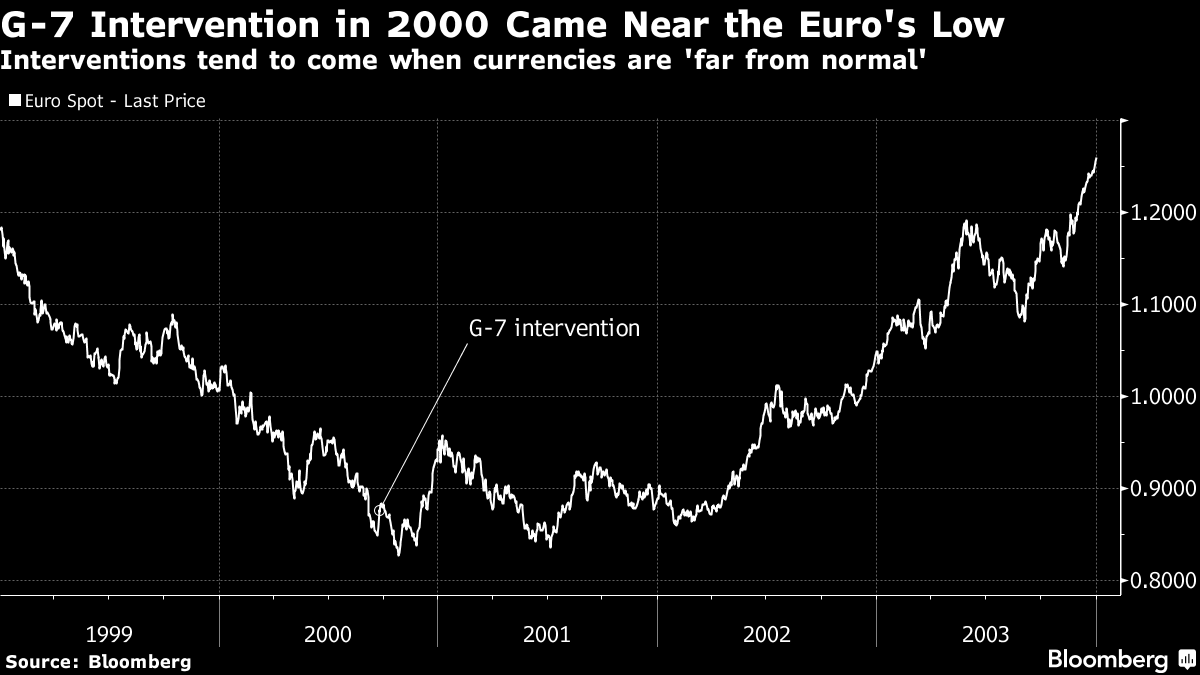
“Nations tend to intervene when currencies have gotten very far from normal levels,” and when that happens, “they sometimes bounce back,” he said. “So I wouldn't want to confidently presume that the yen will devalue further from here — it could go either way,” said Summers, a Harvard University professor and paid contributor to Bloomberg News.
Summers himself oversaw occasional currency interventions during his tenure at the Treasury in the 1990s and in 2000, when the Group of Seven stepped in to support the euro.
“If the yen does appreciate, I'm going to attribute that much more to ‘snap back' than I'm going to attribute it to the efficacy of intervention,” Summers said.
He also said that many observers are failing to grasp the disinflationary impulse on the US that's coming from the exchange rate.
“The dollar is extremely strong right now” and “indeed, it's not just that the dollar is strong, but that the dollar is strengthening,” he said. “That imparts a disinflationary bias to the US economy.”
He cautioned that this effect may wane, adding to Federal Reserve policymakers' challenges in getting inflation back to their 2% target.
Powell ‘Mistake'
“I don't think we can count on that to continue,” he said of the dollar's strengthening. “That's one of the reasons why I think the Fed's a little too serene.”
Summers also reiterated his view that the Fed has mis-assessed how tight its current interest-rate stance is. He was speaking two days after Chair Jerome Powell said that “over time,” the current target range of 5.25% to 5.5% “will be sufficiently restrictive” to get inflation back to 2%.
“I think that the chair is making a mistake if he is confident that policy is meaningfully restrictive,” Summers said.
While data Friday showed that payroll and wage growth slowed in April, Summers noted that earlier in the week a broad gauge of labor costs — the employment cost index — proved “disturbing on the high side.”
Taking in all the week's data, there's little change in the sense at the start of the week that “the most likely thing is no-cut or a little bit of cutting this year” by the Fed, Summers said.
More stories like this are available on bloomberg.com
©2024 Bloomberg L.P.

-
We May Need Another Tukaram Mundhe To Fight Air Pollution | The Reason Why

Developers may install basic measures such as sprinklers and green nets, resume work, and continue violating rules when this equipment stops working.
-
Extracting Value From Battery Scrap Could Be Challenging For India | The Reason Why
A discarded lithium-ion battery still contains valuable materials such as lithium, nickel and cobalt. These can be recovered and reused. When such batteries are crushed and shredded, they produce a dark powder called black mass.
-
One El Nino, India Can Handle. Two Could Break The Granary
India's grain stocks can absorb one bad year, but a second El Nino could drain the buffer in two to three years, economists say.
-
India's Troika Of Good Luck | Joining The Dots
As Jensen Huang's exit drags Nvidia down, a cooling AI trade and resilient earnings have revived investor interest in India. A likely RBI rate hike looms.
-
Talking Points This Week: Leadership Shock At Nvidia, Earnings Strength, And The Fog Over Hormuz
The Anthropic IPO pricing and first trading day, Nvidia's upcoming earnings, and any fresh signals from Iran will set the tone for the following week.
-
Signature Play: The Classic Cocktail Is Dead. Or Is It?
Classic cocktails are disappearing from India's cocktail menus. But they're still being ordered, taught to bartenders and borrowed from. So, who's really having the last drink?
-
A New Samvat Wishlist: Inclusive Prosperity And Human Development
India has strengthened its economic foundations through infrastructure, digital access and enterprise. Its next growth chapter must deepen productivity, create better livelihoods and widen participation in prosperity.
-
Love, Sex Aur Dhokha: The Audacious Plot To Spy On Jensen Huang
A Taipei dinner, a Singapore chip buyer and a suspected Chinese asset: inside the alleged spy operation that got close to NVIDIA's Jensen Huang.
-
Ten Things I Learnt This Samvat
Patience can be a trap. Cheap stocks can stay cheap. Leverage can wipe you out. What did Samvat 2082 teach us? Niraj Shah writes on 10 lessons from the year gone by.
-
Talking Points This Week: Tech Nerves, FII Buying, And A Faraway Banking Shock
The global markets are not shining this Diwali. The exception in the large markets is, India.