- Paramount and Warner Bros. deal paused for two weeks over antitrust concerns by federal judge
- States seek trial in April 2024, risking delays and over $1 billion in late fees for Paramount
- Judge rules states' case likely to succeed and public interest favors delay of merger
Paramount Skydance Corp. was on the brink of closing its blockbuster $110 billion takeover of Warner Bros. Discovery Inc. Now the companies are facing a legal hurdle that risks putting the deal on hold for months at a cost that could quickly climb to billions of dollars.
On Monday, a federal judge granted a request from states challenging the deal to pause the tie-up for two weeks, saying it "likely" violates antitrust law. But that could be just the start of a much longer delay. In early August, US District Judge Araceli Martínez-Olguin will hold a hearing in Oakland, California, to determine whether the acquisition should be put on ice pending the outcome of a full trial.
California and 11 other states opposing the transaction want a trial in April next year. Paramount hasn't offered an alternative and no date has been set. The companies had previously hoped to close as soon as Wednesday, when European regulators are expected to clear the deal.
Also Read | Layoffs Are Rising In Tech, But These Skills Are Helping People Unlock Better Pay
Now, Paramount is facing a race against the clock. If it doesn't close the deal by the end of September, Paramount must pay late fees to Warner Bros.' shareholders of about $7 million per day. That makes an April trial date an eternity for the company that was so close to tying the knot. With the daily fee, an April trial could total well over $1 billion in extra costs to Paramount.
In ordering the brief pause, Martínez-Olguín said the states' case is in the public interest, is likely to ultimately succeed and would be harmed if the deal closed sooner. The judge must make the same determination in two weeks, meaning the odds are high the states will secure a longer delay.
Paramount is expected to appeal if it loses that ruling, but a decision wouldn't likely come until the end of the year or later.
The pause is "certainly not good from Paramount or Warner Bros.' perspective," said Craig Huber, a media analyst at Huber Research Partners. "Any delay in this is certainly not good for Paramount," he said. It is "money they can't afford."
The Writers Guild of America is also challenging the transaction, arguing that it would harm competition in the markets for film and television writing.
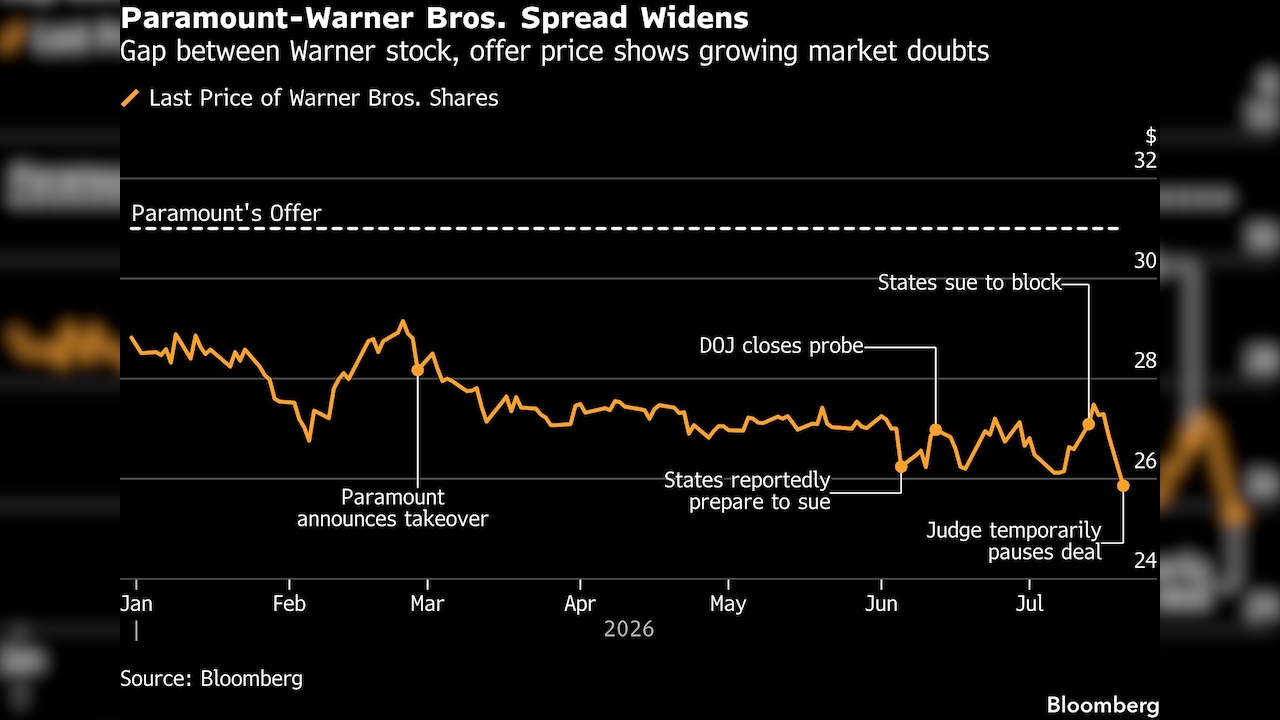
Paramount-Warner Bros. Spread Widens
Photo Credit: (Photo: Bloomberg)
Paramount inked the deal in February after beating back Netflix Inc. following a heated bidding war. The takeover unites two iconic Hollywood studios behind legendary films from Casablanca and Harry Potter to Mission: Impossible. It also brings under Paramount's control two major news networks - CNN and CBS - the streaming powerhouse HBO Max and dozens of cable networks.
Paramount argues the deal is a net win for Hollywood and will provide much-needed competition against tech giants like Netflix, Apple Inc. and Alphabet Inc.'s YouTube. The company already won the blessing of the US Justice Department.
"We are confident the evidence will demonstrate that the state AGs' antitrust arguments are without merit as their alleged markets and claims of anticompetitive effects are without any basis in modern market realities," the company said in a statement Monday after the judge ordered the two-week pause. "This merger is lawful, pro-competitive, and will benefit consumers, creators, workers, and the entertainment industry."
The states' July 13 lawsuit has thrown a wrench into the deal. They have claimed that the merged company will control over 27% of the market for films widely released to theaters and more than 30% of anticipated blockbusters, widely released films with large production budgets. Post-merger, only four companies would control more than 90% of that market - the new entity, along with Walt Disney Co., Universal and Sony Pictures Entertainment.
The states also say the deal will harm licensing of cable TV channels, combining the second and third-largest players in that market with more than 50 channels covering news, sports, general entertainment, kids and family, and lifestyle, giving the company 34% by viewership.
The company argues that the combined market shares it will have in film distribution and TV viewing are nowhere near what is illegal under federal antitrust law. Its deal, Paramount says, is about gaining scale.
Makan Delrahim, Paramount's chief legal officer, said the company has repeatedly tried to reach an agreement with California and has already sent a list of proposed fixes to California Attorney General Rob Bonta's office that could allow the two sides to reach a settlement. Paramount has offered to commit in writing to promises such as releasing 30 movies a year in theaters. Paramount has also said it will increase TV production.
Bonta, meanwhile, told The Town podcast earlier this month that he's not a fan of company promises and prefers structural remedies, such as a divestiture of some of the businesses Paramount is trying to acquire.
When asked on the same podcast Monday about selling CNN, or other cable networks and commitments to produce films in California, Delrahim said that Paramount is "open to all legitimate discussions. Nothing's off the table."
Paramount has a huge incentive to fight for the deal. The company would have to pay $7 billion to Warner Bros. shareholders if the deal is blocked by regulators. Under the merger agreement, it's obligated to defend the deal until June 2027. The company, which is already in debt, doesn't have that kind of money on hand. Chief Executive Officer David Ellison would have to once again tap his father, Oracle Corp. co-founder Larry Ellison.
While David Ellison has said throughout the extended fight for Warner Bros. that its business model is fine as it is, Paramount has also promised major cost savings from a Warner deal. That includes cuts to expenses of some $6 billion on an annual basis. Combining Paramount+ with Warner's HBO Max streaming service will make that business stronger, the company says. Bringing franchises like Harry Potter, Batman and The Lord of the Rings will give the combined companies more ideas for films and TV series going forward, it argues.
(This story has not been edited by NDTV staff and is auto-generated from a syndicated feed.)
Essential Business Intelligence, Sharp Market Insights, Practical Personal Finance Advice, Daily Fuel, Gold and Silver Prices and Latest Stories — On NDTV Profit.