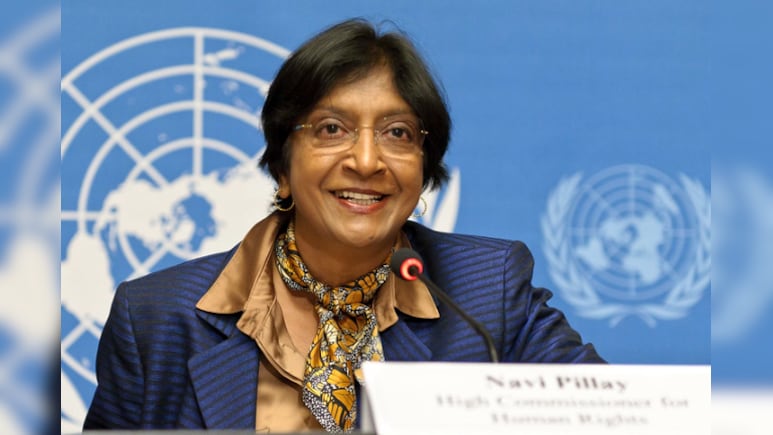
The 2026 Nobel Peace Prize has been awarded to Navanethem "Navi" Pillay, a South African jurist and former President of the International Criminal Tribunal for Rwanda, whose family history traces back to Indian indentured labourers transported to South Africa in the 19th century. Pillay was awarded the honour on Friday for her efforts to promote peace and international law, according to the Norwegian Nobel Committee.
Her journey from a laborer neighbourhood in Durban to some of the world's most influential legal institutions is also a story of migration, discrimination and the fight for human rights.
Pillay was born on Sept 23, 1941, in Durban, then part of the Union of South Africa, to a family of Indian Tamil origin. Her grandparents had travelled from India to Natal in the 1890s as indentured labourers to work on sugar plantations. Her family's history also shows a wider migration that shaped South Africa's Indian-origin population.
Also Read | Layoffs Are Rising In Tech, But These Skills Are Helping People Unlock Better Pay
Under this system, workers were recruited from India and transported to colonies including Natal to work mainly on sugar plantations, often under quite harsh conditions.
Pillay was the fifth of eight children. Samantha Naidu has written in her book, 'Navi Pillay: Realising Human Rights For All', that Pillay's father, Narrainsamy Naidoo, worked as a bus driver, while her mother, Santhama, was determined that her daughters would receive an education alongside their brothers. With limited money for school supplies, her mother stitched together notebooks using blank pages from older children's used books.
Pillay later studied at the University of Natal, earning a Bachelor of Arts in 1963 and a Bachelor of Law in 1965. In 1967, she established her own law firm, becoming the first woman to do so in her home province of Natal.
She later represented people facing apartheid-era discrimination and pursued further legal studies at Harvard Law School. Pillay also became the first non-white woman to serve as a judge of South Africa's High Court. She subsequently served as a judge at the International Criminal Tribunal for Rwanda and the International Criminal Court, and proceeded to then act as the president of the Rwanda tribunal.
From 2008 to 2014, she served as the United Nations High Commissioner for Human Rights, which put her at the heart of global efforts to defend human dignity and challenge abuses of power.
Essential Business Intelligence, Sharp Market Insights, Practical Personal Finance Advice, Daily Fuel, Gold and Silver Prices and Latest Stories — On NDTV Profit.