Kim Jong Un is showcasing his tighter ties with old allies and battlefield lessons from Ukraine, as he positions North Korea as a strong nuclear power before Donald Trump's trip to China.
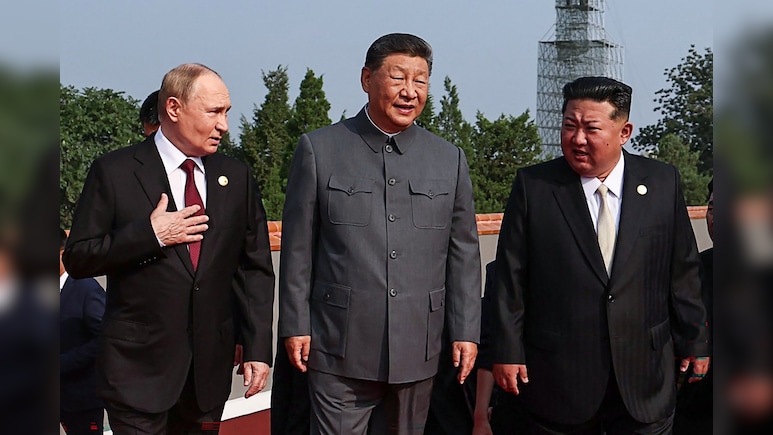
After three days of back-to-back missile tests, including purported cluster munitions plus a bomb for targeting enemy electric grids, North Korea is hosting China's top diplomat for the first time in six years. That comes months after Kim stood beside Xi Jinping and Russia's Vladimir Putin at a military parade in Beijing, for what Wang Yi billed as a “historic meeting.”
On Friday, Kim and Wang reaffirmed close bilateral ties in discussions in Pyongyang, the state-run Korean Central News Agency reported. The North Korean leader stressed the need for broader contact to protect the two countries shared strategic interests, KCNA said.
Also Read | Layoffs Are Rising In Tech, But These Skills Are Helping People Unlock Better Pay
Wang highlighted Beijing's commitment to advancing relations under last year's agreement, adding that the two sides should step up coordination on major international and regional issues amid a turbulent global environment, according to a statement on the ministry's website.
Rail links and Air China flights between Beijing and Pyongyang resumed this year, with analysts speculating this could pave the way for a future return of Chinese tourists to North Korea, which would give Kim another source of hard currency.
Kim's flurry of diplomacy — and weapons tests — come as Trump gears up to travel to China in the first visit of a sitting US president in nearly a decade. South Korea has been trying to encourage a meeting between the US and North Korean leaders around that mid-May trip, already delayed once by the Iran war. It's unclear, however, whether either side is open to the idea.
“North Korea now has a battle-forged alliance with Russia, and China continues to stand behind the regime,” said Doo Jin-ho, a researcher at the Korea Research Institute for National Strategy. “It's no longer the country it once was — and is much harder for the US to deal with.”
Washington has also shifted its approach. Since returning to the White House, Trump has directed America's military might at US adversaries — and sometimes their weapons ambitions. Venezuela's Nicolas Maduro was snatched from his home by US forces in January, while much of Iran's senior leadership has been wiped out as Trump tries to end the country's nuclear weapons program.
Trump and Kim met three times during the US president's first term, as the Republican leader worked to convince the North Korean leader to scale back his nuclear program — an effort that ultimately failed. Despite that, Trump has said he gets along with Kim “very well” and would be available for another meeting.
Bolstered by growing military ties with Russia — and now closer relations with Beijing — Kim has asked Washington to recognize it as a nuclear power for any dialogue to begin.
“Wang Yi might ask if his boss can pass any messages from Kim to Trump,” said John Delury, a senior fellow at the Asia Society. “He might also want to get a sense of Kim's appetite for another summit.”
Wang's trip marks the latest in North Korea's broader efforts to bolster overseas ties after years of isolation and sanctions. Weeks earlier, Kim hosted Belarusian President Alexander Lukashenko in Pyongyang and signed a treaty of friendship and cooperation.
Lukashenko and Kim are allies in Putin's war against Ukraine. North Korea provided artillery ammunition, missiles and soldiers, while Belarus served as a launchpad for Russia's full-scale invasion in the neighboring nation four years ago.
Although diplomatically solid, the Russia relationship appears to have cooled off a bit in recent months, said Leiden University professor and Crisis Group analyst Christopher Green. It's “natural Kim would rebalance, seeking to maintain as diversified a range of partners and income sources as he can within the limits of North Korea's capabilities,” he added.
The experience gained by North Korea in the Russian conflict with Ukraine is helping it to modernize its military, including by incorporating drone intelligence directly into artillery firing systems and creating smaller, more nimble infantry units instead of large scale battalions, John Hemmings, director of the National Security Centre at the Henry Jackson Society, wrote in a recent commentary.
Pyongyang is also now attaching growing importance to AI, anti-satellite weapons and electronic warfare.
The upshot, Hemmings said, is the Korean People's Army “is significantly more dangerous than the one that existed just two years ago.”
(This story has not been edited by NDTV staff and is auto-generated from a syndicated feed.)
Essential Business Intelligence, Sharp Market Insights, Practical Personal Finance Advice, Daily Fuel, Gold and Silver Prices and Latest Stories — On NDTV Profit.