Vice President JD Vance landed in Islamabad on Saturday tasked with ending six weeks of war and overcoming 47 years of enmity - 21 hours later, he flew home without a deal.
The two sides left Pakistan with no resolution to thorny issues like Iran's nuclear program or its control of the Strait of Hormuz. It was always unlikely that they'd reach a breakthrough in a single day even after their highest level meeting in nearly half a century. But by early Sunday morning, it was clear they weren't much closer to resolving a war that's killed thousands and roiled global energy markets.
ALSO READ: Islamabad Talks Failed, But Diplomacy Never Ends: Iran's FM Spokesman On Truce With US
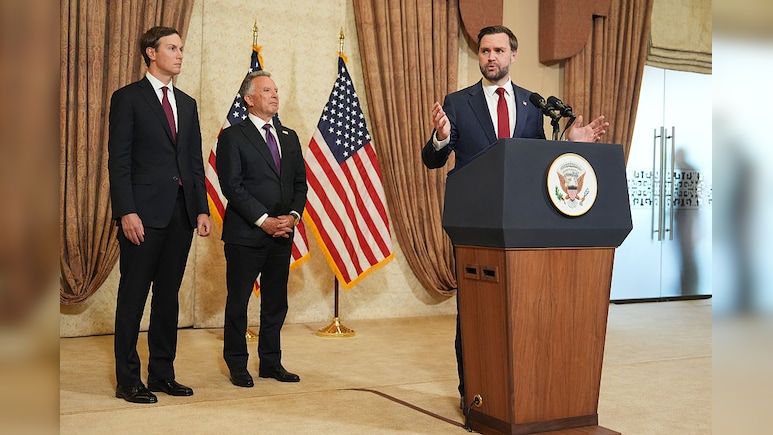
"We leave here with a very simple proposal - a method of understanding that is our final and best offer," Vance said at a short press conference before departing for Washington. "We'll see if the Iranians accept it."
As Vance delivered his verdict in Islamabad - "they have chosen not to accept our terms" - President Donald Trump was in Miami, ringside at an Ultimate Fighting Championship match, where he was joined by Secretary of State Marco Rubio and the 1990s rapper Vanilla Ice.
Vance said the team had updated Trump up to a dozen times during the day, and the president delivered his take shortly before 9 a.m. Washington time on Sunday. In a Truth Social post, he said Iran's team was "very unyielding as to the single most important issue and, as I have always said, right from the beginning, and many years ago, IRAN WILL NEVER HAVE A NUCLEAR WEAPON!"
ALSO READ: Israel Prepares For Potential Resumption Of War With Iran Amid Collapsed Ceasefire Talks
That capped a chapter that began when Vance landed at 10:30 a.m. local time Saturday. The vice president was met on the tarmac by Pakistan army chief Asim Munir, who greeted him in a gray suit and green tie. By contrast, when Munir went out the night before to greet the Iran's 71-member delegation - headed by Parliament Speaker Mohammad-Bagher Ghalibaf - he was clad in full military regalia.
While the fragile ceasefire was holding, the differences remained stark. The Strait of Hormuz, the waterway that carries around a fifth of the world's oil and liquid natural gas flows, remained largely shut. Israel and Hezbollah were still exchanging fire in Lebanon - a ceasefire there is a key Iranian demand - and Lebanon's prime minister on Saturday night would announce the postponement of his own trip to Washington.
Washington was demanding a full reopening of Hormuz, which emerged as the key sticking point, and curbs on Iran's nuclear and missile programs. Tehran was pushing for sanctions relief, a continued grip on the waterway and a broader rollback of US military presence in the Middle East.
"The US must learn: you can't dictate terms to Iran," Iran's former foreign minister, Mohammad Javad Zarif, posted on X. "It's not too late to learn. Yet."
For Vance, joined by senior envoys Steve Witkoff and Jared Kushner, the stakes were also personal. With Trump the final arbiter, getting a deal that satisfies him could bolster Vance's credentials for a possible 2028 presidential run. But failure could tarnish him. A longtime critic of so-called forever wars, Vance had reason to push for a breakthrough.
ALSO READ: Trump Orders US Navy Blockade Of Strait of Hormuz, Threatens To 'Finish' Iran Over Nuclear Dispute
Simply hosting the talks was a win for Pakistan, which has spent years balancing ties with Iran, Gulf states, the US and China and was now at the center of some of the highest-stakes global diplomacy in years. In the middle of it all, Saudi Arabia, which Iran has bombarded over the course of the war, announced that Pakistani air force fighter jets and support aircraft had arrived at King Abdulaziz Air Base as part of a strategic defense pact between the two countries.
Preparation had been intense across Pakistan's usually calm, leafy capital. Workers lined Srinagar Highway with green crescent-moon flags. Businesses shut after authorities declared an impromptu holiday. Shipping containers blocked roads, soldiers fanned out across the city, and hotels quietly cleared their guests. A hastily assembled media center distributed coffee in cups labeled "brewed for peace."
Just before noon, Pakistan Prime Minister Shehbaz Sharif met the Iranian delegation to hammer out details even as the format of the discussions remained unsettled. Iranian media said no decision had been made on direct versus mediated talks, and that Sharif had floated trilateral negotiations.
Sharif also hosted Vance, praising both sides for engaging and expressing hope the talks could lead to durable peace.
Meantime, the first signs of movement appeared about 1,000 miles away in the Strait of Hormuz. Two Chinese supertankers loaded with crude moved toward the strait, hours after a Greek vessel made the crossing. All three cleared the passage late Saturday, marking the biggest day for oil shipments since the war choked off flows.
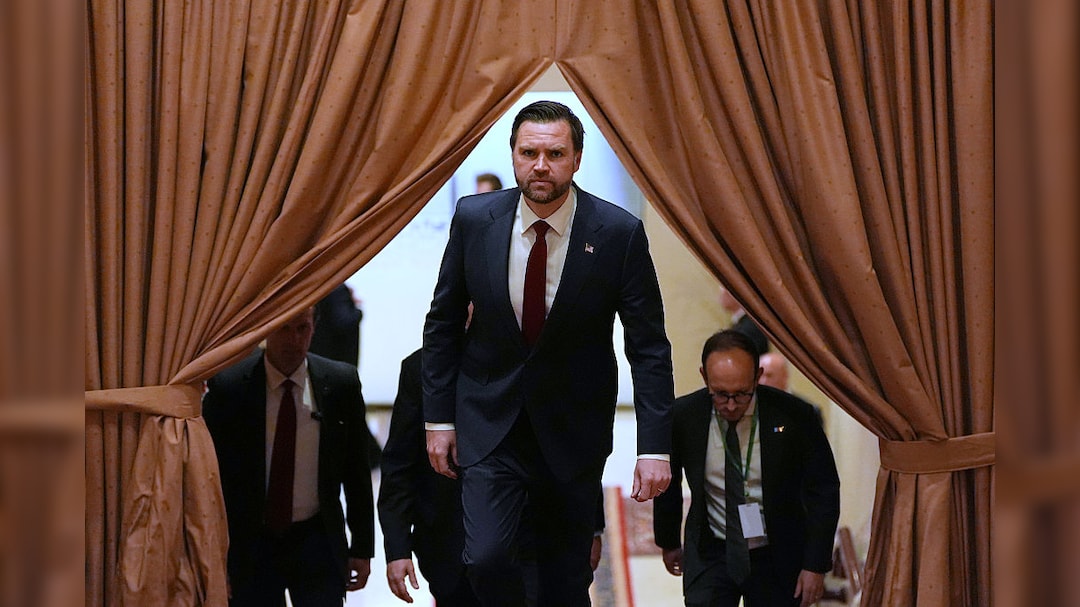
There was far less movement in Islamabad. Just before 2 p.m., three hours after Vance's arrival, the trilateral talks still hadn't begun, as he was with Sharif. From the time that Sharif greeted Vance, press wouldn't see the vice president for another 16 hours.
Trump, watching from Washington, made clear that he was paying attention.
"Massive numbers of completely empty oil tankers, some of the largest anywhere in the World, are heading, right now, to the United States to load up with the best and 'sweetest' oil and gas anywhere in the World," he wrote on Truth Social.
Talks finally began about 5 p.m.
Iran's semi-official Fars news agency reported that fewer Israeli strikes in Lebanon and a US agreement in principle to release Iranian assets helped push the two sides to finally meet directly, which the White House promptly denied.
Iran state TV said the process had entered the “expert phase,” with economic, military, legal and nuclear specialists joining the main negotiators. Talks were broken up by a working dinner hosted by the Pakistani premier.
Sixteen hours after arriving for the Sharif meeting, at about 6:30 a.m. and not long after sunrise, Vance and his team emerged to deliver the news that the talks had failed. Both sides projected a sense that they were fully entrenched, even as they hinted that some progress had been made.
ALSO READ: 'Bad News': JD Vance Confirms US-Iran Standoff After Marathon Talks In Pakistan
“We have no trust in the opposing side,” Ghalibaf posted on X Sunday. “America has understood our logic and principles, and now it's time for it to decide whether it can earn our trust or not.”
Early Sunday morning, the hotel and convention center where talks were held started to clear out - but Islamabad remained in partial lockdown with checkpoints preventing access to the government district — and two large tankers had begun an attempt to cross the Strait of Hormuz. Soon after Vance announced the failure of the talks, they made a hasty U-turn.
(This story has not been edited by NDTV staff and is auto-generated from a syndicated feed.)
Essential Business Intelligence, Continuous LIVE TV, Sharp Market Insights, Practical Personal Finance Advice and Latest Stories — On NDTV Profit.