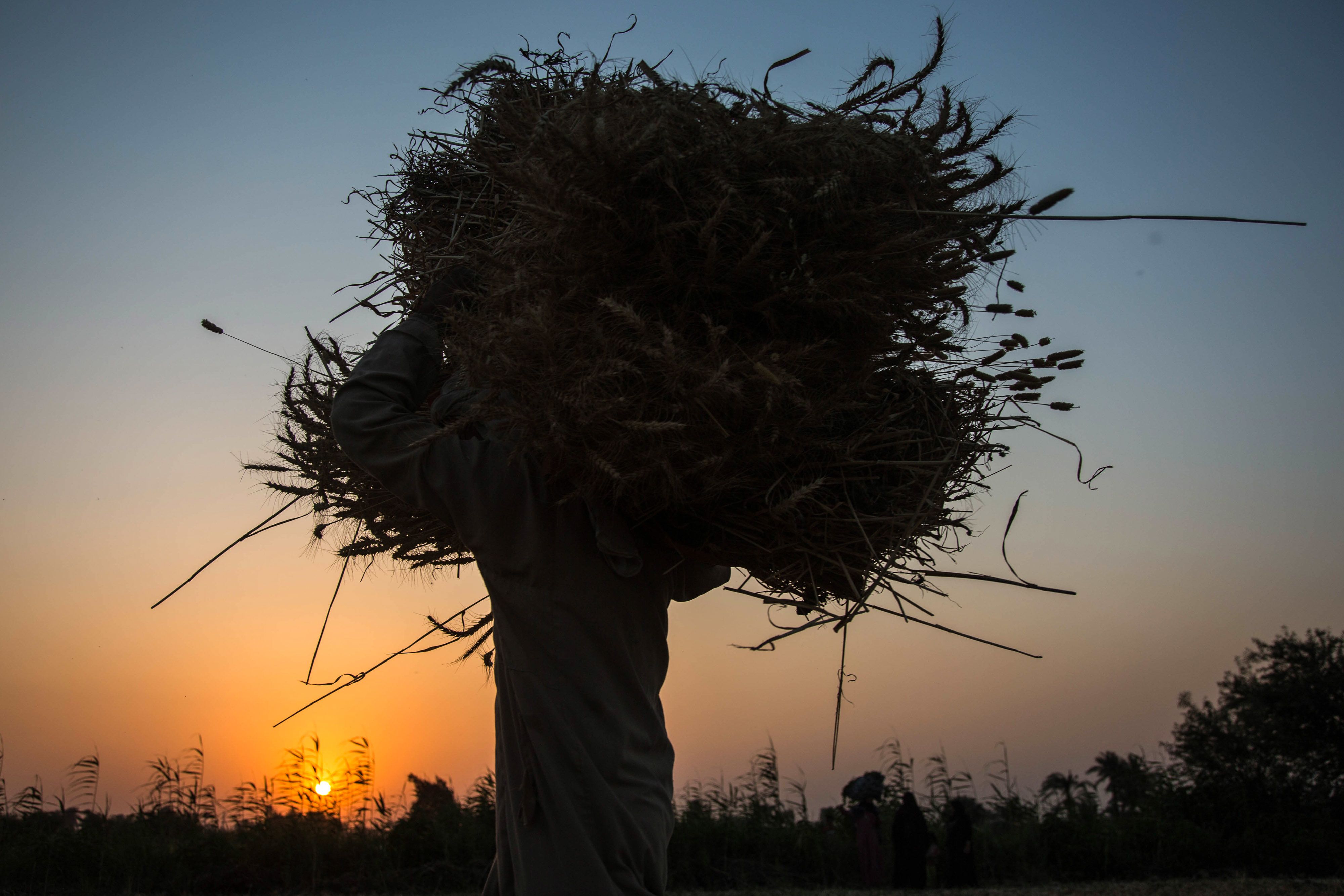
(Bloomberg) -- When Shoukry Mohamed Abdel Salam joined a government program teaching farmers how to grow cotton and vegetables in the desert, his dream was to one day expand his small farm into the Sahara. Two decades on, Abdel Salam is using that desert-farming know-how just to keep his crops alive as salt from the rising Mediterranean seeps into wells around his farm and poisons the soil.
The planet is heating up, but Egypt is warming at a faster pace—making it a bellwether for the painful effects of climate change. The Nile Delta, the breadbasket of Egyptian civilization and where Abdel Salam farms, is gradually turning barren. “I've been working on this land for more than 50 years now. I saw wars, revolutions—big changes,” he says. “But water is my biggest worry.”
When world leaders descend on Egypt in November for the UN-sponsored COP27 climate talks, they'll be stepping into a country that's already living in the searing future. Egypt is almost 2C hotter today than it was at the start of the 20th century. The 2015 Paris Agreement set a fall-back target of holding worldwide temperatures below a 2C warming threshold by 2100. Since Egypt is heating up almost twice as fast as the rest of the planet, it's among the first to reach the hotter future the climate talks are trying to help avoid.
Also Read | Layoffs Are Rising In Tech, But These Skills Are Helping People Unlock Better Pay
Months of record-breaking heat, drought, flood, and fire around the world have raised the stakes ahead of this year's gathering in the Red Sea resort city of Sharm el-Sheikh. This summer in Egypt saw long-lasting heat waves that exceeded 40C (104F). Extreme heat is now commonplace in spring and autumn as well, with a heat wave in April bringing thermometers in Cairo, the capital, to 39C. These effects bolster demands for financial support from Egypt and other developing countries, which are responsible for a fraction of historical emissions but are paying brutal environmental, economic, and human costs.
“We must ask ourselves what sorts of lives we are interested in living, because it's not just about being here and surviving,” says Mohamed Abdrabo, head of the Alexandria Research Center for Adaptation to Climate Change. “It's about being able to feel and act like a human, to develop and live our lives in the way humanity has done through history.”
Relying on little more than their own ingenuity, Abdel Salam and millions like him have found ways to survive in today's hotter Egypt. Without help, it's not clear what they can do to survive tomorrow's. Facing everything from rising seas to drought, desertification, and deadly heat, the Middle East's most populous country is a case study in what happens when efforts to adapt to warming fall short.
Twice the size of France, Egypt is almost completely covered in desert. At present, 95% of its people live on just 5.5% of its land, mostly along the banks of the Nile, the country's lifeline throughout history. As the river's flow ebbs and the desert expands, Egyptians have nowhere to go. Even if the COP27 talks are successful at encouraging countries to cut greenhouse gas emissions and find ways to finance climate disaster recovery, changes on the ground will take years to take effect.
If this year's negotiations and subsequent summits fail to arrest the climbing temperatures, by the time the global average reaches 3C, Abdel Salam's fields will have long since been submerged in brackish water. Cairo will see temperatures above 50C. Parts of Alexandria, a city celebrated since antiquity, will be lost to the sea. Given its place at the extreme end of temperature rises, Egypt will have warmed by as much as 5C.
The following is an examination of what collective failure at the COP talks would mean for the host country and what its people are doing to adapt today.
A Guide to COP27
• Global Climate Summit Is Heading for a Geopolitical Hurricane• A New Era of Climate Disasters Revives Calls for Climate Reparations• Banks Try Quiet Quitting on Net Zero
Rising Seas
If global warming reaches 3C, sea levels will rise by 6.4 meters (21 feet). That would submerge swaths of the Nile Delta and force about a third of Egyptians to migrate, according to Climate Central, a nonprofit based in Princeton, New Jersey.
The type of salinization that Abdel Salam is experiencing now will become more widespread, limiting Egypt's ability to produce its own food and making it more dependent on volatile global commodity markets. With 102 million mouths to feed, the country is already vulnerable to food insecurity. Its population is forecast to double by the end of the century.
Financing the major infrastructure work that will be required to help Egypt and other developing nations adapt is expected to be one of the most contentious issues at COP27. A 2009 pledge by wealthier industrialized nations to contribute $100 billion a year in climate finance by 2020 has never been met.
At COP27, Egypt won't just be speaking for itself, it will be speaking on behalf of other developing nations. It's the world's fourth-most flood-prone nation— ahead of Pakistan, according to the World Resources Institute. At the same time, it has the lowest rate of capital formation among the world's 20 most populated countries, according to the World Bank. Climate-linked disasters such as flash floods and the salinization of the delta contribute to the country's economic woes and to the difficulties in raising capital for infrastructure.
Abdel Salam's fields are nestled on the outskirts of Baltim, the last village the Nile reaches before it flows into the Mediterranean, a place so fertile it gave rise to humanity's first experiments with large-scale agriculture 10,000 years ago.
But as sea levels rise and a decades-long drought driven by climate change weakens the Nile's flow, seawater has begun to travel upstream. The salt has rendered many fields barren and covered them with a white crust that crackles underfoot. “It just keeps getting worse and worse. The Nile is shrinking,” Abdel Salam says. “The water can barely reach us, and when we dig deeper for underground water, it's mostly salty.”
Four years ago, Abdel Salam and a group of other farmers put their meager savings together and rented a dredger to clear and filter the brackish water. Next they bought plastic tubes, pierced holes in them every few inches, and set up a drip irrigation system that's helped them survive with less water. This simple technique may not be enough as the world gets hotter.
It's not just the Nile Delta that's at risk as sea levels rise. Entire neighborhoods of Alexandria, the coastal city founded by Alexander the Great 2,300 years ago, will flood too. Overcrowded, its infrastructure crumbling, Alexandria is already vulnerable. It's set to suffer a more than 100% increase in “average annual losses,” an insurance term based on the sum of losses from all events each year from 2005 to 2050, according to forecasts from the Intergovernmental Panel on Climate Change, a UN-backed group of top climate scientists. Only the coastal city of Barranquilla, in Colombia, is forecast to suffer as much.
Deadly Heat
Daily life will become harder for Egyptians decade after decade. Annual average temperatures in Egypt have increased by 1.98C since 1901, according to data compiled by the World Bank. By 2100, temperatures could be as much as 5.2C higher than the average for the period between 1971 and 2000, according to the Climate Service Center Germany (Gerics). Minimum temperatures will rise too, making nights harder to bear, and heat waves will last as long as 100 consecutive days, the center predicts.
Worst affected will be Cairo. Home to more than 9 million people today, it's absorbed waves of migrants from far-flung provinces since the 1950s, while prosperous residents have fled the densely packed central districts for more secluded suburbs.
The city has grown the old-fashioned way. Already scarce, green areas shrank 3% in the first two decades of this century, while hard surfaces expanded from 23% of the city's total area to 35%, with overpasses built feet away from apartment windows in overlapping layers of concrete and traffic. Older parts of Cairo have merged with vast satellite cities and seemingly endless stretches of informal housing to create today's smog-choked metropolis.
Egyptian real estate giant Talaat Moustafa Group is planning a “green” suburb of the future, offering a tranquil respite from the heat and fumes to those who can afford it. About 40 kilometers (25 miles) east of central Cairo, just north of the new administrative capital already under construction, Noor City is slated to include as many as 140,000 homes for about 700,000 people.
Talaat Moustafa has yet to work out what the suburb's carbon footprint will be—either during construction or once inhabited—but says it will be partly powered by renewable energy. All public lighting in the city, as well as all administrative buildings, malls, and hospitals operated by Talaat Moustafa, will be solar-powered, according to the company's vice president for smart cities, Mohamed Salah. Electric buses, scooters, and bicycles will be available to residents and recycled sewage water will be used to irrigate the vegetation in Noor City's public spaces.
Such oases will provide relief to a privileged few, but, overall, large cities in developing nations such as Egypt stand to suffer most from global warming. Their dwellers will be more likely to die from the heat, because their governments don't have the capacity to help them adapt, according to the Climate Impact Lab, a research consortium that maps the relationship between temperature, income, and mortality.
Cairo's mortality rate from excess heat would increase to 80 deaths per 100,000 people under a very-high-emissions scenario, which contemplates an increase in global temperatures of between 3.2C and 5.4C by the end of the century. The scenario is not a prediction, but a common way for scientists to explore the potential scale of climate change's impact. Heat mortality in Cairo would be above the global average forecast by researchers and much higher than the four heat-related deaths per 100,000 people the city experienced in 2020.
Inequality among nations and also within them will be at the heart of climate talks this year as the UN climate conference is taking place in Africa for the first time since 2016. Poor countries are expected to push for richer nations to compensate them for the disasters they're suffering—despite their smaller contribution to historical greenhouse gas emissions—and for the economic development they're being asked to forgo.
Expanding Deserts
Egypt's history is, in many ways, that of humanity's struggle to tame the desert. For millenniums, Egyptians found ways to grow vegetables, be it on the Nile's fertile banks or in desert oases. That's now changing. Rising sea levels, a lack of rain, heat, and uncontrolled building on agricultural land are contributing to the disappearance of what few green areas remain.
For years, the country was home to one of the world's most successful tree-planting initiatives. That, too, has fallen victim to political turmoil and a lack of support. Under an initiative born in the 1990s, trees were planted in an area of desert on the outskirts of Ismailia, in the country's northeast. The results were surprising, even to Hany El Kateb, the Egyptian-born German researcher who designed the system. Treated sewage water was used as a fertilizer, helping trees grow faster and ensuring higher survival rates than other desert afforestation experiments, El Kateb says.
The funding for Ismailia's Serapium Forest stopped abruptly in 2015, however, when Egypt entered a period of economic turmoil and political repression. Treatment plants broke down, and salt in the water corroded irrigation equipment. Trees fell sick and, in 2019 and 2020, many were cut down and sold at a public auction. They fetched about $60,000, says Salah Abd Elghafar, acting general manager for forests in Egypt.
Today just a few of the original 500 acres are fully forested. New trees are being planted to replace those that were felled. But the place is virtually abandoned. Successive financial crises mean workers can no longer make ends meet, and just seven remain, down from 45 who tended the forest as recently as 2018.
One of the key outcomes of COP26, which took place last year in Glasgow, Scotland, was the promise by more than 100 global leaders to end and reverse deforestation by 2030—and to invest about $19 billion in private and public funds to work toward that goal. This year, environmental nonprofits are expected to shine a light on how that effort has advanced given that deforestation in major carbon sinks such as the Amazon remains at record highs.
Crumbling Heritage
If global warming continues at its current pace, Egypt will lose 0.35% of its annual gross domestic product by 2027, rising to 1.87% in 2067, according to forecasts from the American Geophysical Union, an international nonprofit.
Even tourism, which accounted for about 15% of the country's economy before Covid-19 and employs about a tenth of the workforce, is being hit by rising temperatures. Egypt is home to some of the world's most recognizable monuments—the Great Pyramids, the Luxor Temple, and countless others. Having survived for thousands of years, they, too, are now in danger.
The desert's dry atmosphere and soil had long helped preserve Egypt's iconic heritage. But in recent decades, a combination of unsustainable agricultural practices and occasional flooding caused by more extreme weather has raised groundwater levels.
Unprecedented humidity is slowly rotting the foundations of ancient structures, says Brett McClain, senior epigrapher at the University of Chicago's Oriental Institute Epigraphic Survey, which has worked to preserve monuments in Luxor's Medinet Habu complex for almost a century. Over the past decade, drainage systems have been installed at the site of significant monuments, including the Karnak temple complex on Luxor's west bank, as well as nearby sites at Esna, Edfu, and Kom Ombo. Funded by the Egyptian government and institutions such as USAID, these efforts have dramatically slowed the decay, McClain says. Now archaeologists are working to fix the damage.
“Ancient Egyptians were the first naturalists,” says Dominique Navarro, who works to preserve ancient art. “They documented the environment so beautifully that you can tell bird and fish species apart in hieroglyphs.” An artist herself, Navarro started drawing Egyptian monuments in 2011 and became fascinated by the talents who drew and engraved on the walls of temples and palaces over 2,000 years ago. She began working for the Epigraphic Survey in 2016; even in that short time, she's seen some works disintegrate.
“Our team is dedicated to honoring these ancient artists,” she says, “and trying to capture the craftsmanship of their work.”
Fragile Ecosystems
Below the arid shore of Egypt's eastern coast lies a kaleidoscope of wonders. To plunge into the clear waters of the Red Sea is to enter a realm of lush corals and feathered anemones. Clown fish, tiny nudibranchs, morays, and turtles teem in these underwater gardens. Sail farther south, toward the Sudanese border, and you can spot hammerhead sharks scouting for prey and dugongs peacefully feeding on the sandy floor.
No one knows how Egypt's marine ecosystems will adapt to a hotter planet. Oceans have so far absorbed 93% of the heat generated by greenhouse gases, acting as a kind of sponge for the warming planet. But the more they warm, the less atmospheric heat they can absorb. Hotter waters are already affecting marine life. Under the very-high-emissions scenario, almost 90% of about 25,000 ocean species will be at critical risk. Only by reducing emissions in the coming decades can we mitigate the impact.
Marine biodiversity will take center stage at COP27 on Nov. 10, dubbed Science Day, when the UN and other bodies are expected to present studies on the state of the world's oceans.
Early studies indicate that Red Sea corals are extraordinarily resistant to high water temperatures and the kind of acidification that's caused mass bleaching in Australia's Great Barrier Reef. Yet a lack of funding and scientific research means the data are too patchy for us to understand what's really happening beneath the waves.
The Red Sea Project, based in the southern town of Marsa Alam, aims to change that. A small organization that relies largely on volunteers, it's working with recreational dive centers to enlist amateur divers to collect data on corals, turtles, and larger species like sharks and dolphins. The initiative is inspired by Australia's successful Great Reef Census citizen science program.
“We're trying to create a baseline database, an initial assessment that will allow scientists to go back over time and see what's happened here,” says project founder Ahmed Fouad, a former diving instructor with experience managing marine protected areas. “We need more patrolling, monitoring, and studies. Right now, I can't tell what's the status of our coral reefs, because there are no long-term studies about them.”
Conflict—and a Silver Lining
Because climate change compounds existing troubles, relations between local communities, between the people and government, and between Egypt and its neighbors are likely to become more strained.
“Drought is indeed what pushes people the most,” says Susanne Schmeier, associate professor of Water Law and Diplomacy at the IHE Delft Institute for Water Education in the Netherlands. “Countries that are disadvantaged already by pure geography and hydrology will find it more difficult to deal with drought. The pressure is high, and a single drought can push things over the tipping point.”
Schmeier heads the Water, Peace, and Security partnership, which has developed a model to predict the likelihood of water-related conflict within the next 12 months. While Egypt is not an area of emerging conflict now, it's at future risk, she says. Farther upstream along the Nile, Ethiopia is building Africa's largest dam, part of an ambitious $4 billion project to become the largest electricity exporter on the continent. Years of diplomacy over how to share the river have failed. Barring a war over water, Egyptians fear the dam will further reduce the river's flow through their territory.
Yet as politicians and negotiators prepare for COP27, it's worth remembering that it's not too late. “What really matters is what happens between drought and conflict,” Schmeier says. “That space in between merits a closer look, because that's where solutions will lie. There's a lot that we can do, and a lot that could be done that isn't being done.” —
More stories like this are available on bloomberg.com
©2022 Bloomberg L.P.
Essential Business Intelligence, Sharp Market Insights, Practical Personal Finance Advice, Daily Fuel, Gold and Silver Prices and Latest Stories — On NDTV Profit.