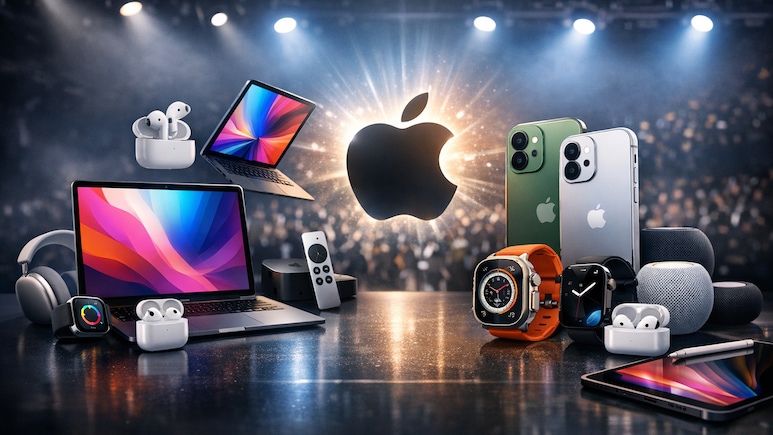
What began on April 1, 1976, as Apple Computer Company has since become one of the most valuable businesses on the planet. The maker of devices such as the iPhone and iPad, and remembered for classics like the iPod Mini and PowerBook, Apple's reach now spans far beyond hardware.
Over 50 years, it has navigated highs and lows to leave an indelible imprint on everyday life through technology, shaping sectors from entertainment to accessibility.
As the company celebrates its 50th anniversary on April 1, here's a look at some of the people who shaped the company.
Also Read | Layoffs Are Rising In Tech, But These Skills Are Helping People Unlock Better Pay
Steve Jobs
Steve Jobs cofounded Apple with Steve Wozniak and Ron Wayne on April 1, 1976. The legacy of Apple is in no small measure due to Jobs.
In those early years, personal computers remained a luxury few could afford. Apple went on to reshape the industry, developing user-friendly and elegantly designed devices that millions around the world would return to time and again.
Jobs revolutionised personal computing with the Apple II and Macintosh. After being ousted in 1985, he returned in 1997 to save the company from bankruptcy. Jobs transformed Apple into a tech giant with iconic products like the iMac, iPod, iPhone, and iPad.
In 2007, Jobs introduced the iPhone, fundamentally changing the smartphone industry.
Steve Wozniak
Steve Wozniak is an electronics engineer and one of the co-founders of Apple. He designed the Apple II, the first commercially successful personal computer, according to Britannica Encyclopedia.
In the mid-1970s, Steve Wozniak joined the Homebrew Computer Club, a gathering of enthusiasts focused on the Altair 8800, itself built around the Intel 8080. During a stint at Hewlett-Packard, Wozniak devised a microcomputer of his own in 1976, though the company showed little appetite for taking it forward.
It was Steve Jobs, equally involved in the club, who recognised its potential and urged collaboration. The two soon launched Apple Computer, raising funds by selling personal possessions, namely, Jobs's car and Wozniak's calculator, and beginning operations in a modest garage workshop.
Ronald Wayne
Among Apple's original trio was Ronald Wayne, who owned 10% of the business at its inception. He later sold his stake for a mere $800, a move often cited as one of the most consequential missed opportunities in business history.
CNBC reports Wayne joined forces with Wozniak and Jobs, who were in their early 20s, to bring experience and oversight to the fledgling firm. His role included supervising engineering work and managing documentation, in exchange for a 10% share.
Concerns over debt quickly troubled Wayne as Apple began operations. Jobs had borrowed $15,000 to secure parts for the company's first contract with a local computer shop. With personal assets at stake, unlike Wozniak and Jobs, Wayne feared he would shoulder the burden if the venture failed. Within less than two weeks, he exited, selling his shares back for $800.
Armas Clifford 'Mike' Markkula Jr
A key architect of Apple's early rise, Mike Markkula played a decisive role in shaping the company's future. The New York Times has described him as the firm's “third and perhaps least understood co-founder”, reflecting his behind-the-scenes influence.
Before joining forces with Jobs and Wozniak in 1977, Markkula had amassed a fortune working with semiconductor pioneers such as Fairchild Semiconductor and Intel. His $250,000 investment secured him a one-third stake and brought vital commercial expertise to the young company.
Jef Raskin
Jef Raskin joined Apple Computer in early 1978 as employee number 31. A year later, his Macintosh concept secured Markkula's endorsement. He subsequently brought in collaborators, including Bill Atkinson and Bud Tribble from UC San Diego. But creative differences with Steve Jobs over the product's design ultimately saw Raskin leave the project in 1981.
Burrell Smith
In February 1979, Burrell Smith entered Apple Computer, beginning his career as a technician servicing the Apple II. While in that role, he worked with Bill Atkinson to push the machine's memory capabilities beyond accepted limits, aiding development efforts for the Apple Lisa. Recognising his talent, Atkinson recommended him to Jef Raskin for a position on the Macintosh project.
Smith subsequently designed multiple motherboard prototypes for the Macintosh, refining five iterations over time. His use of Programmable Array Logic enabled greater efficiency with fewer components. Jobs also played a role in shaping the board's aesthetic. Smith later worked on the logic board for the first Apple LaserWriter.
Michael Scott
Between 1977 and 1981, Michael Scott guided Apple Computer as its first CEO, introducing a more formal corporate structure to the young firm. He implemented policies such as employee ID systems, struck a BASIC licensing deal with Microsoft, and urged employees to adopt Apple hardware internally. Despite these efforts, his tenure was overshadowed by setbacks, including issues with the Apple III and controversial staffing decisions. His leadership came to an end in 1981, when Markkula took over.
Susan Kare
The story of Apple Computer is often told through the achievements of Jobs and Wozniak, yet designers were equally instrumental in defining the user experience. Susan Kare emerged as a key figure in this regard, credited with giving the Macintosh its distinctive, human touch.
Her involvement began in 1982, when Andy Hertzfeld enlisted her help in designing icons. With no background in digital graphics, Kare turned to graph paper to conceptualise pixel layouts, producing early visuals for system tools and MacPaint. The work impressed colleagues and secured her a role at Apple.
Kare's contributions went on to shape the Macintosh's identity. Leveraging software tools developed by Atkinson, she created icons that conveyed warmth and clarity within tight technical limits. The “Happy Mac” symbol became emblematic of this approach, helping to demystify computing for new users. She also became a familiar presence in promotional efforts, demonstrating the system to wider audiences.
Avie Tevanian
At Apple, Avie Tevanian rose to prominence as head of software engineering, serving as senior vice-president between 1997 and 2003 and subsequently as software chief technology officer until 2006.
Before joining the company, he held an engineering leadership position at NeXT. Tevanian's early work at Carnegie Mellon University included designing the Mach operating system, which would later underpin NeXTSTEP as well as Apple's modern operating systems.
Jony Ive
For over two decades, Jony Ive was at the forefront of design at Apple, helping redefine how consumers perceive personal technology. As Chief Design Officer until 2019, he was responsible for the look and feel of flagship devices such as the iMac, MacBook, iPhone, iPod and iPad. Born in London, he joined the company in 1992, preceding the return of co-founder Steve Jobs as CEO.
Tim Cook
Since August 2011, Tim Cook has been at the helm of Apple, while also serving as a member of its board. Previously, as chief operating officer, he managed the company's worldwide operations, including supply chains, sales channels and customer support. Cook also oversaw the Macintosh division and worked to deepen strategic relationships with partners and suppliers.
Apple Inc. was struggling for survival when Jobs made his return in 1997. A year later, Cook joined as senior vice-president of worldwide operations. Although the spotlight largely fell on Jobs and breakthrough products like the iMac, iPod and iPhone, Cook's efforts to streamline operations and logistics were central to the company's revival, as per reports.
A report published in November 2025 by the Financial Times indicated that Apple's board was intensifying its focus on succession strategy. At that stage, Cook had already become the company's longest-serving chief executive, having guided Apple through a period of remarkable growth and global prominence.
Essential Business Intelligence, Sharp Market Insights, Practical Personal Finance Advice, Daily Fuel, Gold and Silver Prices and Latest Stories — On NDTV Profit.