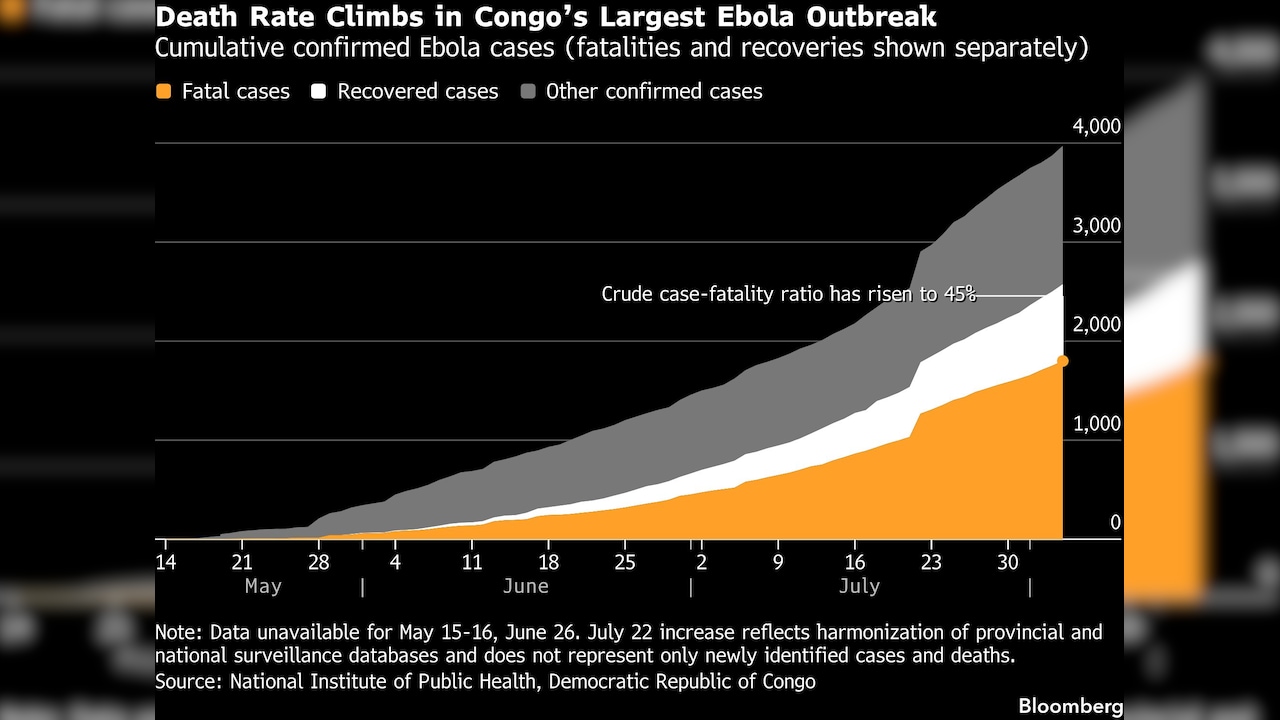
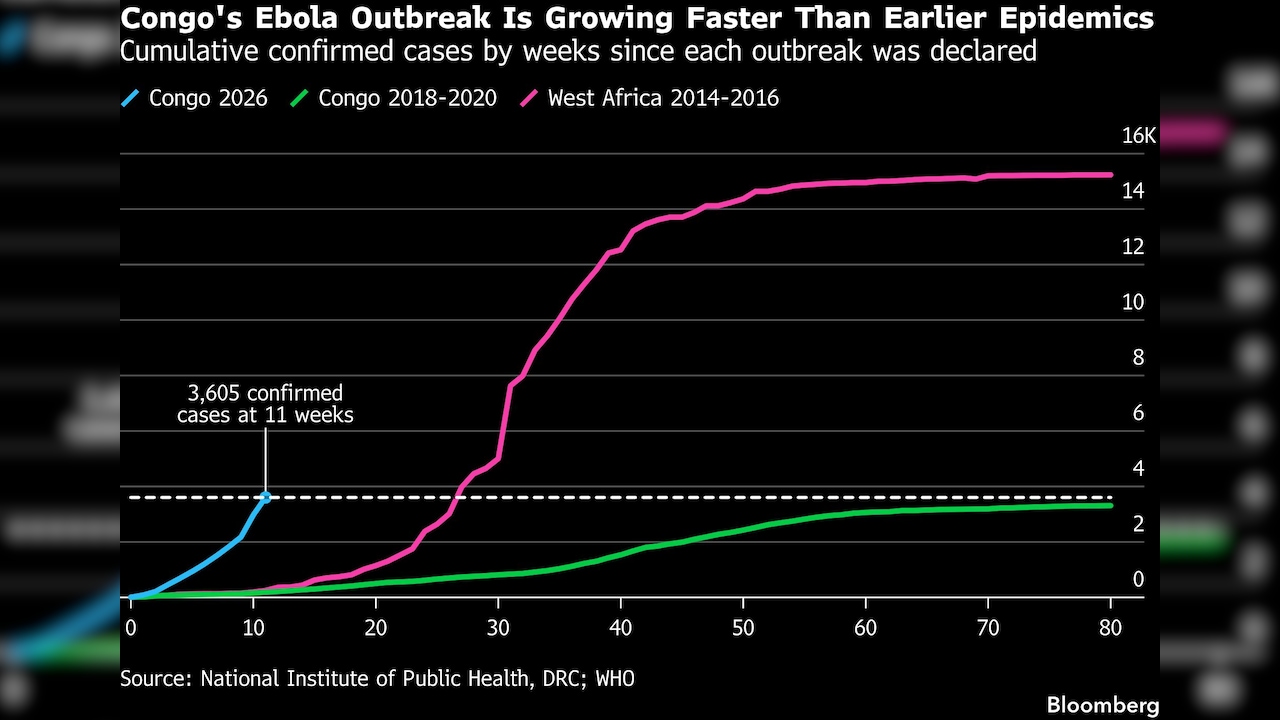
The fastest-growing Ebola outbreak is becoming steadily deadlier on paper, as too many people reach treatment only after the disease has become critical.
The proportion of confirmed Ebola patients dying in eastern Democratic Republic of Congo has climbed above 45% from 31% at the end of June, worsening the toll of an epidemic that's already claimed more than 1,800 lives.
Early treatment improves the chances of survival three- to four-fold, according to the World Health Organization. Yet many patients are arriving at treatment centers only in the final stages of illness - or die before reaching care altogether - reducing their odds of survival while exposing family members and caregivers to infection.
Also Read | Layoffs Are Rising In Tech, But These Skills Are Helping People Unlock Better Pay
The rising fatality rate is becoming a visible symptom of what responders increasingly describe as the defining challenge of the outbreak: confronting the conflict, collapsing health services and chronic deprivation that underlie the fear, misinformation and mistrust keeping infected people from seeking life-saving treatment and leaving them in the community long enough to infect others.
ALSO READ: What Is The Bundibugyo Ebola Strain? DR Congo Outbreak Explained
"The mistrust is coming from so many questions the population have," Jean Kaseya, director-general of the Africa Centres for Disease Control and Prevention, told reporters last week. "Why are you coming just now because of this Ebola outbreak? Why didn't you come when we were dying from measles, from cholera, from bullets?"
More than 70% of the confirmed Ebola deaths Congo reported Tuesday occurred in the community rather than in treatment centers. About 90% of patients admitted to the treatment center run by Médecins Sans Frontires in Bunia, the outbreak's largest hotspot, hadn't been identified through contact tracing, underscoring how many infections are still escaping the response, the medical aid group said Wednesday.
"The response is expanding, but is still not reaching communities quickly enough to break transmission chains," Philippa Boule, MSF's deputy medical director, said in a statement. "Every day lost allows the virus to stay one step ahead and more lives to be needlessly lost."
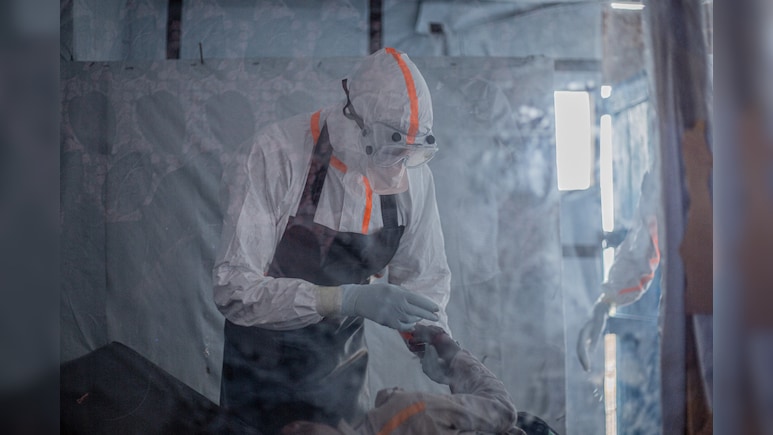
Although there's no specific treatment approved for Bundibugyo - the rare strain driving the outbreak - early supportive care, including up to 5 liters of intravenous fluid a day to replace losses from vomiting and diarrhea and restore dangerously low potassium and blood-sugar - improves a patient's chances of survival.
Many people nevertheless conclude they have a better chance fighting the infection at home, said Alex Lock, communications coordinator for the International Federation of Red Cross and Red Crescent Societies in Bunia. He recalled speaking to a 27-year-old man who told him he knew "nobody who went to the Ebola treatment center and came back home alive."
| Others who have never encountered Ebola first-hand doubt the disease exists at all or attribute illness and death to other causes, Lock said, leaving responders to compete with rumors and long-held beliefs as well as the virus itself. Those tensions have made one of Ebola's most effective control measures - safe and dignified burials - among its most sensitive. Families are often asked to abandon longstanding customs that involve washing, dressing or touching the dead because Ebola patients remain highly infectious after death. Lock recalled one community where relatives reopened the coffin of a man who had died of Ebola because they believed it didn't reflect his social standing. Several people who handled the body later fell ill. Rather than seeing Ebola transmission, many believed the man's spirit had returned to punish those who had violated burial traditions. ALSO READ: DR Congo Reports 1,830 Ebola Cases, 648 Deaths Amid Worsening Outbreak "It's this clash of beliefs - between what people think and the different information we bring - that can create mistrust," Lock said. "It has always been the challenge. It hasn't changed, and it remains the challenge today." 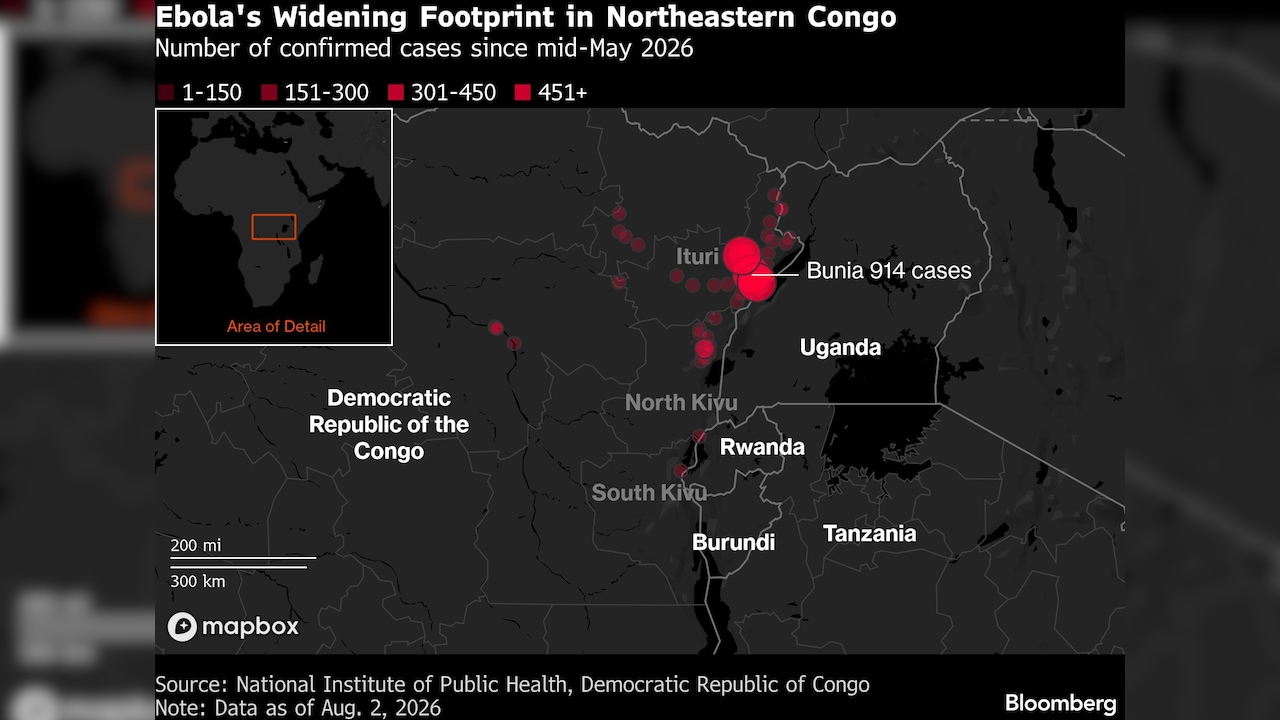 The human cost of those competing beliefs became evident about 20 miles away in the town of Nyankunde last month. Mercy Corps temporarily suspended community-based Ebola response work after protests erupted following the death of a pregnant woman who was unable to obtain the medical care she needed. The nearly two-week interruption halted activities that normally reach more than 1,800 people a week, including community engagement, infection-prevention messaging, mental health support and follow-up of suspected Ebola cases, the organization said. The protests underscore a broader reality confronting the response. "You can't think about the response to Ebola without considering the realities of conflict and the humanitarian crisis," said Karen Naimer, director of programs at Physicians for Human Rights. The organization has described the situation as a "polycrisis," where violence, displacement, collapsing health services and Ebola compound one another. Partner organizations in eastern Congo have expressed "deep frustration" that Ebola has prompted a comparatively robust international response while other humanitarian crises have drawn far less attention, fueling mistrust and making community engagement more difficult, she said. "Trust is something that is built and nourished over time and lost within seconds." Responders say containing the outbreak ultimately depends on reaching patients before the virus does. "The epidemic starts in the community and ends in the community" the Red Cross's Lock said. |
(This story has not been edited by NDTV staff and is auto-generated from a syndicated feed.)
Essential Business Intelligence, Sharp Market Insights, Practical Personal Finance Advice, Daily Fuel, Gold and Silver Prices and Latest Stories — On NDTV Profit.