Having Rs 25 lakh in your bank account may sound like a comfortable financial position, but the bigger question is what you should do with it next. Leaving a large sum idle may mean missing out on potential returns, while investing the entire amount in the wrong asset at the wrong time can expose you to unnecessary risk.
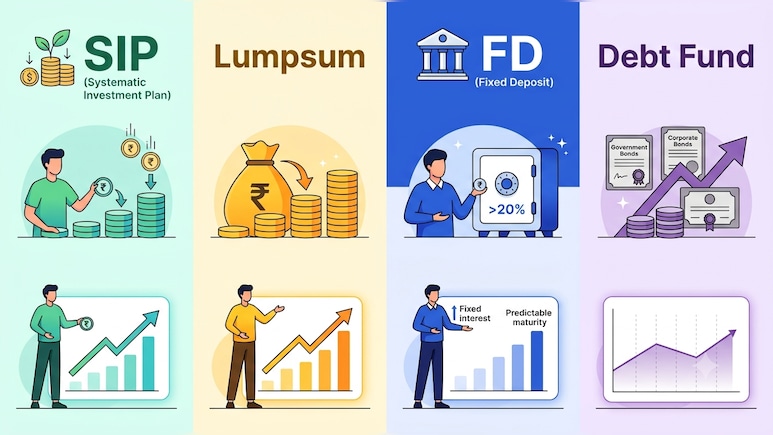
For someone with Rs 25 lakh to invest, the choice is not simply between making money or keeping it safe. Should you put the entire amount into the market through a lumpsum investment, spread it out using an SIP, lock it into a fixed deposit for predictable returns, or choose a debt fund for relatively stable income with greater liquidity?
Each option comes with its own set of advantages, risks and trade-offs. So, where should your Rs 25 lakh go? Join us as we compare SIPs, lumpsum investments, FDs and debt funds to find out which route could make the most sense for different types of investors.
ALSO READ: Who Is Anil Chakravarthy? Adobe Names New CEO To Succeed Shantanu Narayen
What Is SIP?
A Systematic Investment Plan, or SIP, allows investors to put a fixed amount into a mutual fund at regular intervals, usually every month. While SIPs are commonly funded from monthly income, those who already have a large corpus can also stagger their investments instead of deploying the entire amount at once.
For example, rather than investing the full Rs 25 lakh in an equity mutual fund on a single day, you could divide the amount into smaller instalments and invest it over six to 12 months.
This approach can reduce the risk of investing the entire corpus immediately before a sharp market decline. However, there is a trade-off. Money that remains outside the market for longer may miss out on potential gains if markets rise during the investment period.
What Is Lumpsum Investment?
In this option, an investor puts the entire Rs 25 lakh to a mutual fund at once instead of spreading the amount across multiple installments.
If the investment is made in an equity mutual fund, the entire amount is exposed to market movements from day one. A rising market can help the full corpus generate gains immediately, but a market decline soon after investment can also result in a significant temporary fall in the portfolio value.
A lumpsum strategy may therefore be more appropriate for investors with a long-term horizon who can tolerate short-term volatility. Market timing, however, remains difficult even for experienced investors.
ALSO READ: 'US Never Targets Civilians': JD Vance Says Washington Probing Deadly Strikes On Iranian Wedding
What is a FD?
A fixed deposit is different from mutual fund investments. Offered by banks, FDs provide guaranteed interest rates, providing investors with greater certainty about the interest they can earn over the selected tenure.
FD tenures can vary depending on the bank and product, and can range from 7 days to 10 years. If Rs 25 lakh is placed in an FD, the principal earns interest at the applicable rate during the chosen tenure.
Unlike equity mutual funds, FDs are not linked to daily stock market movements. This makes them attractive to investors who prioritise capital stability and predictable returns. FD returns, however, are generally lower than the long-term return potential of equity-oriented investments, and taxation can affect the post-tax return.
What is a Debt Fund?
Debt mutual funds invest in fixed-income securities such as government securities, treasury bills, corporate bonds, commercial papers and other money-market instruments.
They can offer investors liquidity and generally do not have a fixed lock-in period, although some debt-oriented products can have different structures. Unlike bank FDs, however, debt funds do not offer guaranteed returns. The returns are usually not affected by fluctuations in the market.
Considered to be a low-risk investment option, debt funds may suit investors looking for relatively lower volatility than equity funds while retaining access to their money.
SIP Vs Lumpsum Vs FD Vs Debt Fund: Which Is Better?
The right choice ultimately depends on your financial goal.
Choose an SIP if you are uncomfortable investing the entire Rs 25 lakh at once and want to stagger your amount over six to 12 months.
A lumpsum investment may suit investors with a long-term horizon, particularly those who can withstand short-term market volatility. However, investors should avoid assuming that a market correction guarantees better future returns.
As for FD, this option is suitable for those who need the money back in less than 3 years or cannot handle losing any principal. Investors may consider debt fund if they seek relatively stable fixed-income exposure along with liquidity, but it is important to remember that debt funds are market-linked and returns are not guaranteed.
Ultimately, the decision should not be based solely on which option offers the highest potential return. Before investing Rs 25 lakh, investors should consider their investment horizon, liquidity needs, risk tolerance, tax implications and financial goals.
Essential Business Intelligence, Sharp Market Insights, Practical Personal Finance Advice, Daily Fuel, Gold and Silver Prices and Latest Stories — On NDTV Profit.