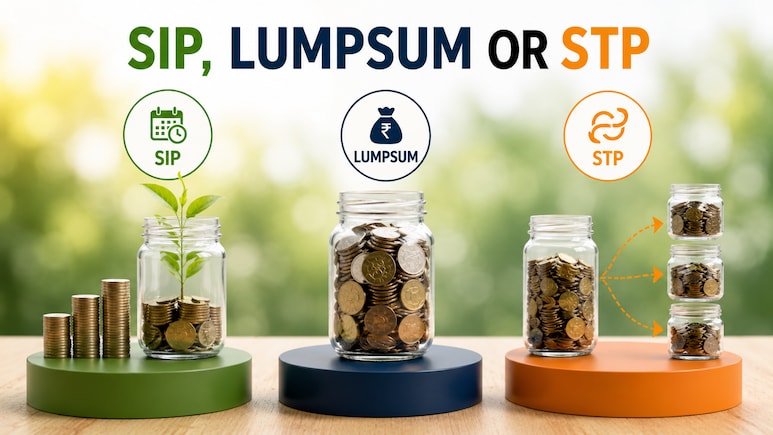
- Lumpsum investing puts the entire Rs 20 lakh into a mutual fund at once, exposing it to full market risk
- SIP spreads the Rs 20 lakh into fixed monthly installments, reducing risk of market timing but may miss gains
- STP invests Rs 20 lakh initially in a source fund, then transfers fixed amounts to equity funds regularly
Having Rs 20 lakh ready to invest can put an investor in a strong financial position, but deciding how to deploy the money can be challenging. Investors can consider investing the entire amount through a lumpsum, spreading it across installments or using a Systematic Transfer Plan (STP) to gradually move money into equity.
But each option comes with its own set of advantages, risks and trade-offs. The right strategy depends on factors such as investment horizon, risk appetite, market conditions and the investor's ability to handle short-term volatility.
Join us as we compare SIPs, lumpsum investments, and STPs to find out which route could make the most sense for different types of investors.
ALSO READ: Want Rs 50 Lakh From Mutual Funds? Here's How Much You May Have To Invest Every Month
What Is Lumpsum Investment?
A lumpsum investment involves putting the entire Rs 20 lakh into a mutual fund at one time. If the money is invested in an equity mutual fund, the full amount is exposed to market movements from day one.
A rising market can help the entire corpus participate in gains immediately. However, a sharp decline soon after investment can also lead to a significant temporary decline in portfolio value.
Lumpsum investing may suit investors with a long-term horizon who can tolerate short-term market fluctuations. However, timing the market is difficult, and investors should not assume that a correction will necessarily lead to better future returns.
What Is SIP?
A Systematic Investment Plan, or SIP, allows investors to invest a fixed amount at regular intervals, usually every month. SIPs are generally funded from monthly income, but an investor with Rs 20 lakh in hand can also choose to stagger the corpus instead of investing it all at once.
For example, an investor could divide the Rs 20 lakh into smaller instalments and deploy the money into an equity mutual fund over six to 12 months.
This approach can reduce the risk of putting the entire corpus into the market immediately before a sharp decline. However, if markets rise during the investment period, some of the money waiting to be invested may miss out on potential gains.
What Is STP?
An STP can be considered by investors who already have a sizable lump sum but want to move into equity in stages.
Under an STP, the initial corpus is invested in a source mutual fund, often a debt- or liquid-oriented fund. A predetermined amount is then transferred from the source fund to an equity mutual fund at regular intervals.
For instance, if an investor has Rs 20 lakh and transfers Rs 1 lakh into an equity fund every month, the entire corpus would be transferred over 20 months, subject to the source fund's returns and the chosen transfer amount.
The mechanism has similarities with an SIP because the investment reaches the equity fund gradually. But the key difference is that the money is initially invested in another mutual fund before being transferred to the target fund under an STP.
SIP Vs Lumpsum Vs STP: Which Strategy Makes More Sense?
There is no single strategy that works best for every investor.
A lumpsum may make sense for investors with a long investment horizon and a high tolerance for market volatility. Since the entire amount is invested upfront, the money gets maximum market exposure from the beginning.
SIP, on the other hand, may appeal to investors who are uncomfortable deploying Rs 20 lakh at once and want to spread their investments over six to 12 months. It can make the investment journey psychologically easier, although it does not eliminate market risk.
An STP can provide a middle path for investors who have a large corpus but prefer to enter equity gradually. The money earmarked for future equity investments remains invested in the source mutual fund until each transfer takes place.
ALSO READ: Rs 15,000 SIP Vs Rs 15 Lakh Lumpsum: Which Can Build A Bigger Corpus In 20 Years?
Ultimately, the choice between SIP, lumpsum and STP should be based on the investor's financial goals, time horizon and ability to withstand market volatility rather than short-term market predictions.
Essential Business Intelligence, Sharp Market Insights, Practical Personal Finance Advice, Daily Fuel, Gold and Silver Prices and Latest Stories — On NDTV Profit.