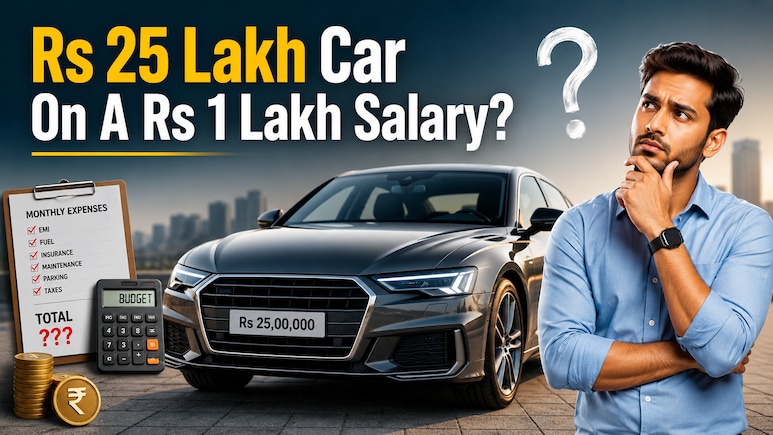
Buying a car is a major financial decision, and the price you can afford should depend on more than just your monthly salary or the loan amount a bank is willing to offer. Even for a person earning Rs 1 lakh a month, a car that cost Rs 25 lakh or more could become a significant financial burden once the down payment, loan EMI, fuel, insurance, maintenance and other running costs are factored in. How?
Consider a Rs 25 lakh car purchased with a 20% down payment. The buyer needs to arrange around Rs 5 lakh upfront, leaving a loan amount of Rs 20 lakh. If the Rs 20 lakh loan is taken for five years at an assumed interest rate of 9% per annum, the monthly EMI is approximately Rs 41,516.
ALSO READ: Rich Dad Poor Dad Author Robert Kiyosaki In Debt? Here's What Report Says
Also Read | Layoffs Are Rising In Tech, But These Skills Are Helping People Unlock Better Pay
But the EMI is not the only expense. Fuel, insurance, servicing, maintenance, parking and other ownership costs can add another Rs 5,000 to Rs 8,000 or more every month, depending on usage and the vehicle.
This takes the estimated monthly car-related outflow to between Rs 46,500 and Rs 49,500. That leaves considerably less money for rent, household expenses, investments, emergency savings, other loans and everyday spending.
How Much Should You Spend On A Car?
A car budget should be based on your take-home income, existing financial commitments and savings goals, rather than simply the maximum loan amount a lender is willing to offer.
The 50% annual income approach is one way to set an initial price ceiling. Under this method:
Rs 8 lakh annual income: Car budget of around Rs 4 lakh
Rs 10 lakh annual income: Car budget of around Rs 5 lakh
Rs 12 lakh annual income: Car budget of around Rs 6 lakh
Rs 20 lakh annual income: Car budget of around Rs 10 lakh
For a person earning Rs 1 lakh per month, the annual income is Rs 12 lakh. Applying the 50% rule would put the suggested car budget at around Rs 6 lakh, significantly lower than a Rs 25 lakh vehicle.
What Is The 20/4/10 Rule?
Another commonly cited guideline for car purchases is the 20/4/10 rule. It suggests:
20% Down Payment: Pay at least 20% of the vehicle's price upfront. A larger down payment can reduce the loan amount and the interest burden.
4-Year Loan: Try to keep the car loan tenure to four years or less. A longer tenure can lower the EMI but generally increases the total interest paid.
10% Of Monthly Income: Keep total monthly car-related expenses, including the EMI, fuel and maintenance, around 10% of monthly income. This means someone with Rs 1 lakh monthly salary should spend roughly Rs 10,000 a month for total car-related expenses. A Rs 25 lakh car with an EMI of over Rs 41,000 would therefore be far above this benchmark.
How To Calculate Your Car Budget
Whether you're looking for a new or used car, buyers should calculate their actual affordability instead of focusing only on the EMI before booking a car.
Step 1: Calculate Your Monthly Take-Home Income
Start with the amount that actually reaches your bank account every month after taxes and other deductions. Your CTC may include components such as bonuses, provident fund contributions and gratuity that are not part of your monthly disposable income. Your real monthly income helps you understand how much you can safely allocate toward a car without straining your other financial responsibilities.
Step 2: Consider Your Existing Expenses
Account for rent or home-loan EMIs, household expenses, insurance, investments, education costs, credit-card payments and other loans. The amount left after these commitments gives you a clearer idea of how much you can comfortably spend on a car.
Step 3: Estimate The Complete Cost
Don't look at the EMI alone. Add the down payment, fuel, insurance, servicing, maintenance, parking, road tax and potential repair costs. The on-road price can also be considerably higher than the advertised ex-showroom price.
ALSO READ: Rs 1 Lakh Savings To Rs 10 Lakh Corpus: How Long Could It Take With A SIP?
For someone earning Rs 1 lakh a month, a Rs 25 lakh car is therefore a significant financial stretch that violates standard budgeting rules, particularly if it is financed with a large loan. Before making the purchase, buyers should assess the total cost of ownership and ensure that the car does not come at the expense of essential expenses, savings and long-term financial goals.
Essential Business Intelligence, Sharp Market Insights, Practical Personal Finance Advice, Daily Fuel, Gold and Silver Prices and Latest Stories — On NDTV Profit.