The data shows that a predominant section of India's population invests in bank FDs, despite their dominance being challenged of late by mutual funds and other market-linked investment avenues. Risk-averse investors and senior citizens particularly prefer bank FDs because they offer fixed and stable returns. Usually, what most individuals look at is the interest rate the FD earns. But the fact is, going by just the rate offered isn't enough.
As you may know, there have been numerous instances of banks offering exceptionally high interest rates that have gone bust. Global Trust Bank in 2004, Lakshmi Vilas Bank in 2020, Punjab & Maharashtra Co-operative (PMC) Bank in 2019, Madhavpura Mercantile Co-operative Bank in 2001, Pen Co-operative Bank in 2010, City Co-operative Bank in 2019, and Rupee Co-operative Bank in 2022 are a few examples.
You see, when a bank offers an exceptionally high interest rate on a bank FD or term deposit compared to its peers, it should be considered a red flag. It is often a sign of liquidity stress and a desperate attempt to raise its deposits. Keep in mind, a high interest rate on a bank FD or term deposit comes with high risk. Apart from the interest rate, you also need to consider a host of other factors when investing in bank FDs.
ALSO READ: How To Structure Mutual Fund Withdrawals In A Volatile Market
So, what are these factors? Well, here's what you need to consider:
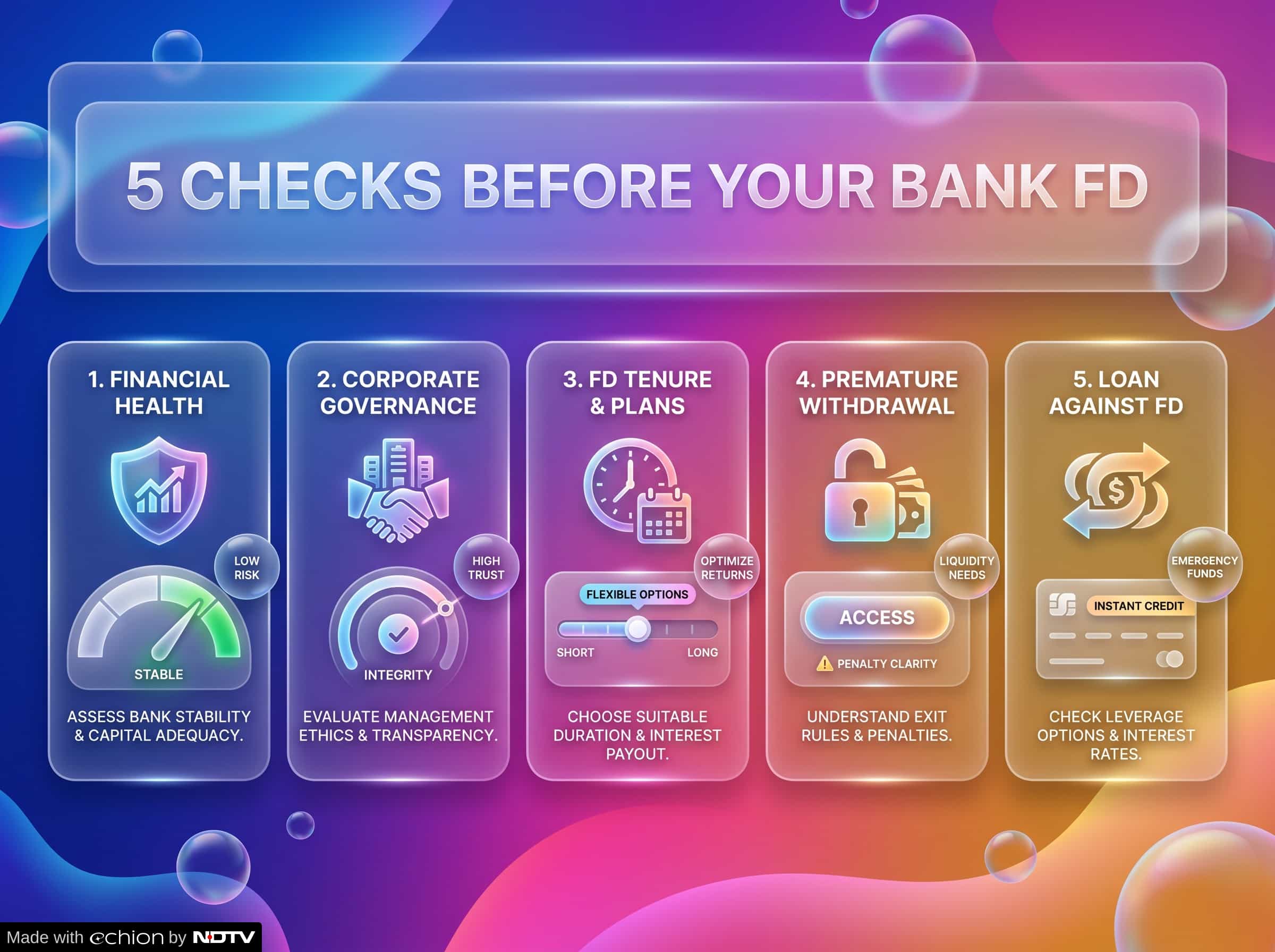
The Financial Health Of The Issuer
It is critical for the safety of your hard-earned money to know the bank's financial health. Just don't go by the name or consider that the bank has been around for several years, and so the money will be safe.
You need to delve deeper to understand if it really deserves your hard-earned money. For that, you need to consider factors such as the capital adequacy ratio (which measures a bank's capital against its risk-weighted assets: higher the better), the level of non-performing assets (a sign of bad loans: lower the better), the coverage ratio for bad loans (indicating whether the bank has prepared for bad loans: higher provisioning is better), credit-deposit ratio (the money the bank lent out against the deposit collected), and the net interest margin (the difference between the interest a bank earns on loans and the interest it pays on deposits), among the host of other aspects.
It would also be in your interest to understand the bank's credit ratings, which are indicators of a bank's ability to honour its debt obligations and return your deposits.
It would be better to have your term deposits with banks that have the highest or a high credit rating (AAA or AA), a stable outlook, and offer a decent rate, rather than chase those offering a high rate and potentially risk your hard-earned money. Your objective should be to earn a competitive rate rather than an exceptionally high rate.
Corporate Governance Practices At The Bank
When you deposit money in a bank, you are its creditor. It is expected that the bank works in your, the depositors' interest by following high fiduciary standards – acting in utmost good faith, integrity, and diligence, and prioritising the interests of depositors.
While the RBI is the regulatory body responsible for mitigating systemic risks, corporate governance at banks also matters. Good corporate governance ensures that reasonable care, skill, and diligence are practised, thereby keeping checks on wrongdoing. You need to evaluate the bank's corporate governance practices.
FD Tenure, Plans/Options
Just because you would earn a better interest on a certain tenure, it is not an ideal way to invest. While the objective should be earning a competitive rate, you cannot ignore your liquidity needs, i.e. when and how you need the money. For example, if you need funds after 11 months, there is no point opting for an 18-month tenure just because the interest rate is better.
Ideally, following the FD laddering strategy makes sense. Here, the FD investments are spread across multiple maturity tenures, or maturity buckets — for example, six months, one year, two years, and three years — instead of investing the entire amount in a single FD.
This approach can help investors manage liquidity while seeking better returns from bank FDs.
The laddering strategy ensures that one FD matures at regular intervals. Each FD in the ladder matures at the specified tenure.
The amount from the maturing FD can either meet liquidity needs or be reinvested, depending on the requirement and the prevailing interest rate scenario.
The FD laddering strategy should be followed across banks, in such a way that you are well covered under the DICGC limit of Rs 5 lakh per bank.
Read more about the FD laddering strategy here.
Also, the investment plan or options need to be selected thoughtfully. For example, senior citizens seeking cash flow to cover retirement expenses could consider interest payout options (monthly or quarterly). Whereas a non-senior citizen, who has a financial goal to fulfil 18 months hence and does not need interest payouts, may be better off with a cumulative interest option.
Premature Withdrawal
There may also be times when you need funds in an emergency – for medical needs, sudden house repairs, etc. It is better to check what the penalty is for premature withdrawal, in case you have to opt for it. Usually, banks charge 0.5-1.0% as a penalty, affecting the interest you effectively earn, depending on the time left before the FD matures.
Premature withdrawal from a bank FD is usually waived only in the case of the account holder's demise.
ALSO READ: Index Funds vs Exchange-Traded Funds: Which One Should You Consider?
Loan Against Bank FD
Say, in case of an emergency, you do not wish to liquidate FDs assigned to address certain financial goals, availing of a loan against the bank FD is also an option. Banks usually keep a margin of 10-15% of the FD value as a security buffer and allow you to borrow 85-90% of the FD value. The interest rate on the loan is 1-2% higher than the rate you earn on a bank FD.
Thus, say a 2-year FD earns you 6.45% interest per annum, the interest on the loan availed against the FD would be around 7.45-8.45%, depending on the bank and what you negotiate.
Note that interest is charged on the actual amount utilised and for the tenure of utilisation. There are no EMI payments or post-dated cheques required, unlike other loans. And the best part is that there are usually no prepayment charges for early closure of a loan against a bank FD.
To conclude
While bank FDs remain a popular choice for saving and investing hard-earned money, it is important to make a thoughtful decision, which is not merely linked to the interest you would earn.
Keep in mind that the interest earned on bank FDs is taxable under the head ‘income from other sources' as per your income-tax slab. The bank is liable to deduct tax at source if the amount exceeds Rs 50,000 for regular/non-senior citizens and Rs 1 lakh for senior citizens. If your total annual income is below the taxable limit, submit Form 15G (individuals below 60) or Form 15H (senior citizens) to the bank to prevent TDS.
Invest in bank FD sensibly, considering your risk profile, financial goals, and liquidity needs.
Happy investing!
ALSO READ: RBI Floating Rate Bond: Why It's A Better Option Than A Bank FD Now
Essential Business Intelligence, Sharp Market Insights, Practical Personal Finance Advice, Daily Fuel, Gold and Silver Prices and Latest Stories — On NDTV Profit.