The 8th Pay Commission is all set to potentially elevate the salaries of mid- and senior-level central government employees, with the revised basic pay likely to depend significantly on the fitment factor recommended by the panel.
The commission is scheduled to hold discussions with employee and pensioner groups and other stakeholders in Jaipur on August 31 and September 2026, followed by similar meetings in Chennai and Puducherry in the second week of September.
The commission's deadline to submit its report is May 2027, bringing its consultations into focus as central government employees await clarity on their revised salaries.
Also Read | Layoffs Are Rising In Tech, But These Skills Are Helping People Unlock Better Pay
Meanwhile, central government employees are eagerly awaiting clarity on the fitment factor, which could determine how much their basic salaries increase under the 8th Pay Commission.
Fitment Factor Demanded By Employee Bodies
A key factor that will determine the extent of the salary increase is the fitment factor. The 7th Pay Commission had recommended a fitment factor of 2.57, which was used to revise employees' basic pay. For the 8th Pay Commission, several employee and pensioner organisations have demanded a significantly higher factor of more than 3.8.
For instance, the National Council-Joint Consultative Machinery (staff side), a major central government employees' body, has demanded a 3.833 fitment factor. The All India Defence Employees' Federation (AIDEF) and Bharat Pensioners' Samaj have also sought the same factor, while the Bhartiya Pratiraksha Mazdoor Sangh has demanded a 4.0 fitment factor.
However, several experts expect the 8th Pay Commission to settle on a fitment factor in the range of 2.0 to 2.25.
ALSO READ: These Credit Cards Still Offer Free Access To Airport Lounges: Do You Own Any?
How much can basic salary increase?
To understand the potential impact, let us calculate the estimated revised basic pay of employees at different fitment factors — 2.00, 2.10, 2.25 and 2.57— using the existing 7th Pay Commission basic pay.
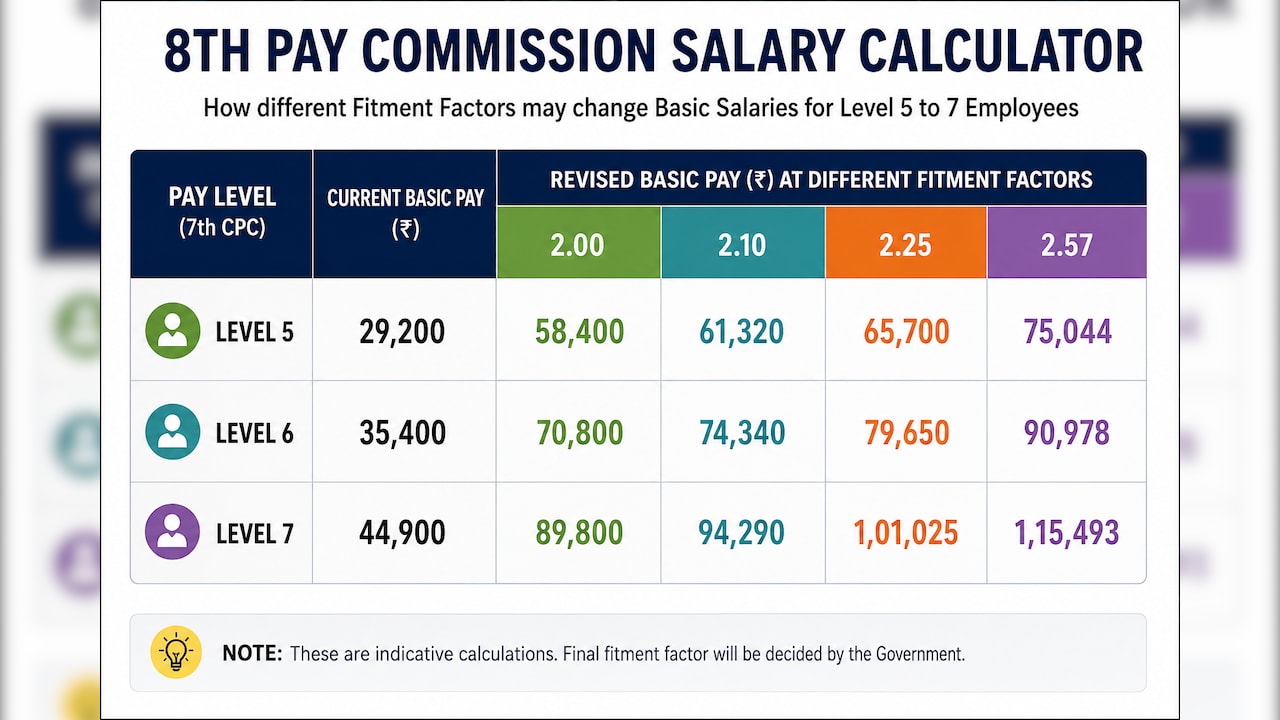
Photo Credit: ChatGPT
For example, a Level 5 employee currently has a basic pay of Rs 29,200. At a fitment factor of 2.00, the revised basic pay would be Rs 58,400. At 2.10, it would rise to Rs 61,320, while a 2.25 factor would take it to Rs 65,700. At 2.57, the revised basic pay would reach Rs 75,044.
Similarly, a Level 6 employee with a current basic pay of Rs 35,400 could see it rise to Rs 70,800 at a 2.00 fitment factor and Rs 90,978 at 2.57.
For Level 7 employees, whose current basic pay is Rs 44,900, the revised basic salary could range from Rs 89,800 at a 2.00 fitment factor to Rs 1,15,493 at 2.57.
The following calculations show how their basic salaries could change if the 8th Pay Commission adopts fitment factors of 2.00, 2.10, 2.25 or 2.57.
It is important to note that these are indicative calculations based solely on the existing basic pay and assumed fitment factors. The actual revised salaries will depend on the fitment factor and recommendations eventually approved by the government.
Also, allowances and other components of the salary have not been included in these calculations.
ALSO READ: Gold ETFs Glitter On Strong Global Cues: Which Are The Five Best Funds Based On Six-Month Returns?
Essential Business Intelligence, Sharp Market Insights, Practical Personal Finance Advice, Daily Fuel, Gold and Silver Prices and Latest Stories — On NDTV Profit.