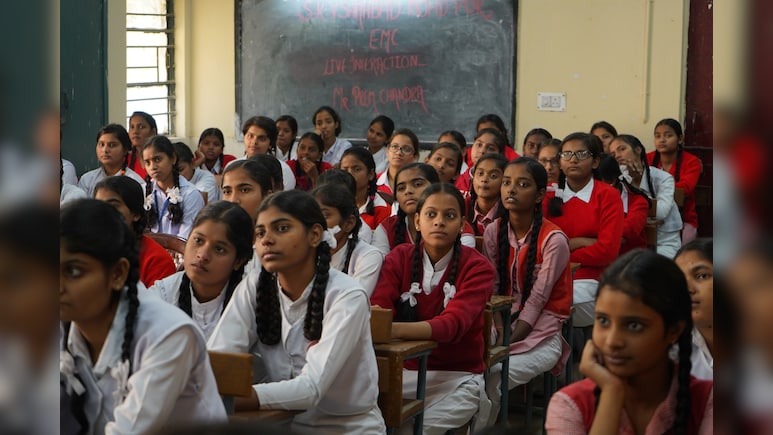
NITI Aayog has pitched for wider rollout of employability and entrepreneurship skills training from Class 6 and structured vocational tracks from Class 9, saying skilling must begin early and be embedded within the school system to shape employability.
The Aayog in a report titled 'Reimagining Skilling for Viksit Bharat@2047', pitched for continuing General Employability and Entrepreneurship Skills (GEES) as a separate subject for all in Grades 11–12.
"Revise Board subject schema in Grades 10 & 12 to include vocational subjects with equal weightage; State board to accept the revised schema for board certification in grade 10," it suggested.
Also Read | Layoffs Are Rising In Tech, But These Skills Are Helping People Unlock Better Pay
While noting that National Education Policy (NEP) 2020 and the National Curriculum Framework (NCF) provide guidance on integrating vocational education and employability skills from Grade 6, the Aayog said implementation remains limited, with fewer than 1 in 12 secondary schools offering vocational subjects.
"Skilling must begin early and be embedded within the school system to shape employability, choice, and progression later in life.
"...General Employability and Entrepreneurship Skills (GEES) for all can be introduced universally from Grade 6 through Grade 12, along side Kaushal Tracks (structured vocational pathways) from Grade 9 onwards that enable deeper vocational specialisation aligned to local and national skill demand," it said.
The Aayog also noted that India's tertiary education system requires structural reorientation to align learning with labour market demand.
"With some curricula remaining outdated and generic degrees dominating enrolment, employability outcomes remain weak," the Aayog said, adding that addressing these gaps requires stronger industry participation through Public-Private Partnership (PPP) models and Apprenticeship Embedded Degree/Diploma Programmes (AEDP) to modernise curricula, embed job-linked learning, and ensure relevance.
The report also called for priority actions including shifting from generic degrees to applied, industry-aligned specialisations, scaling work-integrated and apprenticeship-embedded degree programmes, and expanding flexible, modular, and earn-while-you-learn formats.
"Going forward, the focus must move towards demand-driven skilling aligned to high growth sectors (e.g., green industries, Electric Vehicles (EVs)), General Employability and Entrepreneurship Skills, and reskilling for declining roles," it said, adding that stronger linkage to verified outcomes, delivery through existing public infrastructure, and use of outcome-linked financing models are critical to improving participation and employment outcomes.
The Aayog also emphasised that apprenticeships must be repositioned as a mainstream and trusted pathway to bridge learning and work.
While schemes such as National Apprenticeship Promotion Scheme (NAPS) and National Apprenticeship Training Scheme (NATS), coupled with state-specific programmes, have expanded access, it said participation remains uneven, awareness is limited, and opportunities are fragmented across multiple platforms.
"Making apprenticeships effective requires expanding the number of opportunities (e.g., via Micro, Small and Medium Enterprises (MSME) incentives), providing integrated access through a unified state-led platform, clearer visibility of credible opportunities, and stronger alignment between training and learner/learning demand," the report said.
India's ambition of Viksit Bharat 2047 depends on enabling citizens to learn, earn, and advance continuously. Skilling is central to this goal. Since 2014-15, over 7.67 crore individuals have been trained. To sustain this momentum, the report said the Union Budget for FY 2025- 26 allocated Rs 34,000 crore in skilling-related expenditure across multiple Central Ministries. "Yet, outcomes remain uneven," it said.
(This story has not been edited by NDTV staff and is auto-generated from a syndicated feed.)
Essential Business Intelligence, Sharp Market Insights, Practical Personal Finance Advice, Daily Fuel, Gold and Silver Prices and Latest Stories — On NDTV Profit.