- India’s ethanol-blended petrol (E20) is costlier due to higher ethanol procurement costs.
- E20 rollout followed extensive testing and auto makers assured warranties remain valid for E20 use
- Separate supply chains for E10, E20, and pure petrol are impractical across India’s 100,000+ fuel stations
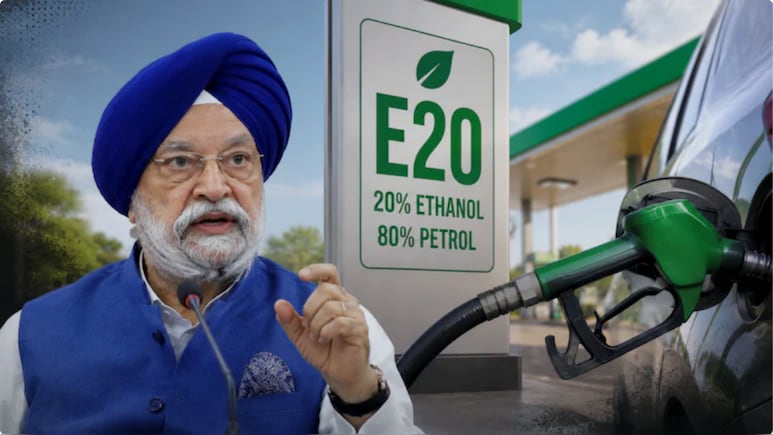
The Ministry of Petroleum and Natural Gas has defended India's ethanol-blended petrol programme, saying E20 fuel is not cheaper than pure petrol because ethanol procurement costs remain higher at current crude oil prices. It also rejected concerns over vehicle compatibility and said maintaining separate supply chains for E10, E20 and pure petrol across the country's fuel stations is not practical.
The clarification addresses recurring questions over the pricing of E20 fuel, the decision to phase out lower ethanol blends, the programme's rollout and its impact on older vehicles. The ministry said the ethanol blending programme has reduced India's dependence on imported crude oil while increasing payments to farmers and limiting the impact of global oil price swings.
Planned Over Two Decades
The ministry said India's ethanol blending programme began with a pilot project in 2001, followed by a policy notified in 2013, before the current government took office.
It said blending remained around 1.5% until 2014 because India depended almost entirely on sugarcane, a seasonal crop, for ethanol production.
According to the ministry, policy changes introduced from 2018 onwards expanded the range of feedstocks and increased processing capacity through coordination across several ministries. That helped ethanol blending rise from about 8.1% in 2020-21 to 20% in the current ethanol supply year.
The ministry said comparisons with Brazil were not appropriate because India benefited from existing technology and coordinated planning while expanding its programme.
Why Fuel Stations Do Not Sell E10 Or Pure Petrol
The ministry said automobile manufacturers were consulted before the rollout of E20 to assess material compatibility, engine calibration and emissions.
It said manufacturers would not have continued to honour vehicle warranties if they had concerns about the safety of E20 fuel.
The ministry cited Maruti Suzuki's servicing of 2.84 crore vehicles in FY 2025-26, including 1.5 crore vehicles that are not certified for E20, and said there were no reported cases of corrosion or component damage linked to the fuel.
It acknowledged that some vehicles may experience a 3% to 5% reduction in fuel efficiency, but said E20 has a higher octane rating and reduces lifecycle carbon emissions by about 40%.
The ministry also said operating separate supply chains for pure petrol, E10 and E20 across more than one lakh retail fuel outlets is not logistically viable.
ALSO READ: E85 Fuel To Cost Around Rs 20 Per Litre Less Than E20, Says Hardeep Puri
Government Explains Why E20 Costs More
Addressing concerns over pricing, the ministry said ethanol is purchased from farmers at fixed prices that do not move with global crude oil prices. It said maize-based ethanol is procured at about Rs 71.86 per litre.
According to the ministry, E20 costs more to produce than pure petrol when crude oil trades around $70 a barrel. However, it said the cost advantage would shift in favour of E20 if crude prices rose to between $120 and $130 a barrel.
The ministry said the programme helps reduce exposure to global crude oil price volatility because about one-fifth of every litre of petrol sold is produced domestically.
Citing data from the Petroleum Planning and Analysis Cell, it said petrol prices in India rose 5.58% between June 2022 and June 2026, compared with larger increases in Pakistan, Sri Lanka, Nepal, Bangladesh and several European economies.
The ministry said the ethanol blending programme has saved more than Rs 1.97 lakh crore in foreign exchange and transferred more than Rs 1.66 lakh crore to farmers.
Ministry Rejects Safety Concerns Over Older Vehicles
Responding to claims that E20 damages rubber components or engines in older vehicles certified for E10, the ministry said those labels reflected the fuel specifications in force when the vehicles were certified and did not mean the vehicles become unsafe as standards change.
"The labels merely reflect fuel specifications at the time of a vehicle's certification and don't render it unsafe as standards evolve," the ministry said.
It said testing by ARAI, SIAM and IOCL, along with data collected from vehicle manufacturers, found no compatibility issues.
The ministry also said it maintains "zero tolerance" for adulteration across the fuel supply chain.
ALSO READ: E20 Backlash: Hardeep Singh Puri Rejects 'Experiment' Charge, Says AG's Remark Misquoted
Essential Business Intelligence, Sharp Market Insights, Practical Personal Finance Advice, Daily Fuel, Gold and Silver Prices and Latest Stories — On NDTV Profit.