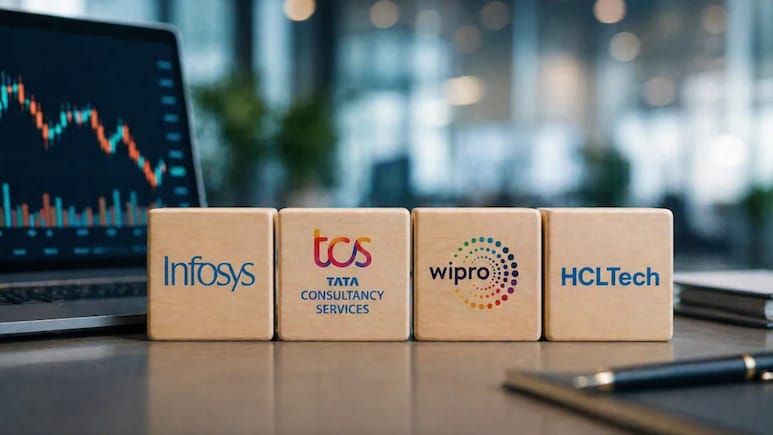
Tata Consultancy Services' September-quarter results offer a mixed read-through for India's information technology sector, with subdued overall growth highlighting continued caution in client spending even as artificial intelligence emerges as an increasingly important source of revenue.
TCS reported a 4% sequential rise in net profit to Rs 13,884 crore from Rs 13,349 crore, while revenue increased 1.3% to Rs 73,188 crore from Rs 72,275 crore. EBIT rose 1.4% to Rs 17,553 crore, with the EBIT margin broadly stable at 24%, compared with 23.95% in the previous quarter.
However, constant-currency revenue growth was just 0.5% sequentially, at the lower end of the 0.5%-0.8% Street expectation. This is important for Infosys, Wipro, HCLTech and Tech Mahindra because it suggests that the broader demand environment has not meaningfully improved.
Also Read | Layoffs Are Rising In Tech, But These Skills Are Helping People Unlock Better Pay
Demand Recovery Remains Elusive
TCS's modest growth suggests that discretionary technology spending continues to be constrained. Clients remain focused on cost optimisation and essential transformation projects, while larger discretionary programmes are taking longer to ramp up.
For peers, this means expectations of a sharp acceleration in growth may need to remain tempered. The extent to which Infosys and HCLTech can outperform TCS on growth will therefore be closely watched, while Wipro and Tech Mahindra remain particularly sensitive to the pace of discretionary spending and large-deal conversion.
TCS did see pockets of strength. Manufacturing revenue grew 3.1% sequentially in constant-currency terms, while Technology & Services also expanded 3.1%. BFSI revenue increased 2.5%, providing support to overall growth. International revenue rose 1.2%.
READ | TCS Q2 Breakdown: $3-Billion AI Revenue To Mega Deals, Five Key Takeaways From Earnings Report
The divergence across verticals suggests that spending is not frozen, but is increasingly concentrated in areas where clients can see clear cost savings, productivity benefits or transformation outcomes.
AI Is Becoming A Real Revenue Stream
The biggest positive takeaway for the sector is TCS's acceleration in AI revenue. TCS's annualised AI revenue run rate crossed $3.1 billion in Q2, up from $2.6 billion in Q1. That means AI now accounts for more than 10% of the company's overall revenue run rate.
The increase is significant because investors have been concerned that AI could eventually reduce traditional IT services billing by automating software development, testing and other activities.
TCS's numbers and the management instead point to an emerging “AI plus human” model, where AI is being incorporated into large transformation engagements. The company said demand for AI-native solutions, AI-led enterprise transformation and autonomous global business services continued to accelerate.
AI-related work has also expanded across sectors, with engagements including Porsche's manufacturing and mobility operations and Best Buy's India capability centre.
READ | TCS Q2 Headcount: 4,258 Employees Added As Attrition Slips To 13.3%
For Infosys, Wipro, HCLTech and Tech Mahindra, the implication is that AI monetisation could increasingly become a differentiator. Investors will want to see whether these companies can convert AI demand into incremental revenue rather than simply using AI to deliver existing services more efficiently.
Deal Wins Remain Healthy, But Conversion Is Key
TCS reported TCV of $9.6 billion in Q2, up from $9.5 billion in Q1 but down around 4% from the year-ago period. The deal pipeline remains sizeable, but the relatively modest revenue growth despite strong deal wins highlights the lag between signing contracts and their conversion into revenue.
This is particularly relevant for peers, as investors increasingly focus on the quality, size and ramp-up of deal wins rather than headline TCV alone.
TCS's $800 million SKF mega deal in Q1 was its sixth mega deal in five quarters. The Porsche-related mega deal was unlikely to have been included in Q2 TCV as the acquisition of MHP closed after the quarter.
Hiring Offers Another Positive Signal
TCS added 4,258 employees sequentially, taking its workforce to 5.98 lakh as of September 30. This was the third consecutive quarter of net headcount addition and took employee strength to a five-quarter high. Attrition also improved to 13.3% from 13.6% in the previous quarter.
However, revenue per employee saw a slight decline, suggesting that the increase in headcount is yet to translate into a proportionate increase in revenue. This will be an important metric for peers as they balance hiring with utilisation and productivity gains from AI.
Essential Business Intelligence, Sharp Market Insights, Practical Personal Finance Advice, Daily Fuel, Gold and Silver Prices and Latest Stories — On NDTV Profit.