- Rupee opened 98 paise stronger after RBI's third currency defense measures on Monday
- Previous RBI rounds curbed banks' positions and attracted capital but gains were short-lived
- Analysts say rupee stability needs lower oil prices, improved capital flows, and easing macro risks
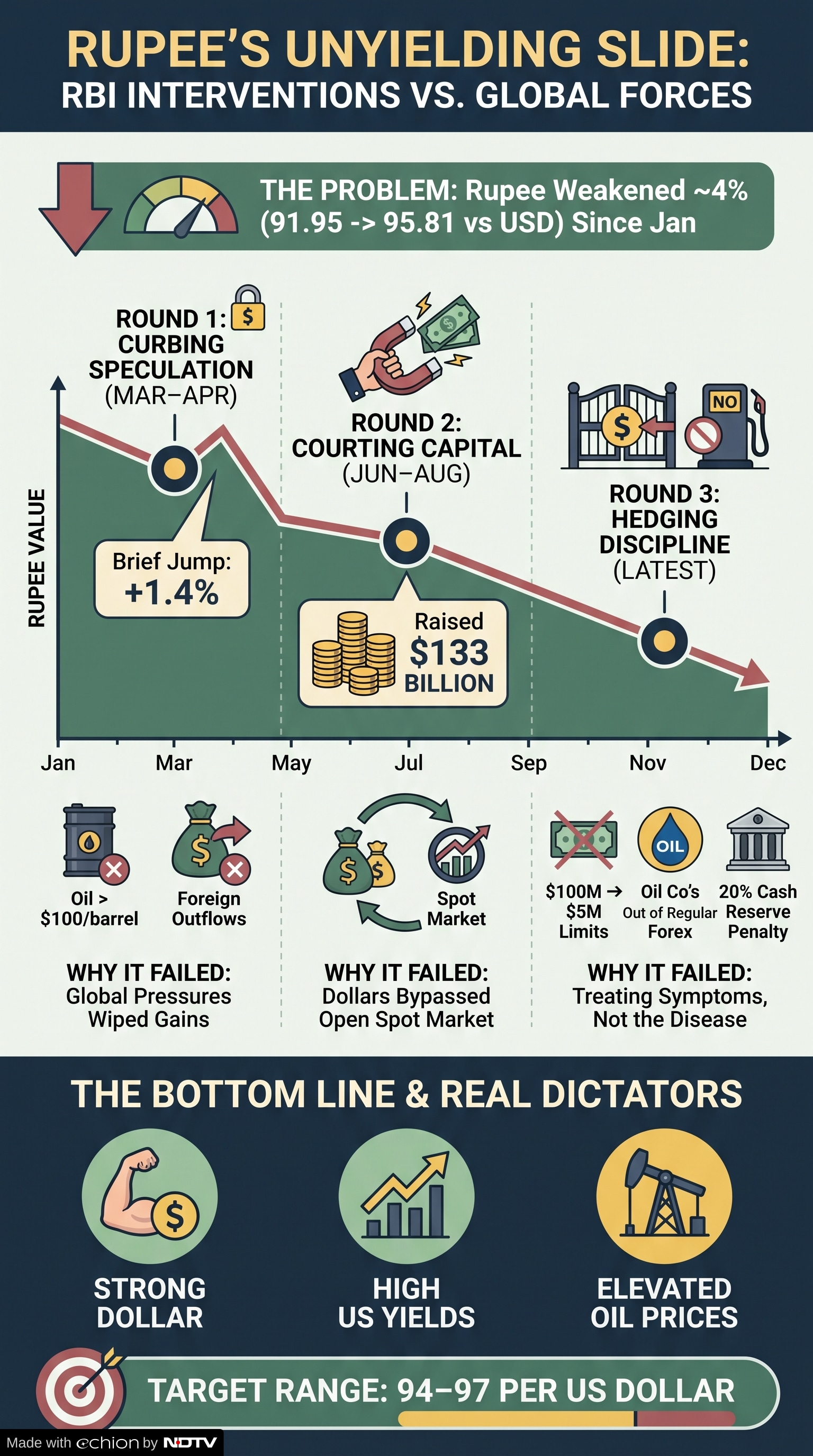
The rupee opened about 98 paise stronger on Monday after the Reserve Bank of India unveiled its third set of measures this year to defend the currency. Whether it holds is the harder question. The first two rounds each steadied the rupee for a while, and yet the local currency is now around 95.81 against the US dollar, roughly 4% weaker than the 91.95 level of January 29.
The RBI, in its latest set of measures, has barred authorised dealers from permitting users to rebook cancelled rupee-linked foreign exchange derivative contracts. It also cut the threshold for derivative transactions without underlying exposure to $5 million from $100 million.
"The latest package is a clear near-term positive for the rupee. It tackles both a large recurring source of dollar demand and the tendency for expectations of rupee weakness to generate additional hedging demand, which can itself amplify depreciation," said Anindya Banerjee, Head Commodity and Currency Research, Kotak Neo.
Also Read | Layoffs Are Rising In Tech, But These Skills Are Helping People Unlock Better Pay
This round of RBI intervention, similar to previous ones, has led to an immediate strengthening of the rupee. However, analysts doubt whether this stability will last long. Let's take a look at the previous measures enacted by the RBI this year, and how the local currency reacted thereafter.
Round One: Curbing Banks' Positions
The first set of measures, rolled out in April, constrained banks' onshore positions and onshore-offshore arbitrage. By capping banks' Net Open Position (NOP) at $100 million, the central bank effectively shut down speculative basis trades between the domestic spot and offshore non-deliverable forward (NDF) markets.
The immediate market reaction was historic, as the rupee posted its biggest single-day jump since 2013, opening 1.4% stronger at 93.59 after having plunged to a record low of 94.8150 in late March.
However, the relief was short-lived. The microstructure fix was soon overwhelmed by broader macro headwinds. As global geopolitical tensions escalated—pushing Brent crude oil above $100 a barrel—and foreign portfolio outflows persisted, India's genuine dollar demand surged. The currency surrendered its initial gains and slipped steadily back toward the mid-90s by early June.
Round Two: Courting Capital
The second phase turned from restricting demand to attracting supply. The government and the RBI offered tax relief, wider access for foreign investors in government securities, and incentives for FCNR(B) deposits and external borrowing.
At its June 5 policy meeting, the RBI announced a package to draw money back in. The government exempted foreign investors from the 12.5% capital gains tax and the 20% withholding tax on interest from government securities, retrospective from April 1, 2026, and expanded the list of eligible bonds. The RBI said it would bear the full hedging cost for banks raising fresh three-to-five-year FCNR(B) deposits, with the window opening on June 8. It also offered a concessional forex swap for external borrowing by public-sector companies.
The FCNR(B) response was large. Banks mobilised about $133 billion by August 31, according to RBI data released on September 21. That was up from about $36.7 billion at the end of July, so most of it arrived in August. The RBI brought the deadline forward from September 30 to August 31 on August 14. Analysts had expected inflows of around $50 billion in 2026-27 from the FCNR(B) and external-borrowing windows.
Despite the massive dollar influx, the rupee's immediate reaction was remarkably muted. Unlike the 2013 taper tantrum—when a similar scheme sparked a massive, sustained rally—the currency closed at 95.38 per dollar, just 0.4% stronger than before the scheme was announced.
The currency then fell further, steadily sliding toward the 97-mark, as seen in recent days. The underlying reason was structural: because the dollars went directly from non-resident Indians to banks and straight to the RBI under the swap window, they bypassed the open spot market. Without fresh dollar selling in the spot market to absorb domestic demand, the scheme successfully bolstered the RBI's foreign exchange reserves but left the rupee fundamentally vulnerable to ongoing pressures.
ALSO READ | Rupee Jumps 1% Against US Dollar After RBI's Foreign Exchange Curbs Take Effect
Round Three: Hedging Discipline
The latest package goes after a different problem: the way expectations of weakness feed on themselves. “It tackles both a large recurring source of dollar demand and the tendency for expectations of rupee weakness to generate additional hedging demand, which can itself amplify depreciation,” Banerjee said.
When traders expect the rupee to fall, importers rush to hedge, and that dollar buying can push the currency down further. The new measures try to cut that loop.
The special window for public-sector oil marketing companies is the most significant element, Banerjee said, because it takes their entire daily dollar requirement out of the regular market. The RBI has also cut the documentation threshold for underlying exposure from $100 million to $5 million. It has added declarations against duplicate hedging and restricted the rebooking of cancelled contracts, which together should curb positions beyond genuine commercial needs.
Banks must also hold a 20% cash reserve against qualifying foreign-currency purchase hedges above $2 million. That adds a funding burden likely to be passed on to customers, which should discourage aggressive front-loading of importer hedges. Genuine hedgers will also pay more. “The reserve is a requirement on banks, not a 20% tax on importers,” Banerjee said.
Buying Time?
The pattern of rupee rising momentarily but subsequently coming under structural weakness may continue, say analysts. The trouble is that none of the interventionary steps touches the forces pulling the currency down. Banerjee points to elevated oil prices, high US yields and a strong dollar as the key external headwinds. The recent retreat in crude is supportive, he said, but sustained appreciation beyond 94 “would require a more durable decline in oil prices and an improvement in capital flows.”
His working range for USD/INR is 94–97. He expects the RBI to be particularly vigilant on a move back towards 96.50, with the new measures helping contain pressure around 96–96.50. This is his reading of the central bank's likely reaction, not an officially declared ceiling.
“These measures can improve near-term market conditions and buy time; a lasting appreciation trend will depend on those macro pressures easing,” he said.
What 2013 Suggests
History shows what it takes for a defence to stick. When the RBI opened a similar window for IOC, HPCL and BPCL in August 2013, the rupee posted its biggest single-day gain since 1998 the next day, and the Sensex rose over 400 points. The central bank withdrew the facility that December once the currency had stabilised.
That recovery lasted because conditions around the rupee improved as well. Whether that happens this time depends on factors outside the RBI's control.
ALSO READ: RBI Curbs May Support Rupee, But Oil Prices Remain A Risk: Nomura's Sonal Varma
Essential Business Intelligence, Sharp Market Insights, Practical Personal Finance Advice, Daily Fuel, Gold and Silver Prices and Latest Stories — On NDTV Profit.