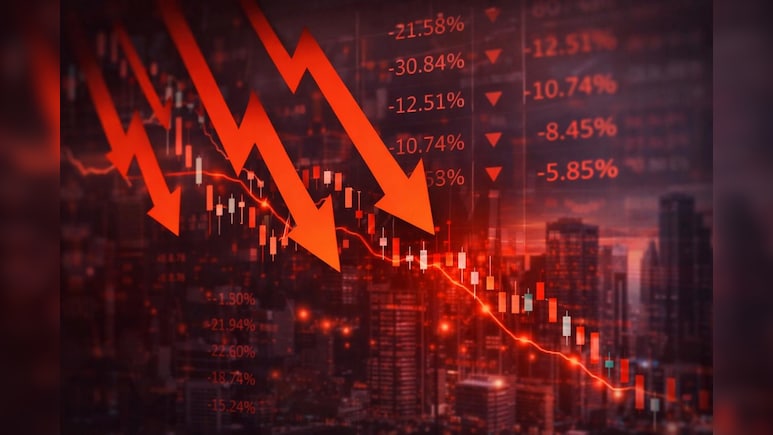
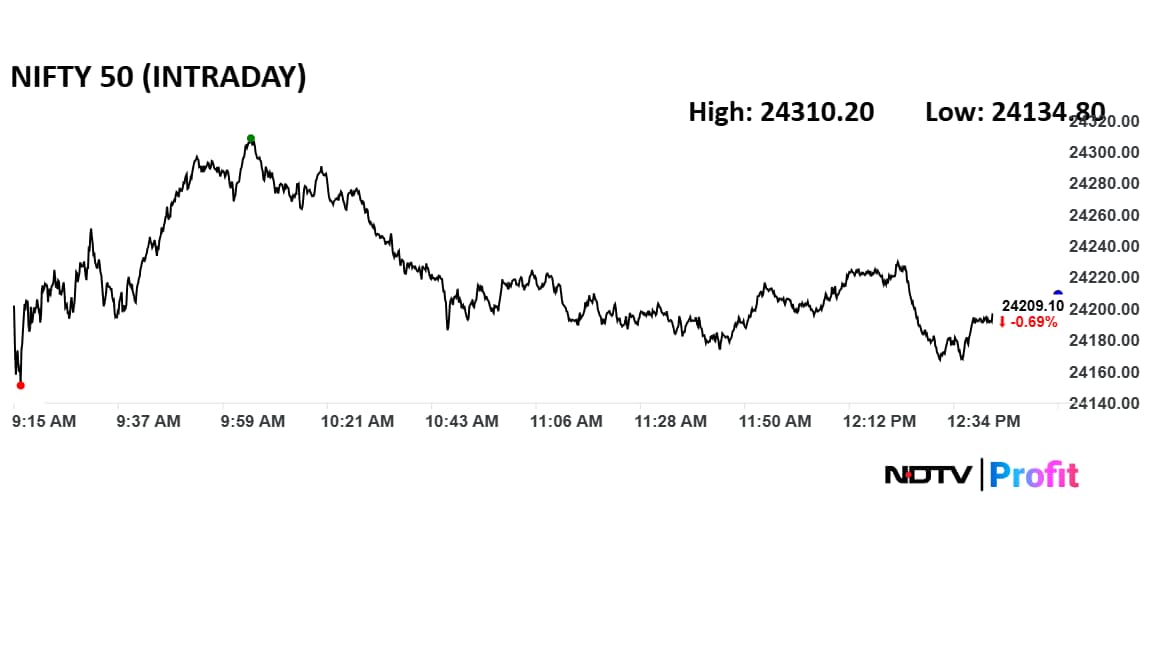
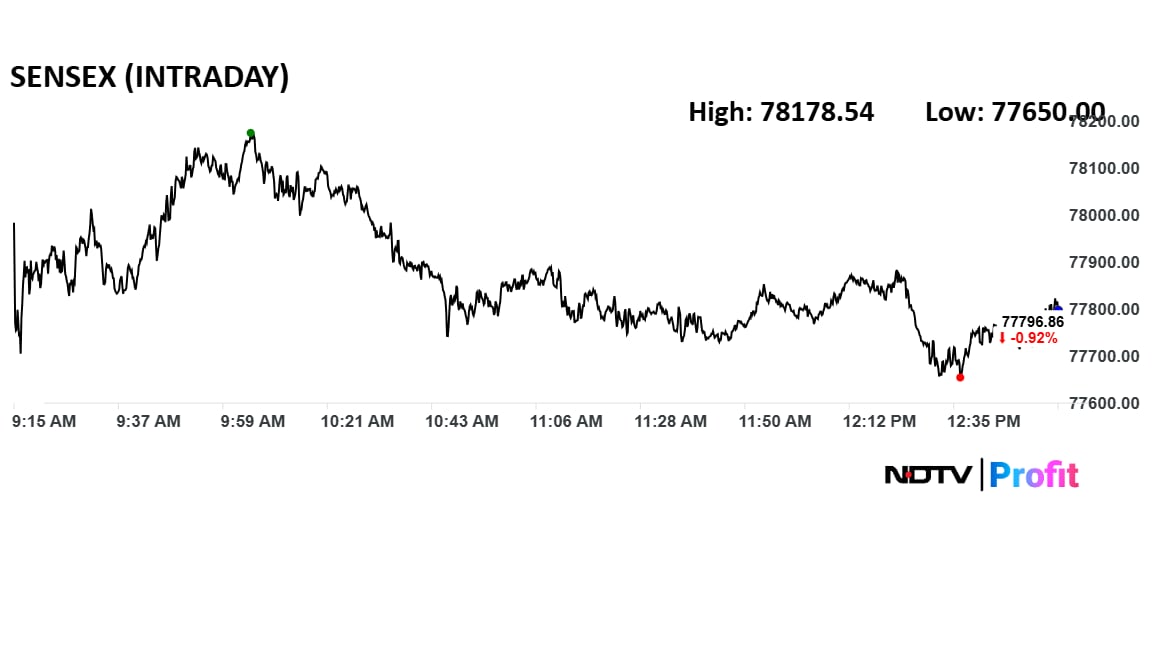
Indian markets are under pressure in Thursday's session as escalating tensions in the Middle East, FII selling,a nd rising crude prices have triggered a broad risk‑off move again. At 1 pm, the Nifty slid more than 170 points (down 0.70%) to around 24,209 while the Sensex dropped over 700 points (down 0.93%) to nearly 78,732.
Add image caption here
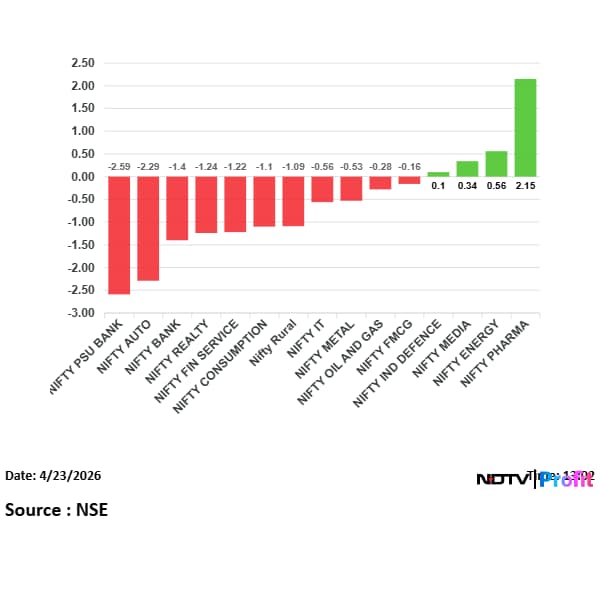
All sectors are trading in the red, with Nifty PSU Bank falling the most by over 2.5%, followed by Auto and Bank.
Also Read | Layoffs Are Rising In Tech, But These Skills Are Helping People Unlock Better Pay
The broader market is facing pressure too, with the Nifty Smallcap 250 falling almost 0.16%, and the Nifty Midcap 150 dropping about 0.26%.
Here are three key reasons dragging the markets on Thursday.
Middle East Tensions
Iran said it would not allow the Strait of Hormuz to reopen as long as a US naval blockade remains in force, despite the extension of a ceasefire, and announced that it had detained two vessels attempting to transit the strategic shipping corridor.
President Masoud Pezeshkian said Iran remains open to dialogue and agreements, but argued that blockades, threats and broken commitments continue to undermine the possibility of meaningful negotiations. He accused the international community of maintaining a gap between rhetoric and action, describing what he called persistent contradictions in global responses.
Separately, energy and shipping analytics firm Vortexa reported a surge in tanker activity linked to Iran and sanctioned entities following the US move. According to the firm, 34 sanctioned or Iranian‑connected tankers were tracked entering or exiting the Persian Gulf in the week after Washington imposed the blockade on April 13.
Get the latest updates on the US-Iran conflict here.
Crude Prices
Oil prices extended gains for a fourth straight session as tensions between the US and Iran intensified, with no breakthrough in peace negotiations and continued disruption in the Strait of Hormuz. Brent crude hovered near $106 a barrel, while US West Texas Intermediate (WTI) traded around $97, reflecting sustained supply concerns.
The ongoing standoff has severely disrupted flows through Hormuz — a key artery for global energy trade. The US has maintained a naval blockade on ships linked to Iran, aiming to increase pressure on Tehran. Iran, however, has kept the strait largely shut to international traffic and escalated tensions, with reports of gunboats firing on commercial vessels. The near-closure has sharply reduced exports from major producers in the Persian Gulf, amplifying supply fears.
ALSO READ: Brent Crude Climbs Above $105 As US-Iran Peace Talks Stall, Hormuz Tensions Escalate
Weak Global Cues
Asian equities weakened as rising oil prices weighed on growth expectations across the region. The MSCI Asia Pacific index slipped around 0.5%, with losses led by Japan, Australia and Hong Kong. Japan's Topix declined close to 0.8%, while Australia's S&P/ASX 200 fell about 0.7%. Hong Kong's Hang Seng slid nearly 0.9%, and mainland China's Shanghai Composite eased 0.3%. The broader MSCI Emerging Markets index was down roughly 0.3%.
US equity futures also moved lower, giving back some momentum after Wall Street closed at record highs in the previous session. Futures tied to the S&P 500 and the Nasdaq 100 were both down about 0.5% in early London trading, as investors reassessed risk following the recent rally driven by strong corporate earnings and optimism around the extended US‑Iran ceasefire.
In derivatives markets, foreign institutional investors continued to hold net short positions in index futures, while client positioning remained mixed, suggesting divergent near‑term views. Traders are closely monitoring institutional flows ahead of the weekly expiry, looking for cues on market direction.
Get the latest updates on the stock market here.
Essential Business Intelligence, Sharp Market Insights, Practical Personal Finance Advice, Daily Fuel, Gold and Silver Prices and Latest Stories — On NDTV Profit.