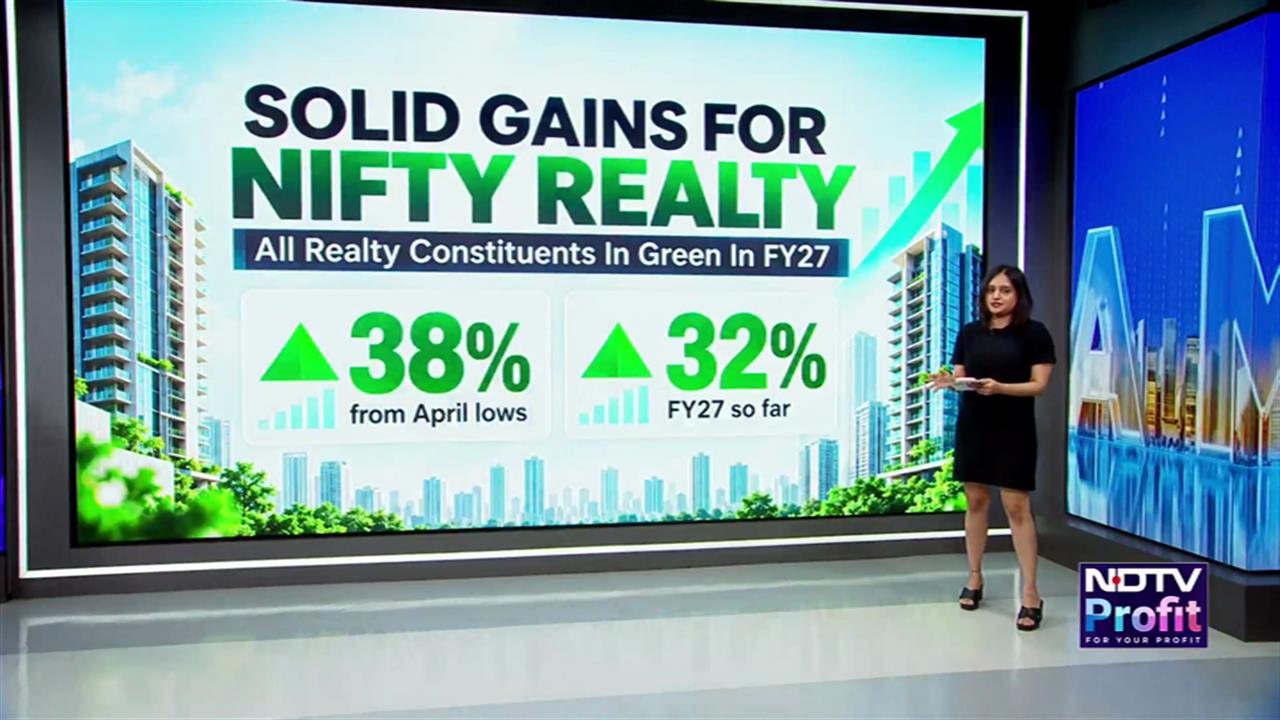
Realty stocks have extended their strong run in FY27, with the Nifty Realty index gaining around 27% from its April lows and nearly 30% so far in the financial year. All constituents of the Nifty Realty index are trading in positive territory in FY27 so far.
Lodha Developers shares have emerged as the top performer among Nifty Realty constituents, gaining around 70% in FY27. Anant Raj has advanced 38%, followed by DLF shares at 34%, The Phoenix Mills at 30% and Prestige Estates Projects at 29%.
What Is Driving The Realty Rally?
The rally in real estate stocks has been supported by a recovery in housing demand, with both sales value and volumes showing growth in calendar year 2026 so far.
Also Read | Layoffs Are Rising In Tech, But These Skills Are Helping People Unlock Better Pay
Across key residential markets, sales value has increased around 10% YTD CY26, while sales volumes have risen about 5%. The stronger growth in sales value compared with volumes suggests that higher ticket sizes and premiumisation, rather than volume growth alone, are playing a significant role in the sector's performance.
Demand momentum has remained particularly strong across major urban markets. Housing sales volumes have increased around 11% in the Mumbai Metropolitan Region (MMR), 14% in Bengaluru and 11% in Hyderabad during the period.
ALSO READ: Domestic Economy Resilient, Global Headwinds Main Concern For Indian Equities, Says Sanjay Parekh
Mumbai Realty: Demand Strong, But Supply Is Rising
The MMR continues to see robust housing demand. Housing sales value in the region has increased 16% YTD CY26, while sales volumes have risen 11%.
However, supply is also expanding rapidly. Launch value in MMR has jumped around 30% during the same period.
The divergence between demand and supply will therefore remain an important factor for investors to monitor. While strong demand provides support to developers, a sustained increase in launches could eventually put pressure on inventory absorption if sales do not keep pace.
Realty Inventory Remains Comfortable, But Uneven
Inventory levels across India's major residential markets remain manageable, although there are significant differences between markets.
| Market | Inventory (Months) |
| Pune | 14 |
| Bengaluru | 18 |
| NCR | 18 |
| Chennai | 20 |
| Kolkata | 21 |
| MMR | 22 |
| Hyderabad | 30 |
| Top 7 Markets | 21 |
Pune has the lowest inventory at around 14 months, while Hyderabad has the highest at 30 months. MMR, despite strong demand, has inventory of around 22 months.
This makes inventory absorption and the pace of new launches key indicators for the sector going forward.
ALSO READ: IT Stocks In Red: TCS, Wipro, Infosys, HCLTech Share Price Falls Up To 2%
Premiumisation: How Far Can It Go?
One of the biggest drivers of sales value growth has been the increase in average ticket sizes. However, the sharp rise in ticket sizes is also raising questions around affordability.
In August 2026, average ticket size increased 23% year-on-year (YoY) in MMR, while Pune recorded a 20% increase. Hyderabad and NCR saw ticket sizes rise around 16–17%, while Bengaluru reported growth of around 10–11%.
The data indicates that developers are increasingly benefiting from premium housing demand. However, for the current momentum to remain sustainable, higher ticket sizes will eventually need to be supported by continued volume growth.
What Lies Ahead For Realty Stocks?
For investors tracking the real estate sector, the next phase of the rally could depend on whether the underlying housing demand remains broad-based. A key question will be whether ticket sizes can continue to rise while housing volumes also accelerate. This will determine whether growth is being driven by genuine expansion in demand or primarily by premiumisation.
Investors will also need to track the absorption of completed inventory, particularly in markets where stock levels are relatively elevated. At the same time, the pace of new launches will be crucial, as aggressive supply growth could alter the demand-supply balance.
Interest-rate movements will remain another important factor. Any change in borrowing costs can influence housing affordability, mortgage demand and buyers' willingness to commit to higher-value properties.
With realty stocks having already delivered strong gains in FY27, the key question for the sector is shifting from whether demand is recovering to whether the current pace of value growth, premiumisation and inventory absorption can be sustained.
ALSO READ: Catch Stock Market Live Updates Here
Essential Business Intelligence, Sharp Market Insights, Practical Personal Finance Advice, Daily Fuel, Gold and Silver Prices and Latest Stories — On NDTV Profit.