RBL Bank, Manappuram Finance, Sammaan Capital and Paisalo Digital were among the small-cap companies that witnessed an increase in promoter shareholding during the first quarter of fiscal 2027, according to a report by JM Financial.
Promoter ownership increased in four large-cap companies, one mid-cap company and 14 small-cap companies in the quarter ended June 2026, the brokerage said. JM Financial considered companies with a market capitalisation of more than Rs 4,500 crore and included those that recorded a change of more than 0.5% in promoter shareholding during the quarter.
Small-Cap Stocks With Increase In Promoter Holding
Among mid-cap companies, GMR Airports was the only stock to see an increase in promoter holding during the June quarter. Promoter ownership in the company rose by 0.83 percentage points (pp) to 67.16%.
Also Read | Layoffs Are Rising In Tech, But These Skills Are Helping People Unlock Better Pay
In the small-cap segment, RBL Bank recorded the sharpest increase in promoter holding, with ownership rising 60% during the quarter, primarily on account of a preferential issue. Manappuram Finance saw a 9.9% increase in promoter holding, also driven by a preferential issue.
Other prominent small-cap companies that recorded an increase of more than 0.5% in promoter holding in Q1FY27 included Sammaan Capital (28.3 percentage points), Gabriel India (8.5 pp), iDream Film Infrastructure Company (13.7 pp), Garware Technical Fibres (0.9 pp), SG Mart (21.6 pp), Hindustan Foods (0.5 pp), Neogen Chemicals (1.8 pp), Stylam Industries (2.8 pp), Paisalo Digital (5 pp), Thomas Cook (0.9 pp), IOL Chemicals & Pharmaceuticals (4.8 pp) and SG Finserve (3.9 pp), JM Financial report showed.
ALSO READ: Axis Securities Top Picks: Bharti Airtel Tops List Of 15 Stocks To Buy — Check Full List
On the other hand, promoter ownership declined in seven large-cap, 12 mid-cap and 34 small-cap companies during the quarter.
Among small-cap stocks, notable declines of more than 0.5% in promoter holding were seen in PhysicsWallah, where promoter ownership fell 1%; ACME Solar Holdings, which saw an 11.8% decline following a QIP in June 2026; Bandhan Bank, where promoter holding declined 1.4%; and DOMS Industries, which recorded a 7% decline.
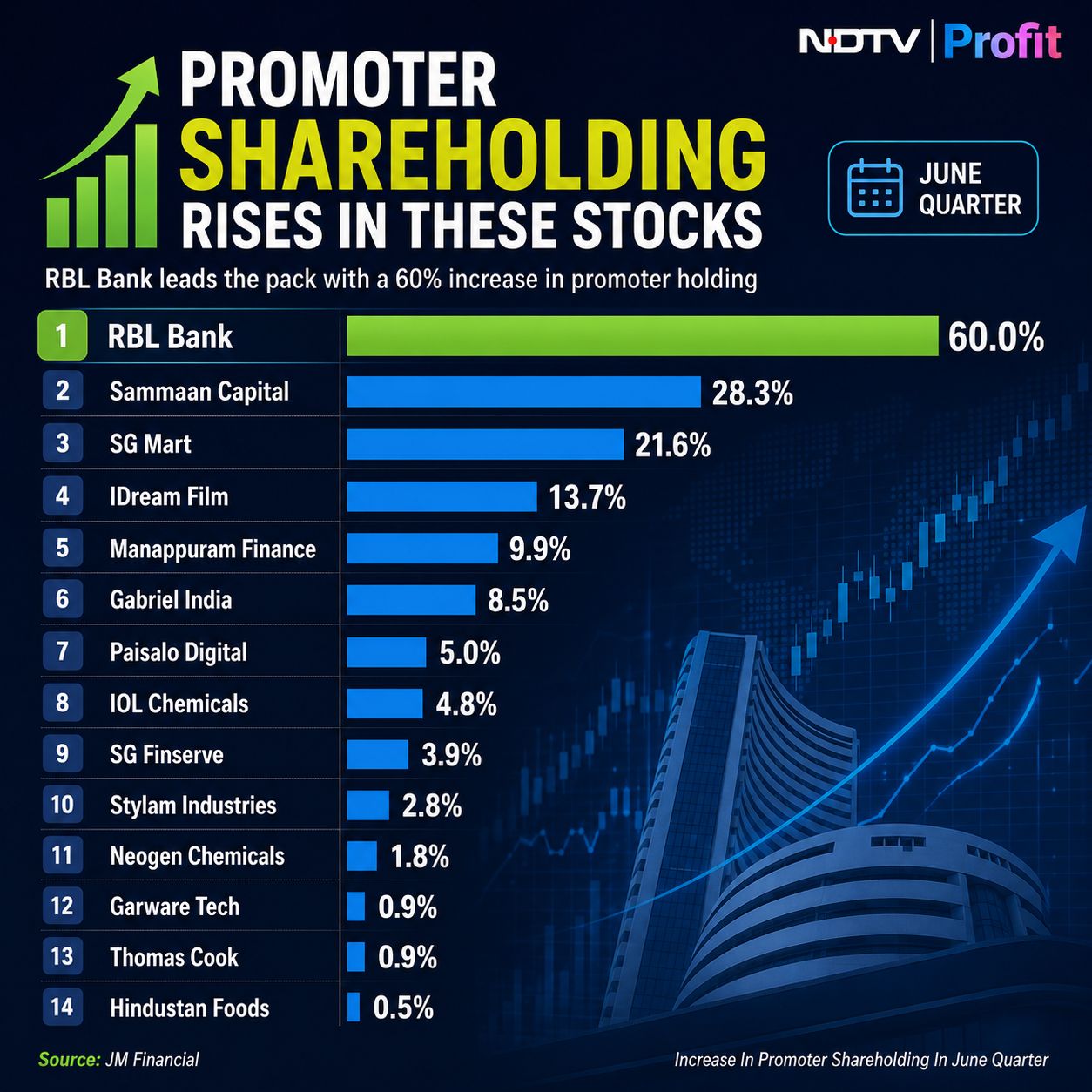
Rise In Promoter Shareholding
Photo Credit: NDTV Profit/AI Generated
Promoter Ownership Has Gradually Declined
Promoter ownership of Indian equities has steadily moderated over the past 12 years, falling to 50.3% in June 2026 from 53.4% in June 2014, JM Financial said.
The gradual decline has coincided with sustained activity through offers for sale (OFS), qualified institutional placements (QIPs) and bulk and block deals.
DII Ownership Nearly Doubles In 12 Years
The ownership structure of the Indian equity market has also undergone a significant shift, with domestic institutional investors increasing their share while foreign institutional ownership has declined.
Domestic institutional investor (DII) ownership has nearly doubled over the past 12 years, rising to 18.9% in June 2026 from 10% in June 2014. In contrast, foreign institutional investor (FII) ownership declined to 14.2% from 19% during the same period.
“The crossover highlights a structural shift in market ownership towards domestic pools of capital, aided by rising household financialisation, sustained SIP inflows and deeper institutional participation,” JM Financial said.
The brokerage attributed the moderation in FII ownership to elevated Indian valuations and global market uncertainty.
ALSO READ: Auto Stocks In Red: Hero Motocorp, Eicher Motors, M&M, Bajaj Auto, Others Fall Up To 6%
Shift Towards Capital Goods, Healthcare
Over the past decade, DII allocations have steadily increased towards banking, financial services and insurance (BFSI), capital goods and pharmaceuticals, while exposure to oil and gas and IT services has moderated.
“The trend reflects rising domestic institutional preference towards financialisation, manufacturing and healthcare-linked themes,” the brokerage said.
FIIs, meanwhile, have materially reduced their exposure to IT services and oil and gas from historical peaks, while increasing allocations towards capital goods, pharmaceuticals and automobiles in recent years. This points to a gradual shift in foreign investor positioning towards domestic cyclical and manufacturing-oriented sectors.
IT services has seen a notable decline in institutional allocations. FII exposure to the sector fell sharply to 4.9% in June 2026 from 13.9% in June 2014. DII exposure, meanwhile, moderated to 7% in June 2026 from a peak of 11.9% in FY21.
At the same time, both DIIs and FIIs have steadily increased their exposure to capital goods and pharmaceuticals, reflecting stronger institutional preference for domestic capex and healthcare-led growth themes.
ALSO READ: Catch Stock Market Live Updates Here
Essential Business Intelligence, Sharp Market Insights, Practical Personal Finance Advice, Daily Fuel, Gold and Silver Prices and Latest Stories — On NDTV Profit.