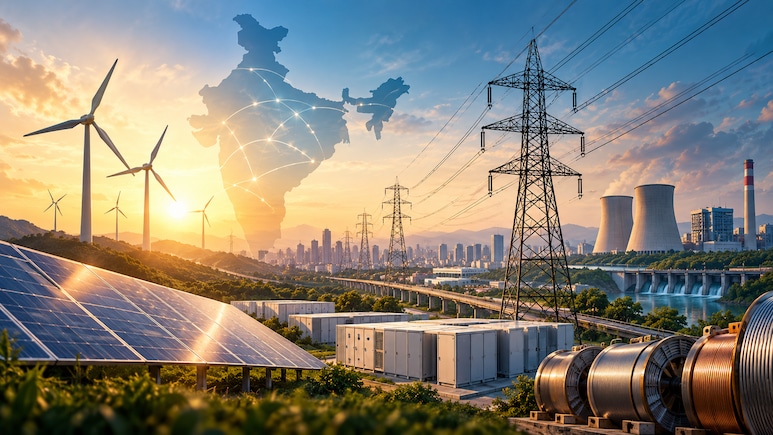
India is in midst of what could be the largest energy investment cycle in its history. Unlike previous phases that were largely centered on adding power generation capacity, the current cycle is far broader and deeper, creating unprecedented expansion of the power ecosystem. It is being driven simultaneously by three structural forces: rising electricity demand, the transition towards cleaner energy, and the urgent need to build the transmission and distribution (T&D) backbone required to support this transformation.
At Bharat Electricity Summit 2026, the Ministry of Power estimated investment roadmap of Rs 200 lakh crore (around US$ 2 tn) for India's power sector over the next two decades. These projections could be aspirational and quite long dated, lacking enough visibility but several industry studies estimate that the cumulative opportunity could exceed Rs 30-40 lakh crore over the next decade to be invested across power generation, transmission, renewable energy, storage, grid modernization and associated infrastructure. This would be double the investment witnessed during the previous decade and has the potential to reshape India's industrial landscape.
At the heart of this opportunity is demand. India's electricity consumption continues to grow at one of the fastest rates globally, supported by urbanization, industrialization, electrification of transport, data centers and digital infrastructure. Central Electricity Authority's (CEA) Long Term National Resource Adequacy Plan envisages around 450 GW of peak power demand by 2035-36 as against 270 GW record peak touched in May this year. Simultaneously, India has set ambitious targets for renewable energy and non-fossil fuel capacity additions with aim of reaching 500 GW by 2030 and 900 GW by 2036, compared to 310 GW at FY26 end (Source: Niti Aayog), entailing Rs 10-12 lakh crore of investments.
ALSO READ: Morgan Stanley's Top India Stock Picks: ICICI Bank, L&T, Adani Power And More
The investment story, therefore, extends well beyond solar modules and wind turbines. Every megawatt of renewable energy requires evacuation infrastructure, substations, transformers, transmission lines and storage solutions before power can reach consumers. National Electricity Plan estimated transmission investments alone could exceed Rs 9 lakh crore by the early 2030s as India builds corridors to connect renewable-rich states with consumption centers.
This creates opportunities across the entire value chain seeding new demand pools. Power generation companies are entering a new growth phase as India simultaneously adds modern renewable capacity along with conventional thermal based capacity to ensure system reliability. Utilities focused on T&D stand to benefit from regulatory support, network expansion, smart grids and smart-meter investments to improve energy efficiency. Equipment manufacturers supplying transformers, switchgear, cables, conductors and grid technologies are already witnessing strong order inflows and expanding capacity to meet demand.
Energy storage is being recognized as essential and complimentary to the renewable capacity addition. Battery Energy Storage Systems (BESS) are becoming critical for managing renewable intermittency and maintaining grid stability.
ALSO READ: Bull Run Coming? Morgan Stanley Sees Sensex At 89,000, 16% Upside By June 2027
Emerging segments offer additional layers of growth. Green hydrogen is attracting significant policy support as India seeks to become a global producer of low-carbon fuels. India's Green Hydrogen Mission aims to reach 5 million metric tonnes of annual green hydrogen to be supported by 125 GW of dedicated renewable energy at Rs 8 lakh crore of investments. Nuclear energy is witnessing a policy revival, opening a potential multi-decade investment opportunity in reactors, engineering, construction and heavy equipment manufacturing. Aiming to increase India's nuclear generation capacity from 9 GW at present to 100 GW by 2047, The Sustainable Harnessing and Advancement of Nuclear Energy for Transforming India (SHANTI) Act offers a long-cycle capex opportunity of Rs 20 tn by 2047.
For investors, the real opportunity may not lie in a single sector. The winners of this cycle are likely to emerge across the broader ecosystem, including utilities, power financiers, transmission companies, electrical equipment manufacturers, cable and conductor suppliers, automation providers, battery manufacturers and engineering firms.
The defining feature of this capex cycle is that it is not merely about producing more electricity. India is effectively rebuilding its entire electricity architecture for a cleaner, more electrified and digitally connected economy. As this investment wave gathers momentum, it could create a new generation of corporate winners and become one of the most powerful long-term structural themes in Indian equities over the coming decade.
ALSO READ: FCNR Deposits Beat Estimates, RBI To Pull Out Rs 6-7 Lakh Crore: Pranjul Bhandari
About the Author: Mandar Pawar is a Fund Manager at Kotak Mutual Fund
Essential Business Intelligence, Sharp Market Insights, Practical Personal Finance Advice, Daily Fuel, Gold and Silver Prices and Latest Stories — On NDTV Profit.