(Bloomberg) -- Tencent Holdings Ltd. led an $80 billion selloff in some of China's biggest online names, after the surprise imposition of new gaming curbs revived fears Beijing may again be targeting the country's giant internet sector.
The top gaming regulator on Friday published draft rules broadly designed to clamp down on practices that encourage players to spend more money and time online. They encompassed caps on the amount each player can spend within a game, a ban on rewards for frequent log-ins and forced player-duels, even a prohibition on content that violates national security.
The sweeping restrictions, which caught industry players and investors off guard on the final trading day before Christmas, reminded many of the brutal tech-sector crackdown of 2021. That year, various agencies abruptly imposed curbs on sectors from e-commerce to entertainment, reining in Jack Ma-backed Ant Group Co. and Alibaba Group Holding Ltd. while decimating the online education industry by declaring profits illegal.
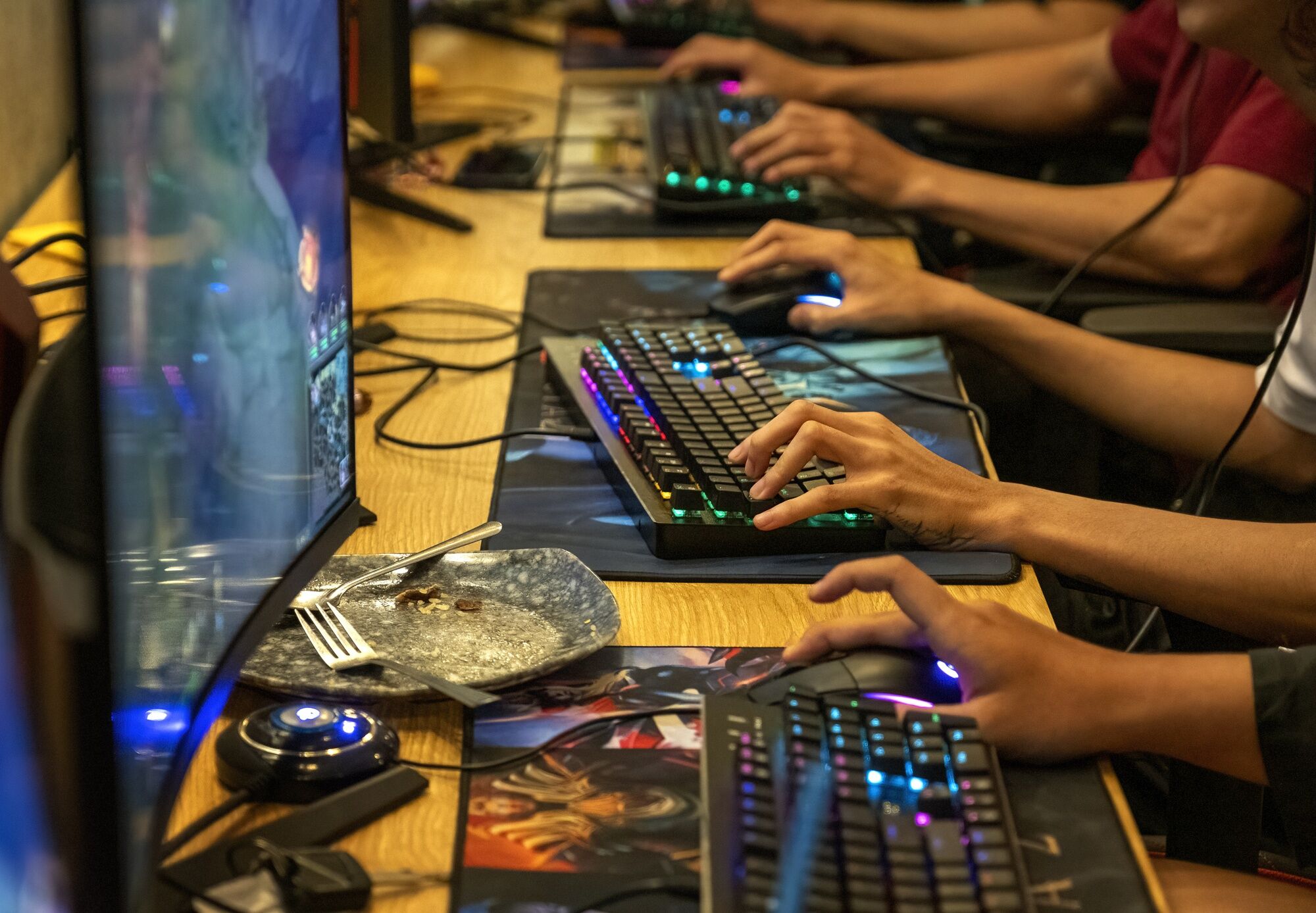
As with two years ago, Friday's regulations emerged with little warning and were at once so vague and all-encompassing that investors couldn't decipher the intent or potential fallout. Outraged and confused posts dominated a WeChat group of hundreds of developers and designers, many complaining in particular about the unspecified cap on player spending. Chinese games are known for shrewd designs and promos that encourage players to spend on decorating and burnishing their avatars — the main source of income for Tencent and its rivals.
Asia Gaming Stocks Sink on Surprise New China Curbs: Street Wrap
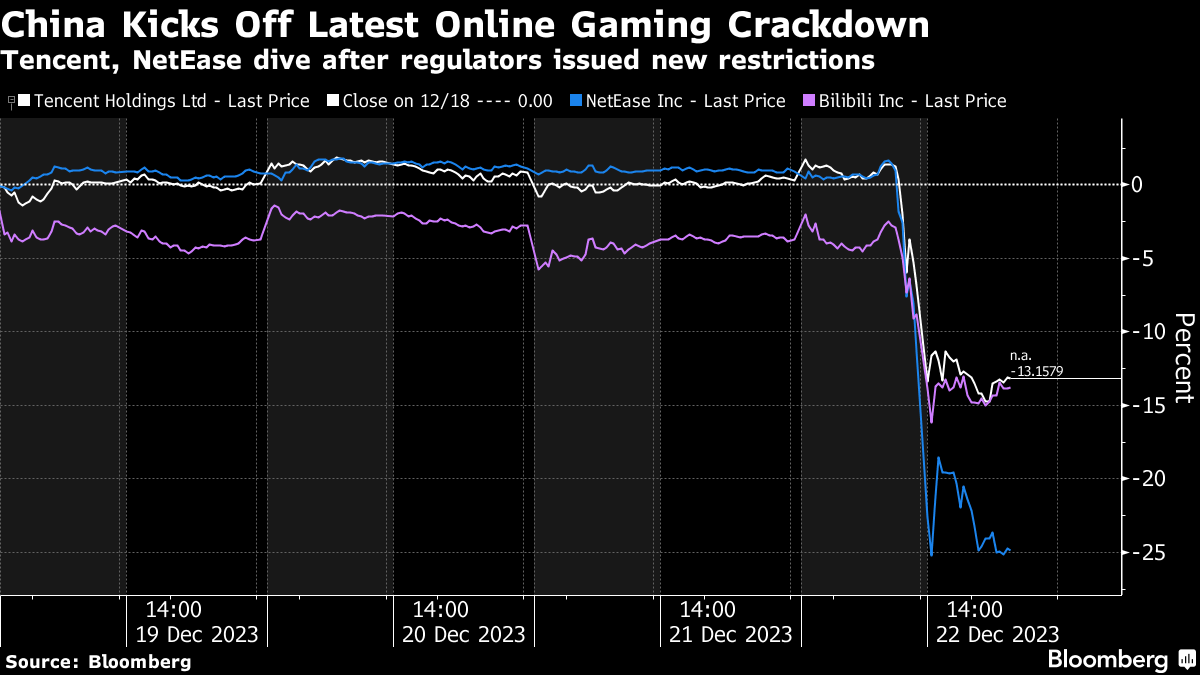
Tencent slid as much as 16% — its biggest intraday fall since 2008 — while smaller rival NetEase Inc. dived a record 28%. Bilibili Inc., a social media service popular with gamers, fell 14%. Combined, the three stocks lost as much as $80 billion in market value on Friday.
“The government gaming curb measures will hurt gaming companies' earnings,” said Yang Junxuan, a fund manager at Shanghai Junniu Private Fund Management Co. “But the more important concern is people are worrying that more measures targeting the sector will come, just like what Beijing did to the education sector in the past.”
The Communist Party since 2020 has waged a campaign against a private sector it regarded as amassing too much power and expanding recklessly, threatening its control of the world's No. 2 economy.
“It caught people off guard, right before the holiday and hitting sentiment hard. It feels disheartening as well for this to happen after a year that is already so difficult for market,” said Willer Chen, senior analyst at Forsyth Barr Asia Ltd.
The crackdown on gaming actually pre-dated that movement, with the first suspensions of game approvals starting around 2018.
Xi Jinping's administration has long sought to combat gaming addiction, blaming online entertainment for the rise of myopia among youths. Chinese users spend more time online on average than in many other markets, fueling the rise of services like Douyin and WeChat. Critics have also linked that to various ills from unemployment to low birth rates. At the height of the tech-sector crackdown, the government froze approvals for new titles and launched several investigations into content, forcing developers including Tencent to modify certain games.
On a separate WeChat feed, Tencent investors and employees called out the rules as irrational and out of touch. Cai Wensheng, a prominent Chinese venture capital investor who co-founded the photo touch-up app Meitu, said on WeChat: “A policy kills an industry.” He later deleted the post. Adding to the confusion, the same gaming regulator on Friday approved 40 new online gaming titles for distribution in China, earlier than anticipated.
Even if Beijing's focus remains squarely on gaming, the regulations could signal a sea change in the traditional “freemium” model, where users download titles free of charge but spend vast amounts within games to either gain an advantage or establish virtual identities. That approach has come under scrutiny in countries like Japan because of its addictive nature and tendency to incite younger players to spend.
“The impact in China will eventually be bigger than the market is pricing in and we believe that results could force other countries to similarly take measures against mobile gaming/social media addiction within a few years,” Lightstream Research analyst Mio Kato wrote. “This is the beginning of the end for the current mobile gaming business model.”
The latest rules stung all the more because Beijing had appeared to thaw on the sector.
Officials in past months had encouraged esports as an engine for the post-Covid economy. Xi himself attended the opening ceremony of the 19th Asian Games in Hangzhou, which featured professional gaming among the medals up for grabs for the first time.
In December 2022, Tencent secured a green-light for a clutch of major releases including and a milestone that reinforced hopes China was easing its two-year crackdown on Big Tech. The WeChat operator is now locked in a fierce battle with NetEase as it rolls out casual title in hopes of replenishing an aging gaming portfolio. Both companies have poured advertising and other promotional costs into the so-called party royale genre, at a level unseen in recent years.
China's gaming market was set to grow almost 14% to 302.9 billion yuan ($42.4 billion) in 2023, reversing a 10% decline from the year before, according to data provider CNG.
“This makes investors remember the nightmare from a few years ago, when the government tried to regulate mobile games' playing time,” said Steven Leung, an executive director at UOB Kay Hian. “With these new rules, investors may just leave the market totally, because the policy risk is too high.”
Smackdown: The Bloomberg Open, Europe Edition
Much of the issue stemmed from the vague wording. The regulations asked that game publishers operating abroad respect Chinese laws and culture and refrain from endangering national security, without elaborating. Tencent is the world's largest gaming publisher, with investments in studios from Epic Games Inc. in the US to Supercell in Europe.
The agency will take feedback on the proposed rules for a month, without saying when they take effect. Some investors held out hope that regulators may eventually be convinced to backtrack on the more unpopular measures.
“Strict regulation will inevitably hinder the long-term development of the online gaming industry, raising doubts about whether the government is contemplating a new round of regulatory direction,” said Mike Leung, investment manager at Wocom Securities Ltd.
Read More: China Hosts Biggest Esports Moment With Tencent at the Wheel
--With assistance from Charlotte Yang, Ishika Mookerjee, Abhishek Vishnoi, Winnie Hsu and Lulu Yilun Chen.
More stories like this are available on bloomberg.com
©2023 Bloomberg L.P.
Essential Business Intelligence, Sharp Market Insights, Practical Personal Finance Advice, Daily Fuel, Gold and Silver Prices and Latest Stories — On NDTV Profit.