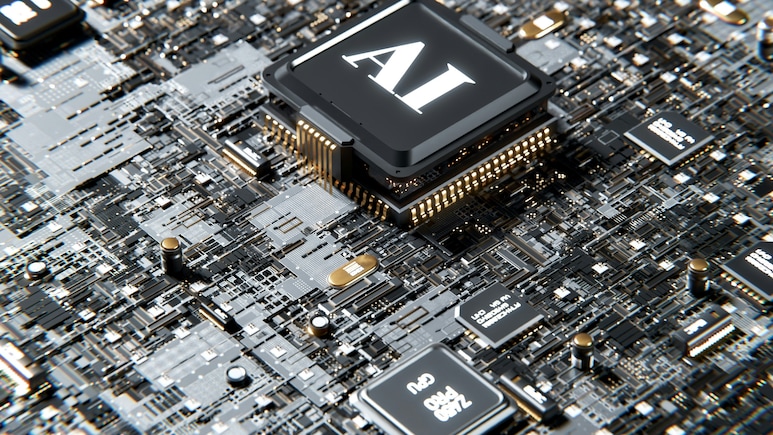
- AI investment in the US is driving one of the largest capital spending cycles in history
- Annual AI capex is projected at 3.6% of US GDP from 2025 to 2032, surpassing past booms
- Concerns exist about sustaining AI capex amid current borrowing costs and revenue doubts
The significant surge in AI investment has boosted strong growth, especially in the US despite huge borrowings by hyperscalers and tech firms put pressure on long term bond yields. The expenditure marks one of the largest capital spending cycles in history, with average annual AI capex is estimated at around 3.6% of US GDP over 2025–32, more than the 1.1% during the 2000 dotcom cycle and 2.2% during the 19th-century railroad boom, according to a report by SBI Funds Management.
With the soaring expenditure, doubts over AI revenues could raise questions over sustainibility of capex at current financing costs. Its impact would also be felt in related sectors such as US equities and in the economy's US growth, along withhow money is allocated across asset classes. One reaction could be a move out of US equities, where valuations already look stretched. Recent worries around sustainability of the AI boom have led to a repricing in US treasury yields and some rotation of FPI flows back into India.
Any doubts over the sustainability of AI revenues could raise questions about whether companies can continue to fund capital expenditure at current borrowing costs. The effect could go beyond the technology sector, affecting US equities, economic growth and the allocation of capital across asset classes. Investors may increasingly shift away from US equities, where valuations remain stretched. Concerns over the sustainability of the AI boom have already driven a repricing of US Treasury yields and prompted some foreign portfolio investors (FPIs) to redirect flows towards India, the SBI Funds noted.
Also Read | Layoffs Are Rising In Tech, But These Skills Are Helping People Unlock Better Pay
READ | What Happens To Gold If The AI Boom Cools? Jefferies Has An Answer
The asset management company's remarks come following a global AI stock rout in early November across Wall Street and Asian tech hubs, driven by Democratic sweep of both chambers of Congress raised investor fears of tighter regulations, potential moratoriums, and scrutiny over US data-centre expansion and energy demand.
Amid the AI-linked selloff, Indian indices inched higher, while large caps performing better than mid and small caps. The Nifty and the Sensex gained about 1.9% and 2.7% respectively for the month, making India one of the few major markets to advance. MSCI EM fell 6.6%, while the AI-linked markets of Korea and Taiwan, which had led gains earlier in the year, dropped 16.2% and 5.7%.
READ | From High-flying AI Stocks To Tariff-hit Alcohol Companies, US Midterms Shook Up Wall Street
How dotcom bubble is different from AI boom?
In July, NYU Stern School of Business professor and valuation expert Aswath Damodaran in Excess Returns podcast argued that the dotcom boom was largely driven by software businesses and equity capital. Companies launched websites, online services and digital platforms with relatively limited investment in physical infrastructure. When the bubble burst, technology stocks collapsed and investors suffered steep losses, but the damage remained largely confined to shareholders.
"The dot-com boom and bust had no huge capital expenditure in that cycle," Damodaran said. "When the bust came, shareholders lost 60%, 70%, 80% or 90% of their money. The loss was restricted to the shareholders."
However, the AI boom is built on a different foundation. Training and deploying advanced AI models requires huge investments in graphics processors, data centres, energy infrastructure and cloud computing networks. He called it the biggest infrastructure buildout witnessed in business history, comparing it to the rise of the automobile industry a century ago.
He also expressed concerns over the spending is being met. According to Damodaran, a significant portion of AI-related infrastructure investment is being funded through debt rather than equity. Much of this borrowing is coming from private credit markets rather than traditional banks. If AI revenues fail to justify the scale of today's investments, companies could face financial distress and defaults.
"The problem with the AI capex boom is that not only is it immense, but a big chunk of it is funded with debt," he said.
That distinction matters because debt problems rarely stay confined to investors. Defaults can affect lenders, private credit funds and broader financial markets, creating ripple effects across the economy.
Essential Business Intelligence, Sharp Market Insights, Practical Personal Finance Advice, Daily Fuel, Gold and Silver Prices and Latest Stories — On NDTV Profit.