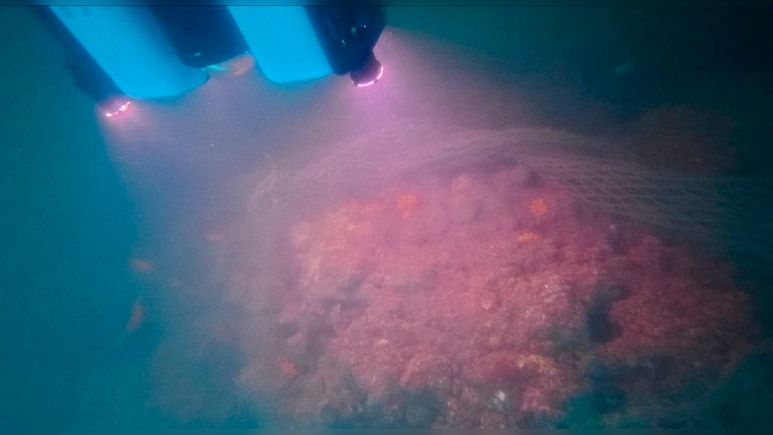
Archaeologists exploring the seabed off Tamil Nadu's Poompuhar have recovered pottery believed to have originated in West Asia, including fragments of a distinctive torpedo jar, offering new evidence of the ancient port's links with long-distance maritime trade.
The finds were recovered from 10 to 12 metres of water, about 1.8 km to 2.2 km off the shoreline, during the third phase of an underwater exploration of Kaveripoompattinam, the historic Chola-era port that is now partly submerged in the Bay of Bengal, The Indian Express reported.
West Asian pottery found off Poompuhar
The torpedo jar is a distinctive vessel associated with long-distance trade across the Indian Ocean. The archaeological team also recovered local and foreign potsherds, fragments of ring wells measuring around 60 to 65 cm in diameter and structural formations on the seabed.
Also Read | Layoffs Are Rising In Tech, But These Skills Are Helping People Unlock Better Pay
K Rajan, academic advisor to the Tamil Nadu State Department of Archaeology, told The Indian Express that the ceramics indicate that people living at the port “indulged in transoceanic trade”.
ALSO READ: 'Joyous Moment For Every Indian': PM Modi As Netherlands Returns Chola-era Copper Plates — Video
The underwater work is part of a state project to map the ancient port and its installations, search for possible shipwrecks and study changes in sea levels and the course of the Cauvery.
The State Department of Archaeology is carrying out the exploration with the Indian Maritime University. The department said only around 10% of the overall exploration has been completed.
Dating of torpedo jar fragments still pending
Images of the finds have been sent to international experts, including specialists in Italy, for further examination. The material broadly belongs to the Early Historic period and the centuries that followed, but the torpedo-jar fragments have not yet been assigned a firm date.
Such jars were used over several centuries, making the archaeological context important for determining when the fragments reached Poompuhar. An earlier excavation of the Poompuhar wharf produced a radiocarbon date of 316 ± 103 BCE.
Poompuhar part of wider trade network
The discoveries add to evidence of India's early maritime links with the Mediterranean and West Asia found at other coastal sites.
Pattanam in Kerala, which has been proposed as the ancient port of Muziris although the identification remains debated, has yielded Roman amphorae and West Asian ceramics, including torpedo jars and Sasanian-era glazed wares.
Archaeological excavations at Alagankulam in Ramanathapuram district have also uncovered hundreds of potsherds linked to Mediterranean trade, while Arikamedu near Puducherry has provided important evidence of India's early contacts with the Mediterranean world.
Archaeology adds to Poompuhar's literary history
The underwater finds also provide material evidence for descriptions of Poompuhar in ancient Tamil literature.
Rajan said texts including Pattinappalai, Manimekalai and Silappathikaram refer to Yavanas, a term initially used for Greeks and later applied more broadly to people from the Hellenistic and Roman Mediterranean and other western regions.
Pattinappalai describes a city where people from different regions and linguistic backgrounds lived, while later traditions refer to a Yavana settlement near the waterfront.
The latest exploration could help archaeologists determine how far the ancient settlement extended and how much of Poompuhar's inhabited landscape now lies beneath the sea.
ALSO READ: Spain's Buried 2,000-Year-Old Gold Mine Reveals Romans' Water Mining: Report
Essential Business Intelligence, Sharp Market Insights, Practical Personal Finance Advice, Daily Fuel, Gold and Silver Prices and Latest Stories — On NDTV Profit.