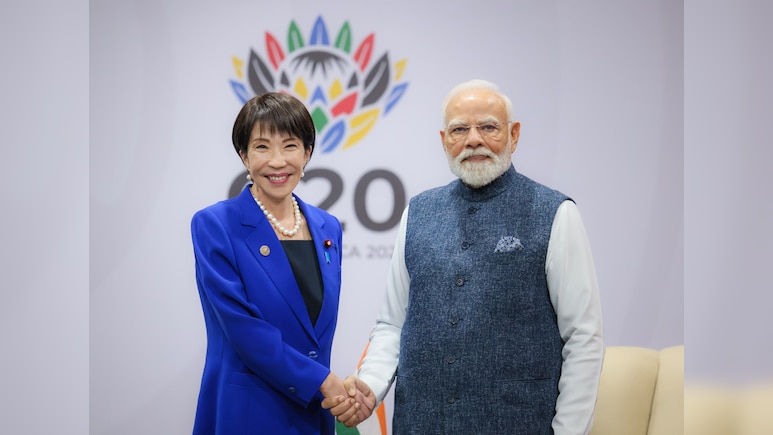
Japanese Prime Minister Sanae Takaichi arrived in New Delhi on Wednesday for her first visit to India as premier, kicking off the 16th India-Japan Annual Summit.
The two countries are set to unveil a Joint Declaration on Economic Security Cooperation, a statement on artificial intelligence and a landmark framework for direct yen-rupee trade settlement, even as Tokyo's deteriorating ties with Beijing cast a shadow over the talks.
インドの首都・デリーに到着しました。
日本の総理として約3年ぶり、私個人としては初めてのインド訪問になります。… pic.twitter.com/F8PKt61SLnAlso Read | Layoffs Are Rising In Tech, But These Skills Are Helping People Unlock Better Pay
— 高市早苗 (@takaichi_sanae) July 1, 2026
AI Cooperation Gets A Dedicated Roadmap
PM Modi and Takaichi are likely to adopt a plan advancing the Japan-India Artificial Intelligence Cooperation Initiative, focusing on joint development of vertical AI solutions for sectors such as manufacturing, healthcare and mobility.
The two sides are also expected to institutionalise a long-term AI framework linking research institutions, technology companies and universities to jointly build domain-specific AI systems capable of supporting multiple languages, with expanded collaboration on large language models, AI governance, joint research, AI safety and cybersecurity. The roadmap is also expected to address the resilience of digital infrastructure underpinning AI, including semiconductors and data centres.
Separately, Tokyo is expected to facilitate the movement of 500 highly skilled Indian IT professionals to Japan by 2030, reports said.
Yen-Rupee Settlement Framework In Focus
India and Japan are preparing to push forward a plan allowing bilateral trade to be settled directly in yen and rupees without routing through the US dollar, according to a Nikkei Asia report.
Under the proposed framework, Japanese non-resident entities would be permitted to open accounts with Indian banks, enabling financial institutions in both countries to settle cross-border payments directly, cutting foreign exchange conversion costs and remittance charges while speeding up settlements.
The proposal could be included in the joint statement issued after the summit, which would mark the first time such currency cooperation has been formally reflected in a leaders' declaration between the two countries, and builds on India's broader push for rupee internationalisation since the RBI introduced the Special Rupee Vostro Account mechanism in 2022.
Economic Security Declaration To Anchor Visit
Senior diplomatic sources told NDTV the economic security declaration is likely to be the centrepiece of the visit, tying the partnership to critical technologies, resilient supply chains, semiconductors, clean energy and strategic minerals.
Energy, Minerals And Next-Generation Mobility
Other areas set to figure in the talks include advanced battery technology, pharmaceuticals, biogas and advanced manufacturing.
Japan is expected to back a large-scale green ammonia project, reportedly planned for Odisha, to aid decarbonisation of the shipping and fertiliser sectors, alongside regional resilience initiatives under the POWERR Asia framework.
Diversifying supply chains for critical minerals used in electric vehicles and batteries is expected to feed into a broader Next-Generation Mobility Partnership covering electric and hydrogen mobility.
Defence And Indo-Pacific Security
Diplomatic sources told The Hindu that India is an "indispensable partner" in advancing Takaichi's updated Free and Open Indo-Pacific vision, with maritime security and defence technology transfer expected to feature prominently, alongside a review of the MAHASAGAR initiative.
The summit follows a May meeting between Modi and Japanese Foreign Minister Toshimitsu Motegi in Delhi.
ALSO READ: India Achieves First GAGAN-Guided Commercial Jet Landing, Says Aviation Minister
China Factor Sharpens The Agenda
The summit unfolds against a sharp downturn in Japan-China relations, triggered by Takaichi's parliamentary remarks suggesting Chinese military action against Taiwan could pose an existential threat to Japan.
Beijing responded with retaliatory measures, including curbs on Japanese seafood imports, and imposed fresh export controls on 40 Japanese entities — among them defence contractors and research institutions — days before Takaichi's departure for Delhi, accusing them of aiding Japan's "remilitarisation."
This has sharpened Tokyo's push for resilient, China-independent supply chains and closer coordination with partners such as India, according to International Business Times Singapore.
Trade And Investment Backdrop
Around 120 memorandum of understanding between Indian and Japanese firms are expected to be signed across manufacturing, infrastructure, clean energy and innovation, building on Japan's pledge to more than double its investment in India to over $61 billion over the next decade, made during PM Modi's Tokyo visit in August 2025.
ALSO READ: Govt Writes To WhatsApp: New 'Username' Feature May Spike Phishing, Digital Arrest Scams
Bilateral trade touched $27.47 billion in 2025-26, with more than 1,400 Japanese firms operating in India, nearly half of them in manufacturing.
Itinerary
Takaichi will receive a ceremonial reception at Rashtrapati Bhavan on Thursday, followed by summit-level talks with Modi at Hyderabad House, the exchange of MoUs and joint press statements.
She is also set to attend the India-Japan Business Forum, ahead of celebrations marking 75 years of India-Japan diplomatic relations in 2027.
Essential Business Intelligence, Sharp Market Insights, Practical Personal Finance Advice, Daily Fuel, Gold and Silver Prices and Latest Stories — On NDTV Profit.