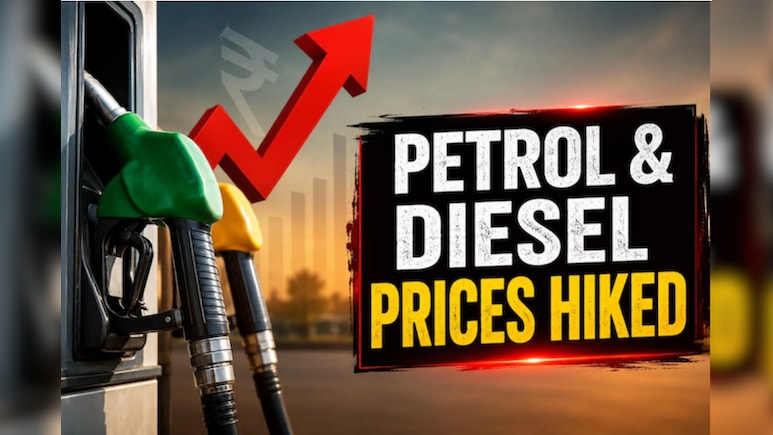
Every time petrol or diesel prices change at the pump, millions of Indians feel it in their wallets—and this time, consumers have been hit twice in a matter of days.
On Tuesday, petrol and diesel prices were increased by 90 paise per litre, the second increase in less than a week. Petrol in Delhi now costs Rs 98.64 per litre, while diesel stands at Rs 91.58.
This follows the first hike in over 49 months on Friday, when state-owned oil companies IOC, BPCL and HPCL raised prices by Rs 3 per litre each.
So who decides these prices, and how are they determined?
It Starts With Crude Oil — Which India Barely Produces
India imports nearly 90% of its crude oil requirement, which means global oil prices set the tone for everything that follows.
Crude oil is bought in US dollars on international markets. So if the price of crude rises globally, or if the Indian rupee weakens against the dollar, the cost of bringing that oil to India automatically goes up, even before a single drop is refined into petrol or diesel.
Then Comes The Refining And The Middlemen
Once crude arrives in India, it goes to refineries where it is processed into usable fuel.
After it is refined, state-owned Oil Marketing Companies (OMCs) — Indian Oil Corporation (IOC), Bharat Petroleum (BPCL), and Hindustan Petroleum (HPCL) — buy it and distribute it to petrol pumps across the country.
These three companies, which control over 90% of India's fuel stations, are the ones who actually set the retail price consumers see at the pump.
Half Your Fuel Bill Is Just Taxes
Here is the part most people do not realise. In broad terms, crude oil cost and refining together account for only about 35–45% of the retail price.
Central excise duty — a flat tax charged by the central government per litre — contributes roughly 20–25%. State VAT adds another 20–30%. Taken together, taxes alone make up around 40–55% of what you pay at the pump.
Dealer commission and the OMC's own margin make up the small remainder.
Why Petrol Rates Vary Across Cities
Each state levies its own Value Added Tax (VAT) on petrol, which varies significantly. Maharashtra charges around 25% VAT plus Rs 5.12 per litre, keeping Mumbai prices among the highest, while places like Delhi and Chandigarh have lower taxes.
Hence, when petrol rates were hiked by Rs 3, the price at the pumps ranged from Rs 97.77 in Delhi, Rs 106.68 in Mumbai, Rs 108.74 in Kolkata, and Rs 103.67 in Chennai.
Why Prices Were Frozen For Four Years
Although India officially follows a daily dynamic pricing system, which means prices can technically be revised every day at 6 a.m, OMCs can and do absorb short-term volatility to avoid frequent changes.
Consumers are shielded from sudden spikes, but this also means they do not always receive the full benefit when global prices fall. That political cushioning has a limit.
Retail fuel prices had largely remained unchanged since April 2022, except for a one-time Rs 2 per litre cut in March 2024 ahead of the Lok Sabha elections.
Public sector oil marketing companies had suspended daily fuel price revisions in 2022 to shield consumers from global crude price shocks following Russia's invasion of Ukraine.
However, crude oil prices have surged again due to the continuing West Asia conflict.
India's crude oil import basket averaged $69 per barrel in February. After the US-Iran war began, it surged to $113–114 per barrel — a jump of over 50%.
The three PSU companies absorbed losses for close to 11 weeks, with officials reporting losses of Rs100 per litre on diesel and Rs 20 per litre on petrol, before the hike became unavoidable.
ALSO READ: Explained: Here's What 90 Paise Fuel Price Hike Means For HPCL, BPCL and IOCL
Does Price Hike Means Shortage Of Fuel?
While the country has managed to secure adequate crude oil volumes from non-Gulf suppliers and has not faced a shortage of crude amid the effective closure of the Strait of Hormuz, Indian refiners have been paying for the oil through their nose, spending valuable foreign exchange.
Given the severity of its impact and the uncertainty over how long the supply crisis could last, Prime Minister Narendra Modi recently appealed for conservation of petroleum fuels, among other measures, aimed at moderating imports and foreign exchange outgo.
Essential Business Intelligence, Continuous LIVE TV, Sharp Market Insights, Practical Personal Finance Advice and Latest Stories — On NDTV Profit.