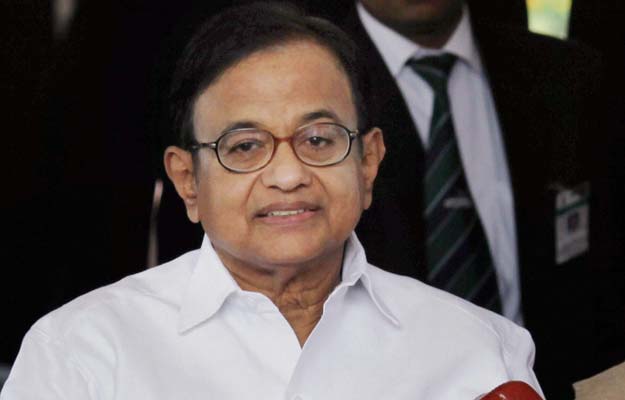
Finance Minister P Chidambaram on Monday boasted he had slashed the fiscal deficit lower than his target, while unveiling an interim budget that political opponents and analysts said contained unrealistic calculations.
Amid uproar in parliament as Members of Parliament (MPs) shouted him down, Mr Chidambaram also announced tax breaks for struggling manufacturers and more money for defence.
He said he would contain the deficit for the current fiscal year (April-March) at 4.6 per cent of gross domestic product (GDP), below his target of 4.8 per cent.
"I can confidently assert that the economy is more stable today than what it was two years ago," he said, while warning that action was needed to revive manufacturing.
Monday's budget was an interim exercise ahead of the election due by May which the government looks sets to lose. MPs will be asked to approve only the period until the new administration takes charge.
The Bharatiya Janata Party (BJP), which polls say is best placed to lead a new coalition government after the election, criticised Mr Chidambaram for cutting spending on public investment while increasing outlay on subsidies and pushing Rs 35,000 crore of oil subsidy spending onto the next administration.
"This move is a mere statistical illusion to keep the fiscal deficit look optically correct while its inflationary impact on the economy remains real," said senior party leader Arun Jaitley.
Party president Rajnath Singh warned that cuts of some Rs 79,800 crore to public investment spending announced for the current fiscal year would hurt the economy.
Mr Chidambaram also unveiled lower factory duties for passenger vehicles, washing machines, TVs and mobile phones in a bid to breathe life into spending and the manufacturing sector, which is contracting despite signs of a slow recovery in the wider economy.
Analysts watching the speech welcomed the progress on the fiscal deficit, including his estimate that it would shrink further to 4.1 per cent in 2014-15, which would be the lowest since 2007-08.
But they voiced concern about a lack of details.
"It is hardly a secret that this has largely been achieved by pushing back expenditures and moving forward tax and dividend collections," HSBC Global Research said in a note.
"It, therefore, implies that the targeted fiscal consolidation will be more difficult to come by next fiscal year."
Markets were largely unmoved by the speech, with the rupee at 61.93/94 against its close of 61.9250/9350 on Friday, but auto stocks responded to the excise cut, leading a 0.48 per cent rise in Sensex.
The rupee hit record lows last year amid concerns about the country's current account and fiscal deficits.
Mr Chidambaram predicted the current account deficit would be contained at $45 billion at the end of March, around half the level at the start of the fiscal year, thanks largely to tight restrictions on gold imports and a recovery in exports.
He said the government was looking into the pros and cons of easing controls on gold imports, but would not let the current account deficit balloon again.
To reach his deficit target, the Finance Minister this year squeezed higher dividends from cash-rich state-run companies as well as rolling over oil subsidies into next year's accounts.
Revised major subsidies for 2013-14 will be Rs 2.56 lakh crore, Mr Chidambaram said. For the coming year, he estimated total spending of Rs 17.63 lakh crore, up 10.9 per cent against revised expenditure for the current year. Within that, projected capital spending was flat.
The new spending included a 10 per cent proposed hike to the defence budget.
Election
Opinion polls predict voters will oust the government led by the Nehru-Gandhi dynasty's Congress amid widespread discontent with its mismanagement of the economy, stubbornly high inflation and corruption scandals.
Mr Chidambaram, struggling to deliver his speech above the din of lawmakers angry over a plan to divide Andhra Pradesh, announced no major changes in tax rates.
However, he unveiled lower duty on vehicles ranging from SUVs to motorbikes, as well as mobile phone handsets, along with small measures to soften student loans and help retired members of the armed forces.
"The current economic situation demands some interventions that cannot wait for the regular budget. In particular, the manufacturing sector needs an immediate boost," Mr Chidambaram said.
Asia's third-largest economy is barely recovering from the worst slowdown in a decade, with shrinking manufacturing, slower jobs growth and high inflation.
Chidambaram said India's economy, the 11th largest in the world, would recover to at least 5.2 per cent growth in the second of 2013-14 from 4.6 per cent in the first half.
Looking back at the two terms of rule under a Congress-led coalition, Mr Chidambaram said there had been an unprecedented growth trend of 6.2 per cent over the past decade and - rejecting charges that the government was mired in a policy paralysis - laid out a raft of reform steps it has taken.
Copyright @ Thomson Reuters 2014
Essential Business Intelligence, Sharp Market Insights, Practical Personal Finance Advice, Daily Fuel, Gold and Silver Prices and Latest Stories — On NDTV Profit.