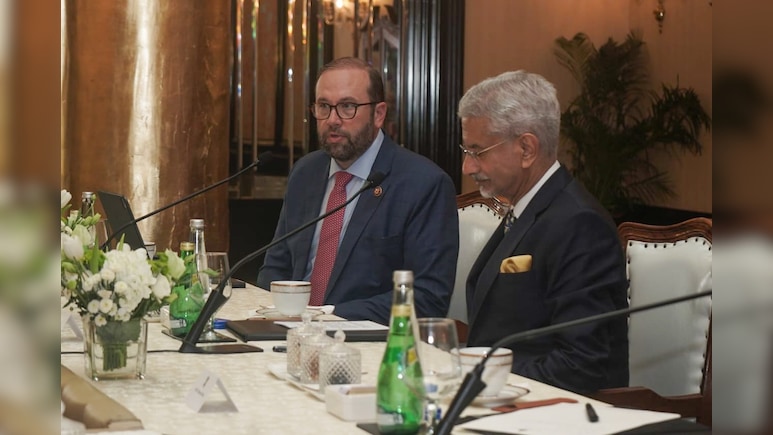
External Affairs Minister S Jaishankar met a delegation of US lawmakers in Mumbai on Tuesday and discussed trade, energy, security and technology, as the two countries work to consolidate ties after a turbulent year.
Jaishankar said on X that he met a US Congressional delegation comprising Representatives Jason Smith, David Schweikert, Elise Stefanik, Andy Ogles and Laura Friedman.
Pleased to meet US Congressional Delegation comprising @RepJasonSmith, @DavidSchweikert, @RepStefanik, @RepOgles and @RepFriedmanCA in Mumbai today. Appreciate their positive sentiments and interest in taking forward India - US ties. Specifically discussed trade, energy, security and technology aspects of our relationship. Also spoke about ease of doing business in India, and deepening of our Indo - Pacific cooperation. 🇮🇳 🇺🇸
Also Read | Layoffs Are Rising In Tech, But These Skills Are Helping People Unlock Better Pay
— Dr. S. Jaishankar (@DrSJaishankar) October 20, 2026
"Appreciate their positive sentiments and interest in taking forward India-US ties," he wrote.
Beyond the four areas he named, Jaishankar said the two sides also spoke about ease of doing business in India and about deepening cooperation in the Indo-Pacific.
Congressional delegations are a regular feature of the relationship, with US lawmakers visiting India to meet government officials and business leaders.
Such visits matter in New Delhi because Congress has a say in trade, defence sales and technology-sharing rules that affect India.
ALSO READ | US Secretary Of State Marco Rubio To Kick Off Three-Day Visit To India On Oct. 20: Day-Wise Schedule
The meeting comes after a difficult period. Washington raised tariffs on Indian goods to as high as 50% last year, partly over India's purchases of Russian oil.
In February, US President Donald Trump and Prime Minister Narendra Modi announced a trade deal that cut the US tariff on Indian goods to 18%.
The deal reportedly included a commitment from India to buy about $500 billion of US energy, aircraft, metals, coal and technology products over five years.
The paper noted it drew criticism from the opposition in India.
Talks have continued since. In April, US Ambassador to India Sergio Gor said an Indian delegation would travel to Washington to take the trade agreement forward.
ALSO READ | Trump's Russia Deal: What 4.8 Million Tonnes Of Diesel Flow Means For Global Markets?
Energy has also become more delicate because of the war involving Iran. India was allowed to buy certain Russian oil barrels in that context, a point Washington said would bring Moscow no financial gain.
Technology and security have long been pillars of the relationship, covering areas such as defence cooperation, semiconductors and artificial intelligence.
Both governments have also described the Indo-Pacific as a shared priority.
Essential Business Intelligence, Sharp Market Insights, Practical Personal Finance Advice, Daily Fuel, Gold and Silver Prices and Latest Stories — On NDTV Profit.