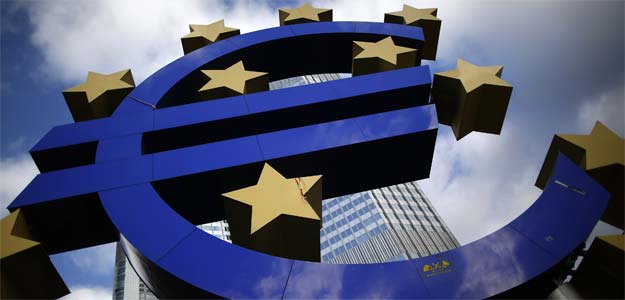
The euro zone economy will expand slightly more slowly next year than expected because of weaker private demand and investment, while inflation will stay well below the central bank target over the next two years, according to the European Commission.
The European Commission forecasts, published on Tuesday, are likely to add to arguments for an interest rate cut by the European Central Bank, which is to discuss its next policy move on Thursday.
They also add ammunition to those arguing for a euro zone banking union to help increase private demand and investment through an easier flow of credit to the economy.
The commission forecast that the economy of the 18 countries that will share the euro from next year will expand 1.1 per cent in 2014 after a 0.4 per cent contraction this year. In 2015, the euro zone is to accelerate to growth of 1.7 per cent.
The last EC forecast in May saw euro zone growth of 1.2 per cent in 2014. But recession is behind the euro zone and the pace of recovery will slowly accelerate quarter-on-quarter.
"There are increasing signs that the European economy has reached a turning point," said EU Economic and Monetary Affairs Commissioner Olli Rehn.
"The fiscal consolidation and structural reforms undertaken in Europe have created the basis for recovery."
The commission forecasts that in 2014 all European Union countries except Cyprus and Slovenia will see their economies grow, with the biggest Germany expanding 1.7 per cent and second biggest France 0.9 per cent.
"As the two largest euro zone economies, Germany and France together hold the key to stronger growth and employment in Europe," Mr Rehn told a news conference.
"If Germany and France together implement what (EU leaders have) recommended, they will do a great service to the entire euro zone and its growth and employment," he said, referring to boosting domestic demand in Germany and fiscal consolidation, lower labour costs and more competition in services in France.
Less austerity
Many euro zone governments were forced to sharply rein in spending over the last three years as investors began demanding unsustainably high prices for lending to them over concerns they might never get paid back. The tight fiscal policy was one of the main factors behind the two-year euro zone recession, but helped win back some investor confidence.
The Commission forecast the euro zone's aggregated budget deficit would shrink to 2.5 per cent of gross domestic product in 2014 and 2.4 per cent in 2015 from 3.1 per cent this year, as consolidation continues at a slower pace to help growth.
EU budget rules, tightened over the last three years of the euro zone sovereign debt crisis, will put more pressure on governments to cut budget deficits below the ceiling of 3 per cent of GDP and then bring accounts into balance or surplus.
The commission will announce next week if 2014 budget drafts of euro zone countries are in line with EU rules. The forecasts showed some countries will need to tweak policies to meet their deadlines for deficit cuts.
Austria and Belgium, which had until this year to cut the budget shortfall, appear to have comfortably met the deadline, but Slovakia's deficit is to grow to 3.2 per cent next year from 3.0 per cent expected this year, unless policies change.
The Netherlands and Malta, with a deadline of 2014, will need to adopt new steps because on a scenario of unchanged policies they will end up with shortfalls of 3.3 per cent and 3.4 per cent of GDP respectively next year.
France and Slovenia, both with a 2015 deadline, will also miss their targets unless they take action. Slovenia's deficit could balloon to 7.1 per cent next year from 5.8 per cent in 2013 because of the need to recapitalise its mainly state-owned banks.
The commission forecast public debt will peak at 95.9 per cent of GDP next year, up from 95.5 per cent this year and then fall to 95.4 per cent in 2015.
Better exports
Reforms forced onto governments by the crisis will see euro zone countries becoming more competitive. Greece, Ireland, Spain, France, Italy, Cyprus and Slovenia would see improvements in their current accounts in 2014, after strong gains in 2013, the commission noted.
Better euro zone exports of goods and services come despite an appreciation of the euro, which is likely to continue in 2014, Commission data showed.
The strong euro will help keep down inflation, providing another argument for those who favour an ECB interest rate cut, like Italy.
Euro zone inflation, which the ECB wants to keep below, but close to 2 per cent over a two-year horizon, will be 1.5 per cent this year and next and 1.4 per cent in 2015, reflecting the slow recovery and record high unemployment, seen at around 12 per cent in 2014 and 2015, the commission said.
Companies need access to affordable credit rates to start investing and hiring again. Now, companies in Greece, Cyprus or Portugal have to pay much higher rates to borrow than their competitors in Germany or France.
"Within a monetary union with well-integrated financial markets, firms with a similar risk profile should face similar credit conditions and interest rates irrespective of the member state in which they are located," it said.
Copyright @ Thomson Reuters 2013
Essential Business Intelligence, Sharp Market Insights, Practical Personal Finance Advice, Daily Fuel, Gold and Silver Prices and Latest Stories — On NDTV Profit.