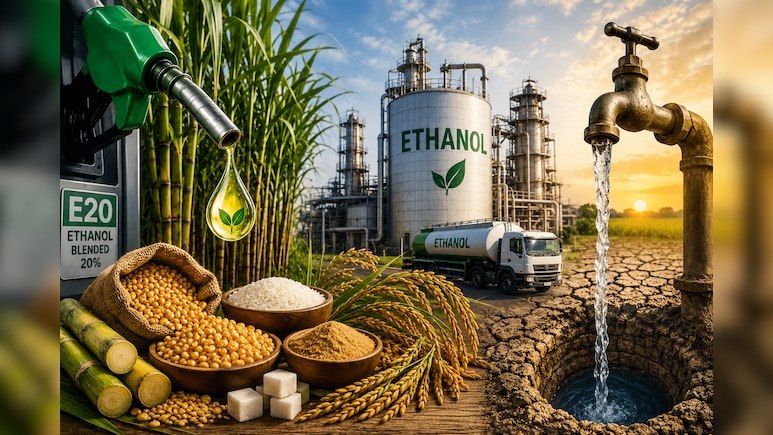
India's ethanol blending programme is often presented as a clean-energy success story. It helped reduce crude imports, save foreign exchange, and provide sugar mills and farmers with a new source of income. But recent debate over water consumption has raised larger questions, and deeper research shows the story goes beyond water.
It's An A-Maize-ing Story
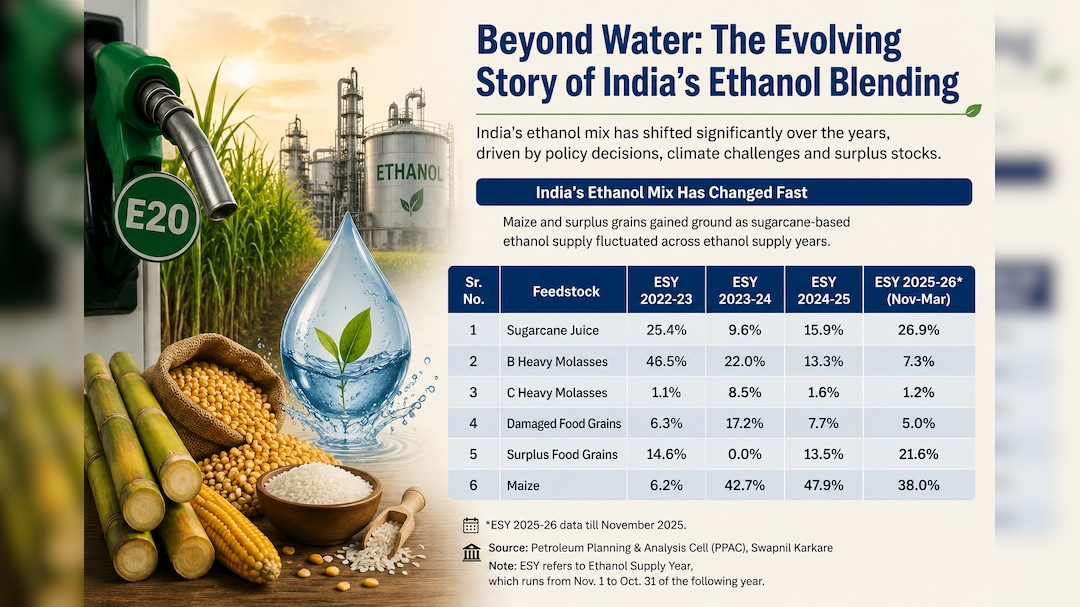
To understand the water debate, we first need to understand how India's ethanol mix changed. It started with sugarcane, but maize later became the main feedstock.
This shift began in 2023 because of low rainfall. Sugar mills feared lower output, prompting the government to restrict the use of sugarcane for ethanol production. It turned to maize instead to avoid a sugar shortage in the country. Oil marketing companies raised the price of maize-based ethanol, making it more attractive. Naturally, demand for maize surged, along with prices.
Then came another shift. By 2025, the Food Corporation of India's godowns were holding excess rice stocks, and the government decided to divert surplus rice for ethanol production. That also helped absorb excess rice inventories and ease pressure on maize prices.
Groundwater Depletion Is The Main Aspect
Now comes the water aspect.
Rice-based ethanol receives the sharpest criticism because of its high water footprint. Roughly 10,790 litres go into producing one litre of ethanol from rice, compared with about 3,630 litres for sugarcane and 2,570 litres for maize. But that water is used to grow the crop, not produce ethanol. So the real question is this: if 10,000 litres of water were already used to produce the rice lying in FCI godowns, is it better to use that rice somewhere - such as ethanol production - or let it go to waste?
But that is not the full story. Nearly 60% of maize is rain-fed, while sugarcane and rice depend heavily on irrigation, especially groundwater. Many of those regions are already water-stressed. Yet farmers continue growing these crops because of subsidised electricity and irrigation support. Moreover, farmers have limited incentives to shift towards less water-intensive alternatives. Therefore, the real question is how long India can continue incentivising large-scale groundwater-dependent irrigation in these regions.
The Second-Order Effects That We Neglect
We often fail to notice the ripple effects of government policy, many of which even policymakers do not anticipate. The ethanol ecosystem is a classic example. Three such effects stand out.
Ethanol production generates distillers' dried grains with solubles, or DDGS, an animal-feed byproduct. As grain-based ethanol production increased, DDGS flooded the feed market. It became cheaper than traditional feed such as wheat bran and soymeal, hurting flour mills, oilseed crushers, and soybean farmers. Last year, flour mills had to raise atta and maida prices to offset lost bran revenues, while weaker soymeal prices reduced returns across the oilseed ecosystem. The government later responded with a series of interventions to stabilise these sectors.
The Economic Survey 2025-26 flagged another risk. As farmers increased maize cultivation, acreage under pulses and oilseeds declined in some regions. It warned that while India may reduce crude oil imports through ethanol blending, it could become more dependent on edible oil and pulse imports if this trend continues.
The most visible effect was that India briefly shifted from being a maize exporter to a maize importer as ethanol demand surged.
Are Farmers Really Benefiting?
Higher maize use for ethanol triggered a wave of investment in grain distilleries. Yet despite higher procurement prices for maize-based ethanol, softer international maize prices, cheap FCI rice, and policy-driven supply gluts have distorted the market. Their effects are already visible on the ground. Last month, farmers in Telangana staged protests, urging the government to procure maize at minimum support prices because they had taken a hit.
Sugarcane-based ethanol faced the opposite problem. Repeated restrictions and sudden policy reversals made long-term planning difficult for mills, distilleries, and farmers alike. Even in profitable years, sugarcane farmers do not automatically receive a share of ethanol gains because Fair and Remunerative Prices, or FRP, are linked to sugar output rather than total cane revenue, which now increasingly includes ethanol. Payment arrears also continue to rise despite mandatory timelines.
The system may be profitable overall, but farmer incomes remain uncertain.
The Hidden Consumer Costs
From farmers, let's turn to consumers. It is true that ethanol blending brings environmental benefits. Ethanol-blended petrol burns cleaner than regular petrol. But the trade-offs are becoming harder to ignore.
Ethanol combustion emits acetaldehyde and formaldehyde, both linked to health risks. The bigger issue, however, is vehicle compatibility.
India has nearly 25 crore petrol vehicles on the road, most of them older models that are not fully compatible with ethanol blending. While they can run on E20 fuel, prolonged use increases wear and tear in fuel lines, injectors, seals, and pumps. Ethanol is also less fuel-efficient than petrol. Many lower-income consumers, especially food-delivery workers and taxi drivers, are already facing higher fuel bills and servicing costs because of these issues.
The Society of Indian Automobile Manufacturers even suggested compensating consumers for the drop in mileage. But no such policy has been implemented.
Recently, the government mandated the production of E20-compatible vehicles. But people do not replace cars and two-wheelers every few years. Which raises another question: if India eventually moves towards E30 or E50, what happens to the existing fleet again? Brazil's flex-fuel vehicle approach appears more practical here. Flex-fuel vehicles can run on anything from pure petrol to very high ethanol blends, allowing fuel policy to evolve without repeatedly creating compatibility risks for consumers. Instead of mandating only E20-compatible vehicles, India should eventually transition towards flex-fuel vehicles, as Brazil did.
The Brazil Comparison Is More Complicated Than It Looks
Brazil's experience offers both lessons and warnings. It differs from India in three important ways.
Brazil relies more heavily on sugarcane as feedstock, although corn now accounts for one-third of total production. Its sugarcane is largely rain-fed, and sugar mills use bagasse - the residue left after crushing cane - to co-generate electricity and steam. That creates a near self-sustaining energy loop.
India, meanwhile, uses sugarcane, maize, and sometimes rice as feedstock, with those proportions shifting every year. It is also far more dependent on groundwater-fed irrigation and coal-powered electricity.
However, aggressive expansion in Brazil also increased deforestation across parts of southern Brazil. Farmers replaced pastureland, while ranchers moved deeper into the forests of the Cerrado and the Amazon. That pushed up land prices, increased monoculture, and forced many small farmers either into seasonal cane labour or towards urban fringes.
Too Many Cooks
India's ethanol programme is increasingly becoming a classic case of "too many cooks spoil the broth". Agriculture itself is already one of the country's most overregulated sectors - something farmer leader Sharad Joshi criticised repeatedly for decades.
The ethanol ecosystem adds another layer of complexity. Every year, oil marketing companies and the government decide feedstocks, procurement prices, quantities, and regional allocations. What began as an energy policy now depends on coordination across multiple ministries and departments, including agriculture, food, petroleum, trade, fertilisers, power, and industry.
Even the pricing structure reflects this complexity. The government directly fixes ex-mill ethanol prices for sugarcane-based feedstocks, while public-sector oil marketing companies separately decide grain-based ethanol prices. At the same time, GST does not apply to petrol, but ethanol used for blending attracts 5% GST. The result is a heavily administered system where prices, incentives, supply decisions, and even crop choices increasingly depend on policy signals rather than market signals.
What Are We Achieving, Really?
All of this leads to the core question: what exactly is India's long-term ethanol objective?
If the goal is cleaner transport fuel, then water consumption and groundwater depletion create another problem. If the goal is foreign-exchange savings, ethanol blending has reduced crude imports, but higher demand has also led to maize imports. If the goal is energy self-reliance, rising maize acreage is displacing pulses and oilseeds, increasing dependence on edible oil imports.
In trying to solve one vulnerability, the programme risks creating another.
That is why the policy architecture needs to become far more coherent. First, the feedstock hierarchy must be clearly defined. If maize is the priority, policy must align with that ecosystem while gradually reducing support for other feedstocks.
Second, India needs predefined rules for supply shocks and extreme weather events. The framework should define how reserves will be managed, when trade restrictions will be imposed, when prices will be intervened in, and how alternatives such as sugarcane or rice will be used as balancing tools.
Finally, the government must decide how much control it wants to retain. Today, the state influences petrol prices, ethanol procurement prices, feedstock allocation, MSPs, FRPs, fertiliser subsidies, and electricity subsidies. Every additional layer of intervention creates fresh distortions, complications, and fiscal burdens.
One of the biggest reforms India eventually needs is market-linked ethanol pricing. Fixing prices indefinitely only creates larger problems over time. Brazil offers an important lesson here: when oil prices rise, producers divert more sugarcane towards ethanol because the economics become attractive. Price becomes the signal - not the government. India may not be ready for such a transition today, but the government must begin building consensus and institutional frameworks if it wants to move in that direction over the next decade.
Thus, the problem is not ethanol itself - or even water usage alone. It is the absence of a predictable, consistent, and stable framework governing this agriculture-energy-water nexus. Without clearly defined objectives, India risks controlling everything while achieving very little.
Essential Business Intelligence, Sharp Market Insights, Practical Personal Finance Advice, Daily Fuel, Gold and Silver Prices and Latest Stories — On NDTV Profit.