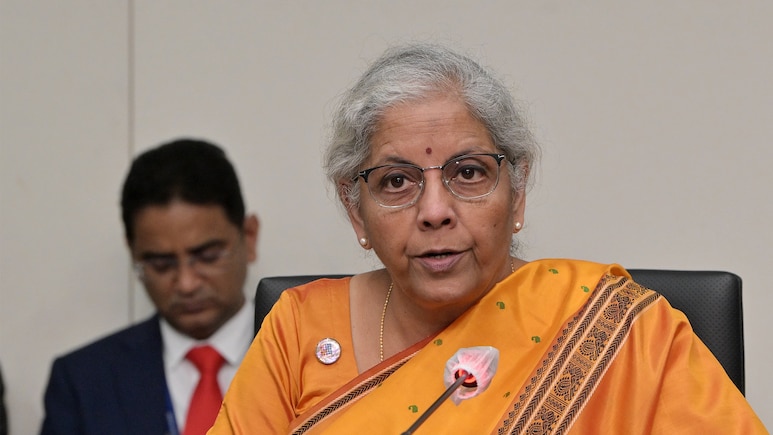
Finance Minister Nirmala Sitharaman is set to present the Union Budget in the Parliament on Feb. 1, outlining the Government's roadmap on spending, taxation and key economic measures for FY 2026-27. The presentation comes at a time of heightened global uncertainty, with India facing a sharp 50% tariff imposed by the United States on its exports.
Here are some important fiscal metrics to watch out for in Budget 2026.
GDP Growth
Also Read | Layoffs Are Rising In Tech, But These Skills Are Helping People Unlock Better Pay
The government's approach to gross domestic product (GDP) growth rate will be watched out for by all in FM Sitharaman's Budget speech in view of the economic challenges posed by the US tariffs and geopolitical tensions. The Economic Survey, presented in Parliament on Jan. 29, has projected a real GDP growth rate of 6.8-7.2% for FY27, compared to 7.4% estimated for the current fiscal (FY26), reflecting a steady economic advancement.
Fiscal Deficit
The fiscal deficit was estimated at 4.4% of GDP for FY 2025-26. In this Budget, the government is likely to reduce the fiscal deficit target further.
ALSO READ: Budget 2026 Expectations: Focus On Manufacturing, MSME Push And More
Revenue Deficit
The gap between revenue expenditure and revenue receipts was expected to narrow to Rs 5.24 lakh crore in FY26, or 1.5% of GDP, compared to Rs 6.1 lakh crore (1.9% of GDP) in the revised estimates of 2024-25.
Effective revenue deficit, which excludes grants-in-aid for creation of capital assets, is budgeted to decline sharply to Rs 96,654 crore, or 0.3% of GDP, underlining a shift towards more spending for creation of assets.
Capital Expenditure
The Budget 2025 underscored continued emphasis on capital spending, with capital expenditure on the books at Rs 11.21 lakh crore for FY 2025-26, slightly higher than the revised Rs 10.18 lakh crore for the previous financial year.
When grants-in-aid for creation of capital assets are added, effective capital expenditure was projected at Rs 15.48 lakh crore in 2025-26, up from Rs 13.18 lakh crore in the revised estimates of the previous financial year.
Total Expenditure
The Centre's total spending for FY 2025–26 was pegged at Rs 50,65,345 crore, reflecting a 7.4% rise compared to the revised outlay for the previous financial year.
Total Receipts
The government aimed to raise Rs 34,96,409 crore in receipts, excluding borrowings, in FY 2025–26, an increase of 11.1% over the revised figures for the preceding fiscal. The shortfall between income and spending was to be financed through borrowings of Rs 15,68,936 crore, broadly in line with last year's revised estimates.
Gross Tax Revenue
Budget 2025 pegged gross tax revenue growth at 10.8% for FY26, marginally higher than the projected expansion in nominal GDP.
Income tax was set to deliver the strongest gains, with collections estimated to rise by 14.4%, while corporation tax was expected to increase by about 10.4%. GST receipts were projected to grow by 10.9% compared to the revised estimates for the previous fiscal.
Net Tax Revenue
Net tax receipts for the Centre, after excluding states' share, were projected at Rs 28,37,409 crore in FY26, representing an increase of about 11% over the revised figures for the previous year. In contrast, the revised estimates for 2024–25 indicated a marginal 1% decline from the original Budget projections.
Debt-To-GDP Ratio
The debt-to-GDP ratio was projected to ease to 56.1% in FY 2025–26, down from 57.1% in the previous financial year. Under its fiscal consolidation roadmap, the government aims to maintain deficit levels between FY27 and FY31 that would place public debt on a steady downward trajectory, with a target of around 50%, plus or minus 1%, by the end of March 2031, barring any significant macroeconomic disruptions.
Essential Business Intelligence, Sharp Market Insights, Practical Personal Finance Advice, Daily Fuel, Gold and Silver Prices and Latest Stories — On NDTV Profit.