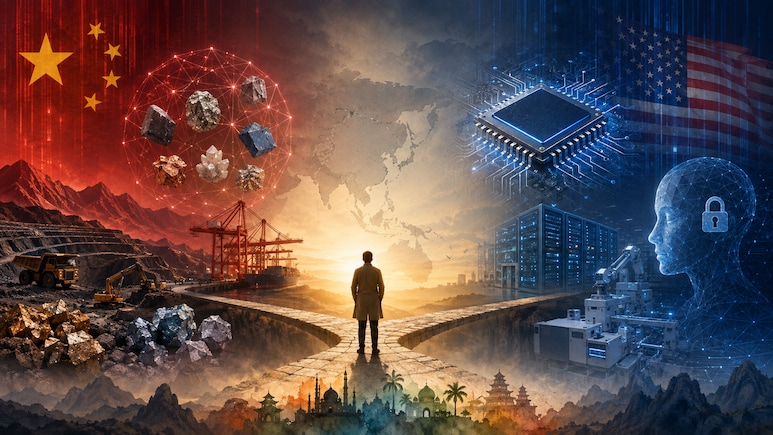
The world around us gets divided day after day. AI is now getting split even before it can generate sustainable profits. On one side is the West. On the other side is China.
The divide is simple. China controls the resources, while the West controls technology.
China processes most of the rare earths, metals and minerals needed for AI. There's no meaningful alternative. The West leads in chips, lithography machines, and AI models.
Also Read | Layoffs Are Rising In Tech, But These Skills Are Helping People Unlock Better Pay
Then, there's another divide in AI models.
Leading US models remain closed. Google, OpenAI and Anthropic do not disclose their training data or workings. Nvidia's Nemotron is an exception. By contrast, almost all leading Chinese models are open.
So, the world stares at an asymmetry. China wants to control raw materials and supply chains. But it is keeping its models open. The West controls the technology but wants its models closed.
That is a battleground for the AI-related conflict that is hard to miss.
The Chinese Way of Doing Things
China isn't letting go of its hold on raw materials easily.
It has tightened controls on key minerals. It has increased checks on the goods that can be used for both civilian and military needs. Exporters may need approval before shipping certain goods abroad.
Indian firms have seen this firsthand.
Chinese firms have not always shared key technology and parts with Indian firms. In the past, EV and electronics firms have faced delays in getting parts. Chinese experts have also been stopped from training Indian workers at Foxconn plants in India.
China is using what it has to protect its lead. The West is doing the same at the other end of the supply chain.
ALSO READ: China-US Spat At G20 Largely Came Down To Dispute Over One Word
US is Restricting China
The US and its allies are trying to restrict tech transfer to China. They don't allow the sale and servicing of ASML's lithography machines in China. These machines are used to make semiconductor chips.
The US has also restricted exports of high-end chips such as Nvidia's A100 and H100. It is also limiting American investment in sensitive Chinese sectors.
But there is a problem. The West cannot rebuild its supply chains as quickly or as cheaply as China did. So it needs another solution.
That is where initiatives such as Project Vault, FORGE and Pax Silica come in.
Project Vault Builds Reserves
The US wants to stockpile critical minerals needed for AI. Project Vault is part of that effort. It plans to build reserves of around 60 minerals.
Think of it as an emergency stock, much like the Strategic Petroleum Reserve (SPR) for oil. US manufacturers can access the stock if supplies are disrupted.
The minerals will be stored in facilities in the US. VaultCo, a public-private partnership, will run the reserve. The US Export-Import Bank will provide up to $10 billion in financing.
But the plan has its critics.
Veronique de Rugy of the Mercatus Centre argues that it could become government-backed risk management for a small group of companies. Critics also question whether simply building a stockpile is enough to reduce US dependence on foreign supply.
ALSO READ: US Trade Gap Widens To Largest Since Early 2025 On AI Push
FORGE Helps Build
Project Vault may buy some time. But the technology asks for more mines and processing facilities. That is FORGE's role. It stands for the Forum on Resource Geostrategic Engagement.
It has two broad jobs. First, it identifies important mining and processing projects. Second, it tries to align policies, standards, export controls, and even pricing norms across participating countries.
It also encourages long-term purchase agreements from various suppliers. That matters because financing such projects can be risky.
These projects require huge amounts of upfront capital, and a small price swing can change decisions. Abrupt halts and cost overruns are common. Therefore, banks hesitate to lend.
The administration has plugged public finance into this stage.
MINVEST Makes All Investments
That brings us to MINVEST, or Minerals Investment Network for Vital Energy Security and Transition.
FORGE decides which projects matter. But MINVEST helps figure out how to finance them.
It brings together private investors, mining companies, manufacturers, export-credit agencies and governments.
Representatives from 55 countries attended its inaugural Critical Minerals Ministerial. India has participated in the wider ministerial process, although it has not joined FORGE.
Pax Silica Seals All This
Then comes Pax Silica. The aim is to bring the entire AI supply chain under the US-led group. That includes everything - from critical minerals and advanced materials to chips, data centres, electricity, logistics, AI models and finance.
The main goal is to reduce dependence on China.
The plan is to pool each country's strengths. Countries within the group have different specialities such as US chip design, Dutch lithography, Japanese chemicals, Korean memory chips and Australian minerals.
Through Pax Silica, the group can bring these strengths together. Countries can invest in each other's projects and build supply chains. This can give members better access to the resources and technologies they lack.
Currently, it has 24 member countries, and India is one of them.
Put together, the three initiatives cover different parts of the problem. Vault builds the buffer. FORGE coordinates the resource projects. MINVEST helps finance them. Pax Silica connects technology and downstream AI models to upstream resources.
In other words, the West is trying to build a mine-to-model chain of countries that can rely on one another.
ALSO READ: India Wants To Be Vietnam; Vietnam Wants To Be China | The Reason Why
WAICO Brings Global South Together
China is also trying to bring some countries together.
But it is doing it differently from the West. It wants to build an international coalition around Chinese AI models, infrastructure and standards, particularly across the Global South.
It is called WAICO, or the World Artificial Intelligence Cooperation Organisation. There are 29 countries in this group, including Russia, Brazil, Kazakhstan, Indonesia, Malaysia, Pakistan and several African and Central Asian countries. No G7 country has signed yet.
Most governments are concerned about cost. They are also concerned about getting access to computing, infrastructure, skilled people, and local language data. Advanced AI models, especially the US ones, are expensive. But Chinese models like Kimi, Qwen and DeepSeek can be deployed at relatively low cost.
China has also promised around 5,000 AI training opportunities. This gives China a different route to influence.
WAICO isn't restricted to anti-US or China-aligned countries. It doesn't say explicitly that it will not allow countries closer to the US or its allies. Chinese commentators argue that it should not be seen as an anti-US bloc.
The question is how long this openness can survive.
Southeast Asia is Trying to Balance
Southeast Asia has become the most visible test of whether the world really splits into two clean camps. So far, it has refused.
Five ASEAN countries - Indonesia, Malaysia, Cambodia, Laos and Myanmar - were among WAICO's founding members. But Singapore and the Philippines are connected to Pax Silica. As of now, nothing has changed for these countries by joining any bloc.
Indonesia has joined WAICO. But it says that national interests will trump anything around it.
Malaysia is dependent on Chinese raw materials and supply chains. It also has deep links with Western cloud and semiconductor ecosystems. At the same time, it is developing its own sovereign AI cloud infrastructure.
Singapore's geopolitical neutrality has turned into an 'interoperability' approach in AI. It also has its own AI governance framework.
Southeast Asian countries need both countries for different needs. But above all, they want policy freedom to work with both.
Kazakhstan Might Be In Trouble
Speaking of working with both, Kazakhstan is a great example. It is the only country that has joined both, WAICO and Pax Silica.
The country holds significant reserves of uranium, tungsten, copper, and rare earth elements. Its mineral wealth is what makes it attractive.
WAICO gives it access to Chinese AI co-operation and open-weight models, while Pax Silica gives it access to an advanced technological network. It seems like the best strategy.
However, Reuters reported that the US may warn countries from participating in both blocs. That could be bad news for Kazakhstan. If that happens, it will be interesting to see whom it chooses.
ALSO READ: Curbing China's Reliance: US Hits Foreign-Made Drones With Tariffs of Up to 100%
India's Love-Hate Relationship Continues
India's position is complicated in a different sense.
Geopolitically, India's stance is non-aligned or multi-aligned.
It has border issues with China and Pakistan, both members of WAICO. It is coming closer to the Western powers in defence cooperation and technology exchanges. However, it has past ties with Russia, which it doesn't want to leave. Also, it is the only original BRICS member to stay out of WAICO and join Pax Silica.
India's manufacturing ambitions still depend on Chinese inputs and supply chains. The government wants to reduce this dependence, an objective Pax Silica shares too. But that dependence is far from over.
The trade deficit with China has continued to rise. Tariffs, investment restrictions and app bans have not reduced that dependence. Even China's restrictions on doing business with India, as highlighted earlier, have not changed much on a macro level.
Pax Silica may help India diversify its suppliers over time. But those alternatives are likely to be expensive.
This matters. India wants to scale manufacturing, grow faster and lift people out of poverty as quickly as possible. More expensive technology and manufacturing inputs could slow that progress.
If WAICO and Pax Silica remain relatively open, India can function better. If they become exclusive blocs, that could be a difficult economic and foreign policy decision for India.
India's Role
So this isn't a race between AI models.
It is a race over the system around them. This includes chips, cloud services, data centres, power, key minerals, machines, standards, money and rules.
Most countries need something from both sides.
Turning this into a contest is something the world may regret in the future. The best outcome is to keep both options open. But this can work only if both sides allow it. The US has hinted that this may not be possible.
Choosing one side over the other could take the world back to the Cold War era. This is where the old idea of non-alignment could help.
Asian and African nations should try to keep both systems open.
India has a chance to lead this effort. Jawaharlal Nehru, India's first Prime Minister, took a similar stand after independence. India became one of the leading voices of the Non-Aligned Movement and the Global South.
India can play that role again. Other Asian nations, such as Singapore, can do the same.
ALSO READ: China's Two Pronged Stealth Move: Leap Ahead On AI, Slip Lesser On Crude
Essential Business Intelligence, Sharp Market Insights, Practical Personal Finance Advice, Daily Fuel, Gold and Silver Prices and Latest Stories — On NDTV Profit.