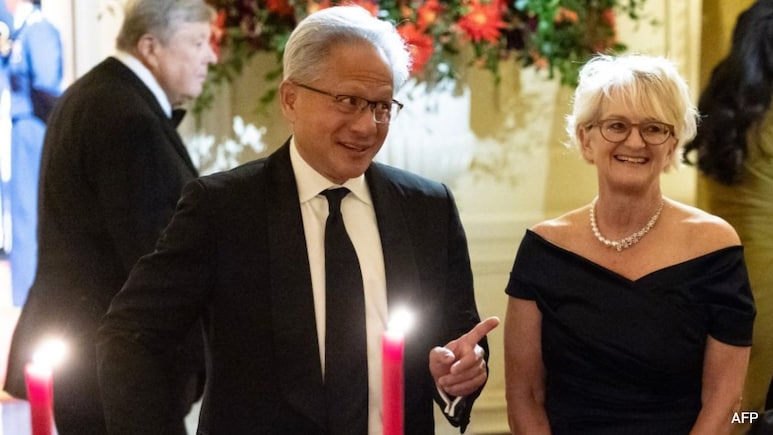
- Jensen and Lori Huang gave away 438,000 Nvidia shares in September, mostly to charity
- Their living trust holds 467,693,547 Nvidia shares worth nearly $84 billion at Monday's close
- Both spouses are named in multiple Nvidia filings as trustees and beneficiaries of trusts
In September, Jensen and Lori Huang gave away 438,000 Nvidia shares. Two-thirds went to the family foundation. The rest went to a donor-advised fund. The most interesting number in the filing was what their living trust had left.
467,693,547 shares.
At Monday's closing price, that one line was worth nearly $84 billion. It covered only the shares the trust held directly. And the name on the trust was the same one that had appeared alongside Jensen's in Nvidia's filings for years.
Also Read | Layoffs Are Rising In Tech, But These Skills Are Helping People Unlock Better Pay
On Sunday, Jensen Huang told Nvidia employees he had been unfaithful to his wife. “My family bears no responsibility for my choices,” he wrote. Nvidia's board announced an independent investigation into reports that he had been targeted by a foreign intelligence effort. The Huangs have made no public announcement of a divorce. But if they ever did split, the financial question would reach back to a deal Jensen struck long before he had any Nvidia shares to give away.
The Sunday homework deal
At Oregon State University, Lori Mills was Jensen Huang's electrical engineering lab partner. His pitch, as he later told it, was simple. Do homework with him on Sundays and he'd get her straight As.
They married, had two children and, in 1993, Jensen co-founded Nvidia. Two years later, both names went on a living trust dated May 1, 1995. Nearly three decades after Nvidia's founding, the couple pledged $50 million to build a research centre at the university where they met. By then, the shares in their trust were worth more than the endowments of most universities.
The order matters. The wedding came before Nvidia. California generally treats property acquired during marriage as community property, subject to exceptions. If California law governed a divorce, a court would ordinarily divide the net community estate equally unless a valid agreement or a statutory exception changed the result. The affair itself gives Lori no larger percentage under California's no-fault rules. The dates, the trust deeds and any agreement the couple signed are what would count.
Her name was there all along
A 2003 SEC filing names both Huangs in connection with the living trust. By 2009, a filing attributed beneficial ownership of 3.9% of Nvidia to Lori, with shared power to vote and dispose of shares. The 2017 proxy named both spouses as co-trustees of an irrevocable trust set up in 2012. The 2019 proxy listed two more vehicles, the Lori Lynn Huang 2016 Annuity Trusts, with Lori as trustee of both. An annuity trust can pay a fixed sum back to its creator and pass excess growth to beneficiaries. If the asset inside is Nvidia stock, that excess can be the biggest number in the room.
The distinction is buried in Nvidia's spring proxy. It attributed about 3.58% of the company to Jensen under SEC beneficial-ownership rules. That figure included nearly 59 million shares held by the couple's foundation. Both Huangs sit on its board. Neither has a personal financial interest in those shares. The proxy also counted roughly 140 million shares across two irrevocable trusts. Who ultimately benefits from those shares depends on the trust deeds. A filing can show who has the power to vote a share. The deed can tell you who gets the money.
The day $100 billion made sense
On October 2, Forbes put Jensen Huang's fortune at $204.5 billion, seventh in the world. Half was a little over $102 billion. Then came the chip selloff. Bloomberg estimated that Huang lost $15.1 billion on November 5 alone and fell out of its global top 10. By Monday's close, Forbes had him at $155.2 billion. The same back-of-the-envelope calculation now came to $77.6 billion. Nobody had changed the law or signed a deal. The stock had moved.
The share filings give the hypothetical more shape. Add the shares held by six companies wholly owned by the living trust to the trust's direct holdings, and the block is worth about $107.4 billion at Monday's close. Half comes to $53.7 billion. Add the shares Jensen reported holding directly and half rises to about $60 billion, assuming the entire block qualifies as community property. Count the two irrevocable trusts as well and the arithmetic reaches about $72.5 billion, although their terms would determine whether any of that wealth could enter the split. An $80 billion to $100 billion share would require a net community estate of $160 billion to $200 billion. The October wealth ranking explains where that idea came from. The filings leave the size of the marital estate open.
Then there's the price on the day that counts. A 20% swing in Nvidia would move the $60 billion illustration by $12 billion in either direction. In a contested California divorce, a court generally values community assets as close to trial as practicable. And a valid prenup or postnup, if the Huangs have one, could change the division before anyone even reaches for a calculator.
MacKenzie Scott got the shares. Bezos kept the votes.
In 2019, MacKenzie Scott took roughly a quarter of the couple's Amazon holdings. It was about 4% of Amazon, worth $38.3 billion when the divorce was finalised. Jeff Bezos retained voting authority over her shares under a proxy agreement. That arrangement is on the public record. The terms of Bill Gates and Melinda French Gates's 2021 divorce stayed private, leaving the much-circulated $73 billion to $76 billion estimates unconfirmed. Rupert and Anna Murdoch's reported $1.7 billion split, once a byword for an expensive divorce, gives a sense of how far the scale has shifted.
A straight half of either Nvidia block modelled here would surpass Scott's benchmark. Copy her quarter-share and the arithmetic comes out at roughly $30 billion to $36 billion, depending on which holdings are counted. The more consequential part of the Bezos deal for Nvidia may be what happened to the votes. In the $60 billion illustration, Lori could receive a block equivalent to roughly 1.4% of Nvidia. She could vote it independently, or the couple could agree on who gets to vote it. Wall Street would read that clause as closely as the dollar figure.
A transfer in shares could happen without an immediate sale. Federal law generally recognises no gain or loss on a qualifying divorce transfer, and the recipient ordinarily takes the existing tax basis. A later sale can bring a hefty capital-gains bill. It can also put billions to work elsewhere. Scott went on to give away more than $26 billion by the end of 2025. The Huangs have made those decisions together for years, from the Oregon State pledge to the Nvidia shares they gave away in September.
Thirty-one years ago, two former lab partners put both their names on a trust. For much of the time since, the world has counted the fortune under one of them. If the Huangs ever divide it, the number on the rich list will change with the next trade.
Essential Business Intelligence, Sharp Market Insights, Practical Personal Finance Advice, Daily Fuel, Gold and Silver Prices and Latest Stories — On NDTV Profit.