(Bloomberg View) -- America's opioid epidemic is getting worse. What's most depressing is that it's hard to imagine how anyone involved -- the addicts, the doctors, the drug companies or the government -- will do anything in time to mitigate it.
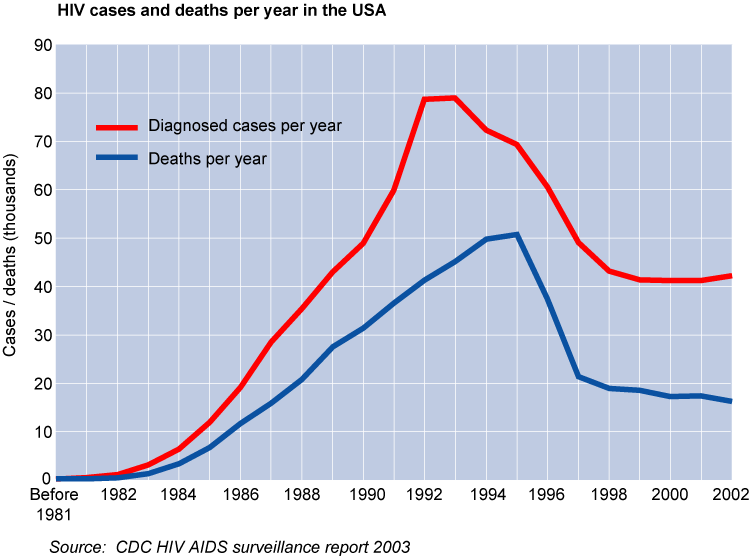
The newest data show that at least 64,000 Americans lost their lives to drug overdoses in 2016. Of those, 20,000 involved fentanyl, the synthetic version of heroin. That's twice as many as in 2015 and more than five times as many as in 2013. It also exceeds the worst years for deaths to AIDS, car crashes and gun violence.
So what's going to stop this? Reducing prescriptions to new users could help, given that many people find their way to street drugs such as heroin and fentanyl after maxing out on legal opioids. The U.S. has managed to cut prescriptions to 71 per 100 people in 2015 from 81 per 100 in 2010, but the rate is still nearly four times as high as Europe's -- and the prescriptions are for longer periods.
Unfortunately, doctors have little incentive to slow down. Patients arrive in real pain -- either from the original injury or from withdrawal -- and alleviation is considered part of the duty of a medical professional. Beyond that, the need to get good evaluations from patients puts pressure on doctors to cede to their demands. And many doctors probably worry that, if they don't prescribe, patients will find their way to lethal dosages of street drugs.
If we want doctors to act differently, we'll have to reevaluate the way we compensate them and the way we think about and treat pain. But that will take time, and it addresses only half the problem. The other half is that there really is no known cure for opioid addiction. It changes the way the brain works, particularly in users who start young. Even after high quality rehabilitation, relapse rates are as high as 90 percent.
Market forces may be doing more damage than good. Private equity money has flooded into expensive rehab facilities -- which, given how desperate parents of addicts tend to be, seems more opportunistic than fundamentally helpful. The company that sells the life-saving naloxone with an auto injector has reportedly increased its prices sharply, in a move reminiscent of last year's EpiPen scandal.
The government at least recognizes the problem. A White House panel recommended declaring a national emergency and increasing Medicaid access to treatment and to naloxone, which can save someone's life in an overdose. But important as such moves may be, they won't do much to stem the flow.
Policy makers need to try some new ideas, fast. They could include providing people with a safe place to use illegal drugs -- an approach that can save lives and help get people into rehab. It could also entail providing treatment for the large share of addicts who end up in prison. To help pay for such efforts, states could be more active in seeking damages from the pharmaceutical companies that marketed opioids so aggressively in the first place.
Barring that, all that remains is to wait for the epidemic to exhaust itself as epidemics do, after causing untold mayhem and despair. The typical progression is a swift increase in deaths per year, followed by a turning point and an even sharper decline. Problem is, we don't know where we are in the cycle. We could yet lose the equivalent of an entire generation. If that's what happens, we can only hope that the next generation will want nothing to do with the stuff.
This column does not necessarily reflect the opinion of the editorial board or Bloomberg LP and its owners.
Cathy O'Neil is a mathematician who has worked as a professor, hedge-fund analyst and data scientist. She founded ORCAA, an algorithmic auditing company, and is the author of "Weapons of Math Destruction."
To contact the editor responsible for this story: Mark Whitehouse at mwhitehouse1@bloomberg.net.
For more columns from Bloomberg View, visit http://www.bloomberg.com/view.
Essential Business Intelligence, Sharp Market Insights, Practical Personal Finance Advice, Daily Fuel, Gold and Silver Prices and Latest Stories — On NDTV Profit.