.jpg?downsize=773:435 "Transition To Indian Accounting Standards: The Story In Numbers")
The adoption of Indian Accounting Standards (Ind AS) that are converged with International Financial Reporting Standards (IFRS) by large Indian companies is now a reality, with these companies going live earlier this year with their public reporting under Ind AS. This culminates almost a decade of efforts by the regulators to make this transition. With this change, India Inc has embraced a set of standards that are contemporary and better suited for the needs of multitude of domestic and international stakeholders. This also brings in a new era in financial reporting, which is more closely aligned to economic substance of business arrangements, while also bringing in greater transparency and comparability, including with global peers.
Ind AS: Impact On Corporate India
An analysis of the first and second quarter numbers published by the top Indian companies don't tell a consistent story. Most companies have presented only the minimum mandatory reconciliations explaining the variation between the profit reported under earlier accounting standards (AS) for the quarter ended June 30, 2015 and the profits reported under Ind AS for the same period.
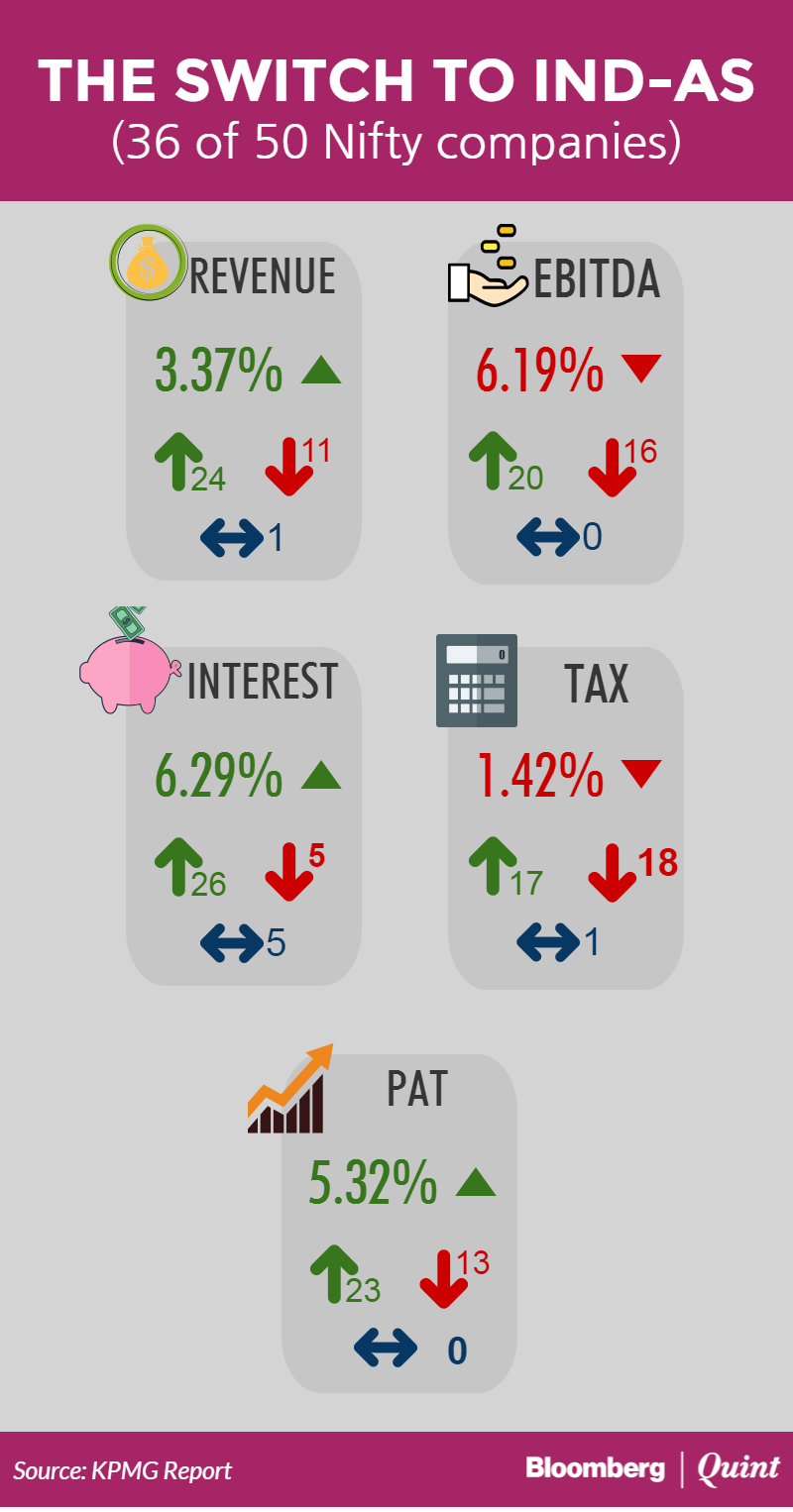
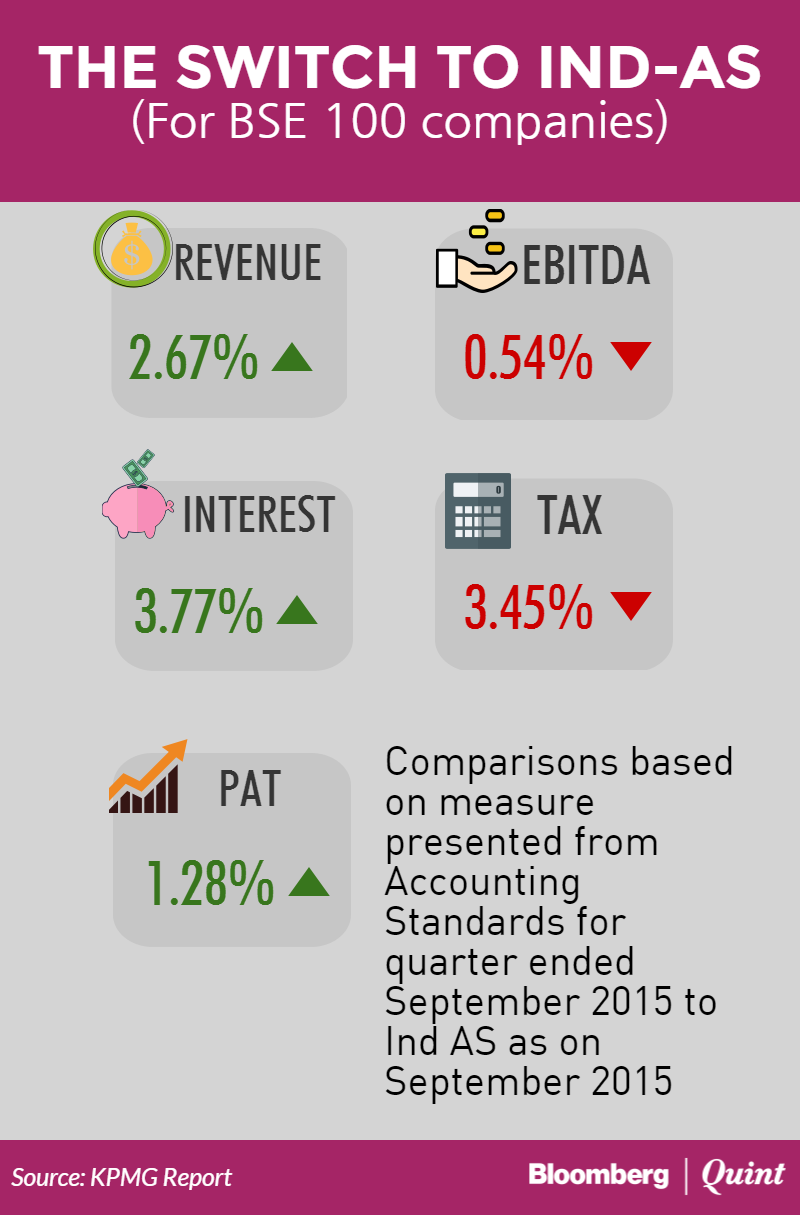
As second quarter results draw to a close, the analysis of the results announced by 36 of the top 50 companies when compared with their results under the previous accounting standards for the same period, shows that revenues have shown a marginal increase (largely on account of inclusion of excise duty in revenues), EBITDA has shown a decrease of over 6 percent whereas PAT has increased by over 5 percent. In contrast the first quarter (Q1) results showed very different trends – the results announced by the top 100 companies show that revenues have shown a marginal increase (however lesser than second quarter (Q2) due to inconsistent reporting in Q1), EBITDA has declined by just over 0.5 percent whereas PAT increased by just over 1 percent.
While Q1 results seemed to suggest that the operating profits were not significantly impacted by the transition, Q2 tells a different story. The delta between EBITDA and PAT in Q1 was just under 2 percent whereas the same for the second quarter was over 11 percent. Interest cost accounts for most of this variation – while Q1 showed an increase of close to 4 percent, Q2 shows a decline of over 6 percent. Therefore, while operating performance seems to have declined in Q2 under Ind AS, it seems to have been more than compensated by the reduction in interest costs, thus resulting in an overall increase in PAT in Q2.
However, it may also be misleading to draw conclusions based on such headline numbers, as the impact varies from sector to sector and also from quarter to quarter, based on either sector specific nuances or due to movement in markets such as currency or interest rates, etc.
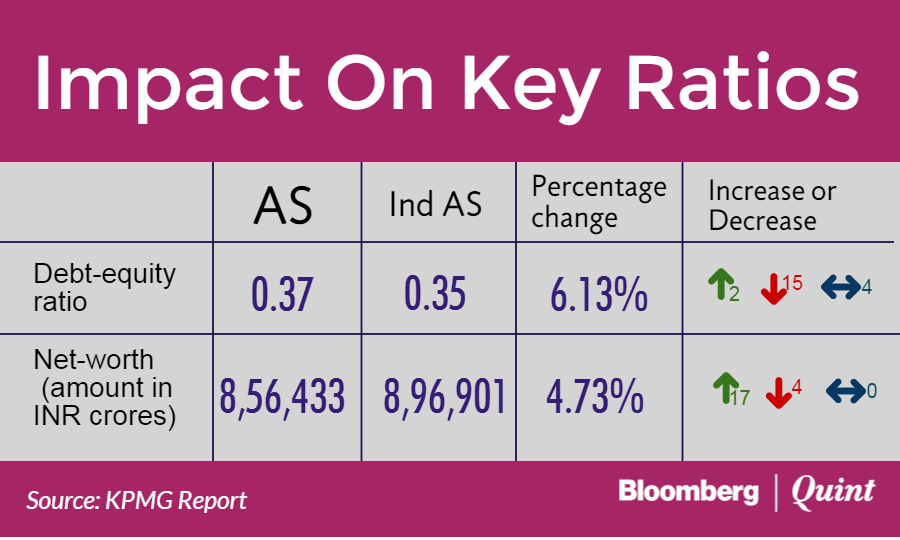
The balance sheet presented by the 36 Nifty 50 companies also show only a marginal impact at an overall level, with net worth under Ind AS going up by close to 5 percent, and the debt-equity ratio showing a marginal dip.
The Story Beyond The Numbers
In comparison to the extent of differences between the previous accounting standards and Ind AS, the reported results haven't shown significant differences as yet.
While transition to Ind AS provided companies an opportunity to view their accounting practices with a fresh perspective, many companies seem to have chosen the path of least change, keeping their practices and resultant results as close as possible to their previous practices, using either materiality or other considerations. The existence of carve-outs (deviations from IFRS) to ease transition would have also minimised the impact of existing assets and arrangements.
Further, some companies used this as an opportunity to align with international standards, but benefited from this due to the way the markets had moved during the period of transition. For instance, when choosing the policy on charging off foreign exchange fluctuations to P&L, companies have seen a favourable result in the period of transition, but this could swing either ways going forward depending on how the markets move.
However, many companies have also used this as an opportunity to re-balance their assets and liabilities, making effective use of the first time adoption provisions of Ind AS. As a result, companies have on the one hand written down assets or taken accelerated amortisation/depreciation charge, including tangible and intangible assets, investments, etc., whereas on the other hand, they have written up assets such as fixed asset, primarily land, as a result minimising the net impact to net worth. Some of the changes are quite significant, and one wonders it would raise questions on what the veracity of previously reported numbers.
The relaxations provided by market regulator Securities and Exchange Board of India on quarterly disclosures has also meant that companies are able to drip feed the information to the investors in a gradual manner over the quarters, and hence the full impact of the choices made by companies is also not evident yet. While companies have been selective on the use of these relaxations, most have availed the relaxations on disclosures as compared to the relaxations on timelines for reporting. However, it is encouraging to note that there is an improvement in the extent of disclosures provided in Q2 as compared to Q1 with more companies disclosing the net worth reconciliation as of March 31, 2016.
Tax And Regulatory Issues
The computation of Minimum Alternate Tax (MAT), distributable profits and free reserves under the Ind AS regime still remain open issues, and these could have material impact on both the cash flows as well as the evaluation of financial position by various stakeholders.
The Next Six Months
Based on the clarity that emerges on various company law and tax law matters discussed earlier, companies may revisit the accounting positions taken by them at the transition date and during the interim quarters, as they would ultimately like to minimise any unintended consequences of the transition, including tax outflows on account of MAT.
Further, over 40 percent of the top 50 companies that declared their results (till November 18, 2016) have still not provided a reconciliation of their net worth between the previous accounting standards and Ind AS. A lot of the finer details of the transition, including how many companies have used this as an opportunity to strengthen their balance sheets by writing down bad assets and writing up good assets, will all be known when companies make their year-end mandatory disclosures, including detailed net-worth and net income reconciliations with explanatory notes.
Until one sees all of these disclosures and knows the final accounting positions, it would be difficult to understand the full purport of Ind AS transition on a company, and how this has impacts current and future earnings. Till then, one has to make do with the mostly little and sometimes large drops of information that trickle in each quarter of this transition year.
Sai Venkateshwaran is a Partner and Head of Accounting Advisory Services at KPMG India. The views and opinions expressed herein are those of the author and do not necessarily represent the views and opinions of KPMG in India.
The views expressed here are those of the author's and do not necessarily represent the views of BloombergQuint or its editorial team.
Essential Business Intelligence, Sharp Market Insights, Practical Personal Finance Advice, Daily Fuel, Gold and Silver Prices and Latest Stories — On NDTV Profit.