- Public sector banks increased branch networks from FY22 to FY26, but employee growth lagged at most.
- Eight of ten state-run banks showed a decline in employees per branch between FY22 and FY26.
- Digital transactions now exceed 95% of total transactions at Punjab National Bank and others.
India's public sector banks expanded their branch networks over the past four years, but employee growth lagged behind at most lenders.
NDTV Profit's analysis of annual reports from 10 state-run banks showed employees-per-branch declined at eight lenders between FY22 and FY26. State Bank of India, Bank of Baroda, Bank of India, Canara Bank, Indian Bank, Punjab National Bank, UCO Bank and Bank of Maharashtra all reported lower employee-to-branch ratios over the period.
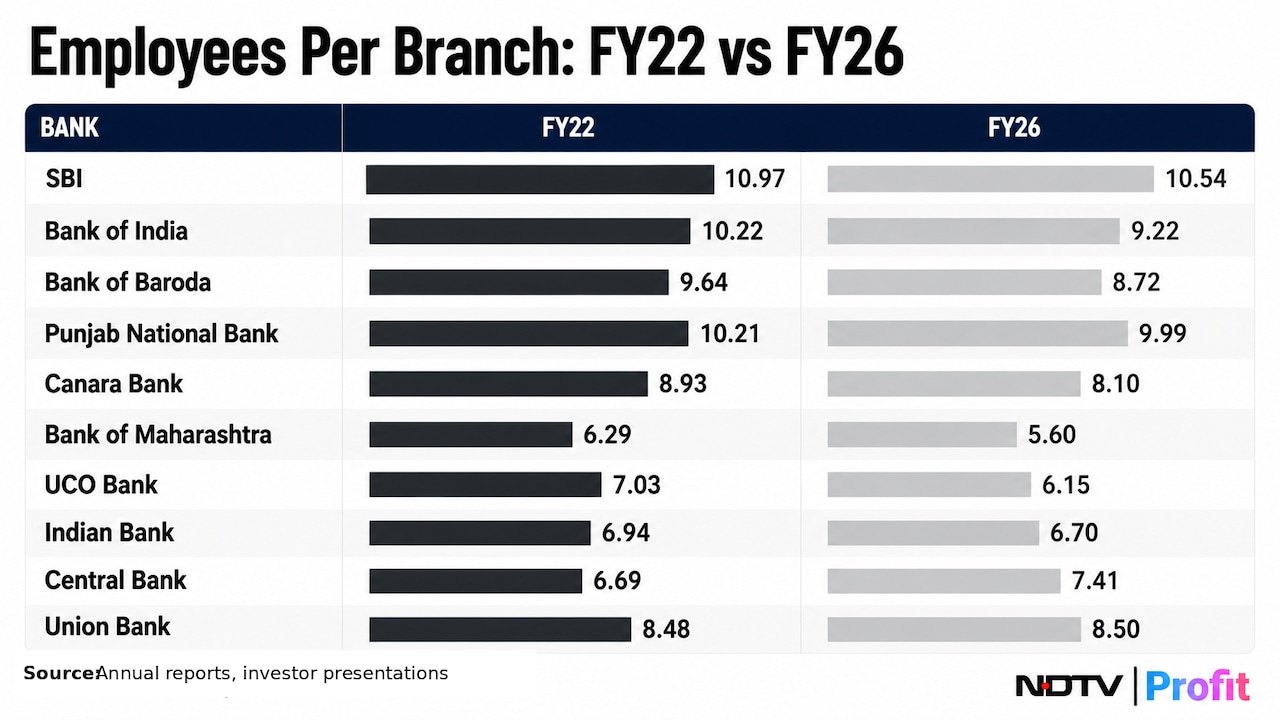
State Bank of India increased its branch network to 23,265 in FY26 from 22,266 in FY22, while employee strength rose to 245,131 from 244,250.
Bank of Baroda expanded its branch network to 8,648 from 8,168 during the same period, while employee strength fell to 75,376 from 78,740.
Bank of India increased branches to 5,533 from 5,127, while employee numbers declined to 51,010 from 52,374. Meanwhile, Canara Bank expanded its network to 10,097 branches from 9,734. Employee strength fell to 81,827 from 86,919.
ALSO READ: 97% Of Transactions Are Digital. So Why Does HDFC Bank Have 9,700 Branches?
Digital Banking
The workforce data comes as public sector lenders continue to report rapid growth in digital banking activity.
Punjab National Bank said digital transactions accounted for more than 95% of total transactions during FY26.
"The digital-first approach has shifted the landscape of the Bank's operations with digital transactions now accounting for more than 95% of all transactions," management said during the bank's earnings call. The lender also said more than Rs 20,873 crore of loans were sanctioned and disbursed digitally during the March quarter and that every third loan was sanctioned through digital channels.
Indian Bank reported that digital business increased 63% to Rs 2.72 lakh crore in FY26.
"The digital adoption rate in retail and agri has reached to 97%," Executive Director Ashutosh Choudhury said during the lender's earnings call. He also said the bank was implementing more than 10 AI and agentic AI platforms with support from more than 160 fintech partners.
Automation Push
Indian Overseas Bank told analysts it had deployed robotic process automation across several functions.
"As far as robotic process automation is concerned, we have deployed this for repetitive tasks like complaint management, batch processing, reconciliation, thereby reducing manual work and improving accuracy," management said during the earnings call.
The lender also said it had onboarded retail, agriculture and MSME loan schemes onto a loan origination platform and introduced digital account opening, e-KYC and customer service tools.
State Bank of India reported that 66% of new savings accounts originated through its Yono platform during FY26.
"At SBI, digital transformation remains a continuous journey where Yono is central to our strategy," Chairman C.S. Setty told analysts. SBI said Yono registrations crossed 4 crore within three months of the launch of its new platform and total users approached 10 crore.
Branch Expansion
The move towards digital channels has not slowed branch expansion plans.
Punjab National Bank said it plans to continue expanding its network after opening 144 branches during FY26. Other state-run lenders also added branches during the period covered by the analysis.
Bank executives repeatedly highlighted digital lending, automated workflows, AI tools, customer self-service channels and online onboarding initiatives while discussing business strategy with investors during recent earnings calls.
ALSO READ: 95% Of Transactions Are Digital. So Why Is PNB Still Opening Hundreds Of Branches?
Essential Business Intelligence, Sharp Market Insights, Practical Personal Finance Advice, Daily Fuel, Gold and Silver Prices and Latest Stories — On NDTV Profit.