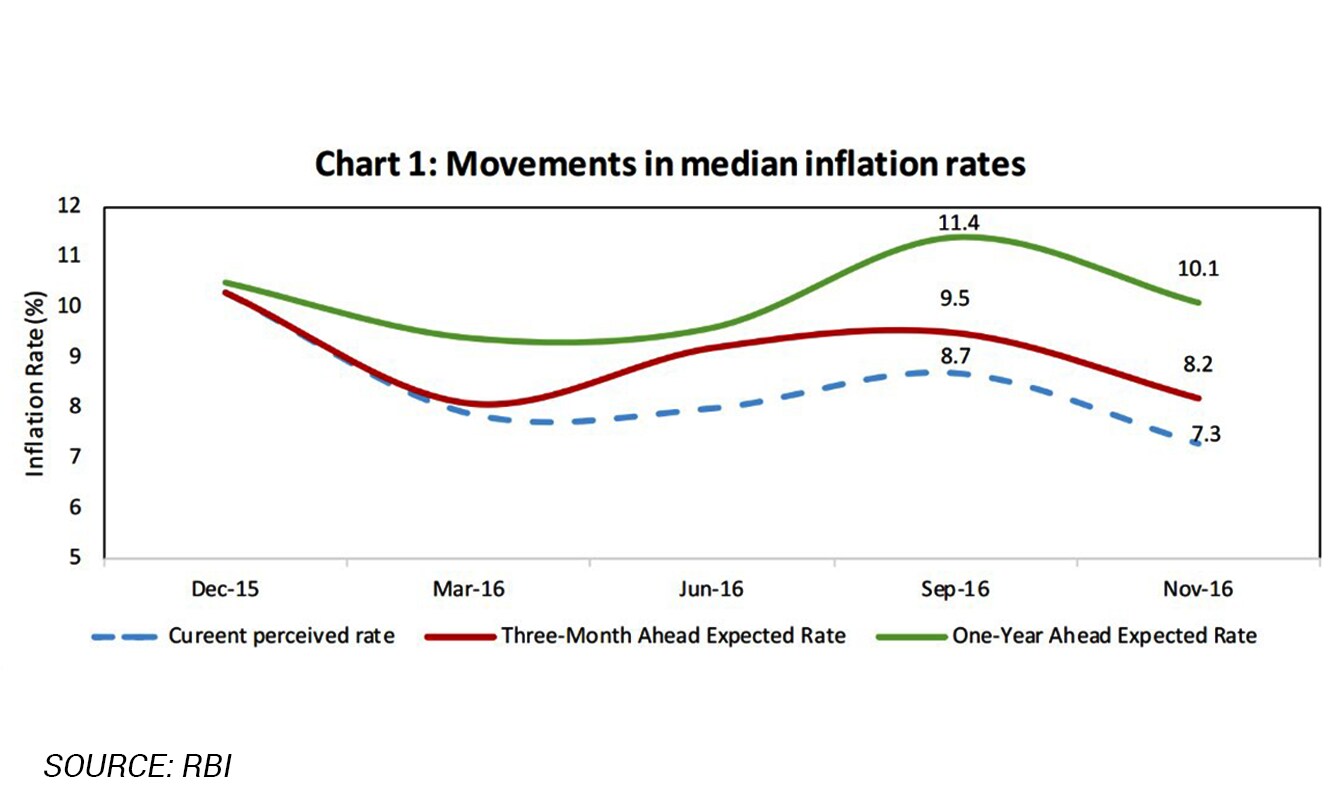
Household inflation expectations, both for the next three months and for the period a year from now, have moved down sharply, showed a survey conducted by the Reserve Bank of India. Inflation expectations are a key input into monetary policy and a decline in these expectations could lead to lower price pressures down the line.
The median inflation rates, as projected by the survey, declined from 9.5 percent in September to 8.2 percent in November for the three-month ahead period. The median inflation rates for the one-year forward period also reduced by the same amount, that is 130 basis points, to 10.1 percent, the report showed.
The current perceived rate of inflation, according to the survey, was 7.3 percent in November, down from 8.7 percent in September.
This indicates that inflation expectations are still higher than the actual data but have fallen of the past two months. In October, consumer price inflation moderated to 4.2 percent from 4.39 percent in September, and moved closer to the RBI's medium-term target of 4 percent (+/- 2 percentage points).
On Wednesday, the Monetary Policy Committee voted unanimously to maintain a status quo in interest rates. This was contrary to most estimates that pointed towards a 25 basis point reduction in the repo rate.
One of the reasons provided by the RBI was that non-food inflation pressures were persisting. The central bank retained its target for consumer price inflation at 5 percent by March 2017, but stated that the upside risks that were identified in October had waned to a certain extent.
Professional Forecasters Cut Growth Outlook
Professional forecasters polled by the RBI in a separate Survey of Professional Forecasters expect the economy to grow at 7.1 percent in terms of gross value added, 50 basis points lower than the previous survey round, the RBI said.
The median of the estimates of these professional forecasters for economic growth for the next five quarters pointed to a possible moderation to 7 percent in the current quarter. This, though, is expected to then improve to 7.4 percent till the second quarter of next financial year.
The RBI, in its fifth bi-monthly monetary policy statement, reduced its growth estimate for the current financial year to 7.1 percent from 7.6 percent earlier. This, it said, was largely on account of slower-than-anticipated growth in the second quarter of the financial year.
These forecasters also expect a moderation in consumer price inflation to 4.1 percent in the current quarter. This, however, is subsequently expected to gradually increase to 4.7 percent till the second quarter of 2017-18, the RBI said.
“The core CPI (defined as excluding food and fuel) inflation is revised up compared to the last round and is likely to remain below 5 percent till Q2:2017-18,” the central bank said.
During the press conference after the release of the monetary policy statement on Wednesday, RBI Governor Urjit Patel said that core inflation remains sticky.
“The committee felt that it is now important that the targets of 5 percent for Q4 of 2016-17 and of 4 +/- 2 percent for the medium term are achieved. This assumes critical importance in view of the stickiness of the inflation excluding food and fuel, what we call core, and the recent rising profile of international crude prices and the continuing firmness of the prices of certain salient food items,” Patel said explaining the committee's decision to hold rates.
Consumer Confidence Survey Points To Rise In Optimism
The Consumer Confidence Survey, an indicator of peoples' perception of the health of the economy and their own finances, showed an increase in the level of optimism in November compared with September, the Reserve Bank of India said in a release on its website on Wednesday. The central bank did not specify what part of the survey, if any, was conducted before the government decided to withdraw notes of Rs 500 and Rs 1000.
According to the RBI, the Current Situation Index, an indicator of the respondents' perception of the present compared with a year ago, showed a turnaround and improved by 4.5 percentage points in November to 108.7. “(This was) due to increase in net response of all parameters except price level,” the RBI said.
The Future Situation Index, which indicates respondents' expectations of how things will look one year ahead compared with the current scenario, also showed an improvement, though at a lower rate of 2.2 percentage points to 125.5.
A reading above 100 shows sentiment is moving upwards.
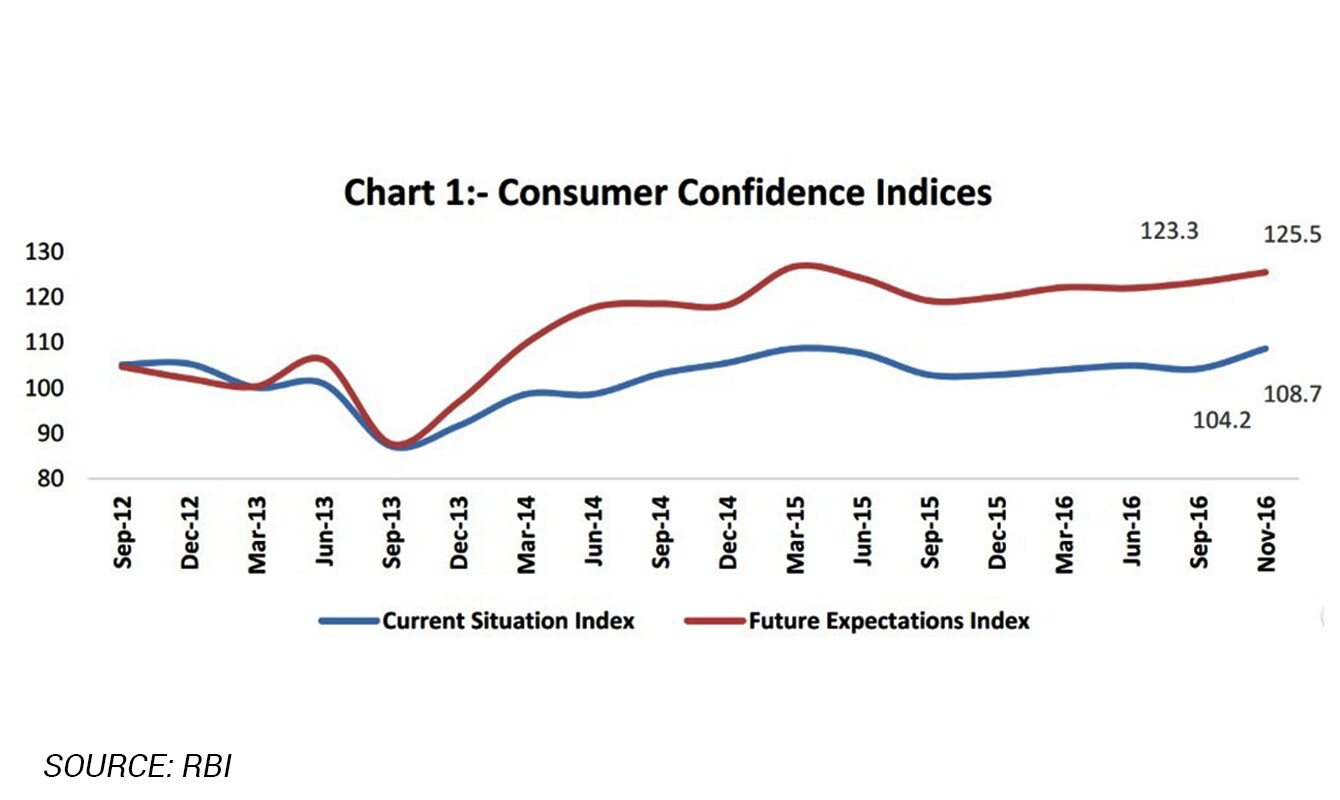
The survey showed that more respondents felt there would be an improvement in the economy both in November and one year down the line.
Likewise, there was a reduction in the number of respondents that felt that their current income would decrease or remain the same, and a subsequent increase in those that felt that their income would increase in November. Compared with September, a larger number of respondents expected their incomes to increase after a year.
Essential Business Intelligence, Sharp Market Insights, Practical Personal Finance Advice, Daily Fuel, Gold and Silver Prices and Latest Stories — On NDTV Profit.