(Bloomberg Opinion) -- I instinctively fill up my car whenever war breaks out in the Middle East, yet it appears my better-safe-than-sorry anxiety is premature. Nearly a month after Hamas attacked Israel, oil prices have barely inched higher.
The reason? For now, despite ample rhetoric on both sides, Tehran and Washington are trying to prevent an energy crisis on top of the diplomatic one.
Let me emphasize “trying” and “for now” here. As oil trading throughout this geopolitical crisis continues, one should remember former UK Prime Minister Harold Macmillan's warning: “Events, dear boy, events.” As a whole, oil traders seem relaxed. Brent crude, the global benchmark, closed at $84.58 a barrel on Oct. 6, the day before Hamas militants attacked Israel in a surprise dawn raid, killing more than 1,000 people and taking hundreds of hostages. Almost a month later, with several thousands more killed on the Palestinian side amid Israel's fierce retaliation, Brent is only slightly elevated.
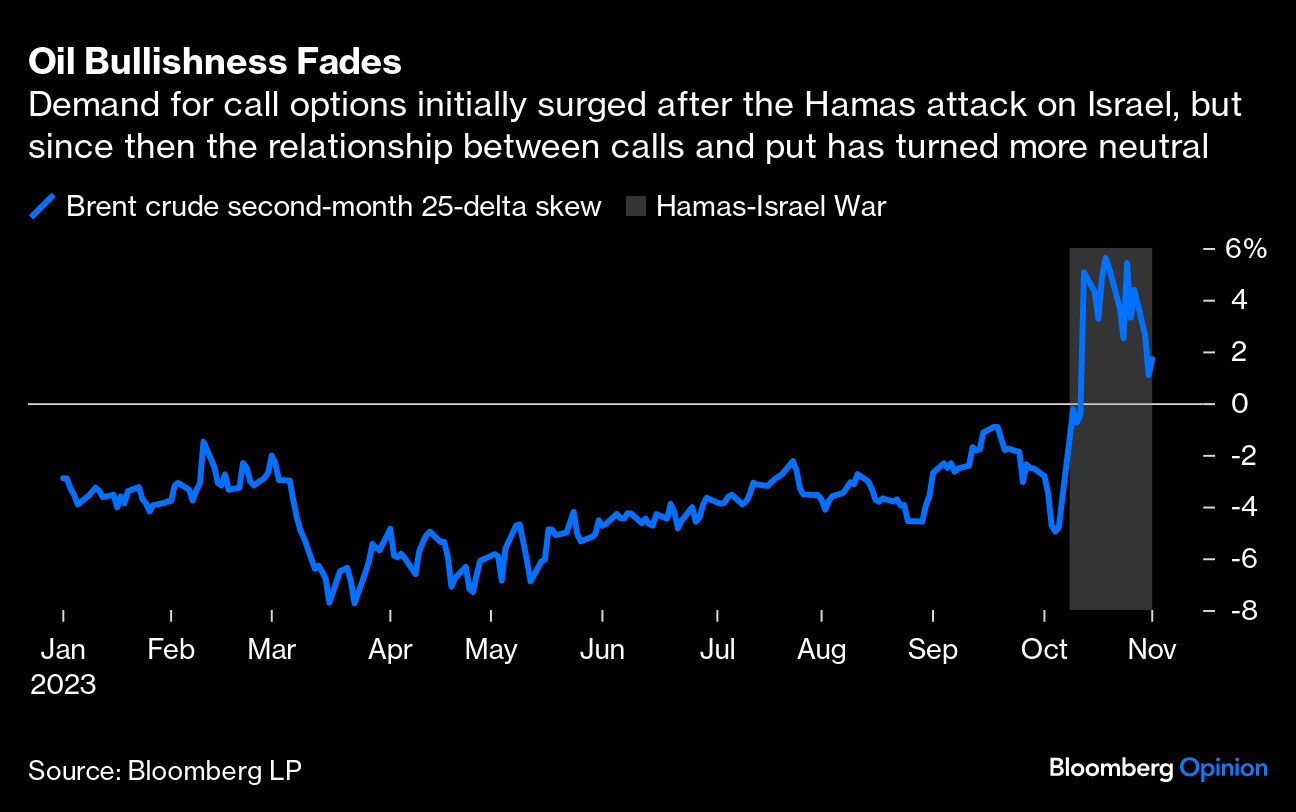
On Wednesday this week, it changed hands at just above $85.But what about the options market, the arena where tail risk is priced? Shortly after the attack, the so-called put-call option skew turned bullish as traders priced in the risk of a spike. Since then, the skew has given up most of its gains.
Tellingly, the open interest on the call option contract that would profit from oil rising to $100, $110 and $115 over the next three weeks has declined the past couple of days, after more than doubling since October. That's perplexing. The likelihood of a wider regional war may be far-fetched, but its impact would be severe. In market parlance: The tail is rather fat. It does feel like the options market is a bit too sanguine.
The Hamas strike came on the eve of the 50th anniversary of the world's first oil crisis, and the parallels between October 1973 and October 2023 were easy to draw. But as I warned in my tentative reaction after the attack, the resemblance ended quickly. The main upside risk for oil prices — both a month ago and now — is if the war directly engulfs Iran.
For as much as Iran's proxy groups are harassing Israeli and US troops, Tehran doesn't seem in a hurry to enter a regional war. Nor is Washington rushing to strictly enforce its longstanding oil sanctions on the Islamic Republic, a move that would reduce global oil supply going into 2024. In the eyes of bearish oil traders, each day that passes without a broadened conflict is another day that the threat recedes.
There's a grain of truth in that argument.Consider the American position: Other than a letter signed by dozens of lawmakers pushing for penalties, Washington hasn't even verbally threatened Iran with sanctions enforcement. The Biden administration has spent the past few weeks deflecting. US Treasury Secretary Janet Yellen went as far as saying America had not “in any way relaxed” its current sanctions. Technically, that's true; but practically, it isn't.
Instead, Washington appears to have relaxed enforcement rather than the restrictions themselves. The result is nevertheless the same: As fighting rages in Gaza, Iranian oil production is heading this month to a fresh five-year high of about 3.4 million barrels a day. For the Biden administration, it's the necessary cost to keep prices relatively low ahead of the 2024 presidential election. For Iranian Supreme Leader Ali Khamenei, it's a gusher of petrodollars helping a weak economy.
Now, from the other side: Khamenei, in a fairly theatrical move, had called for an oil embargo on Israel — more noise than actual risk. And Iranian officials have repeatedly warned about an all-out regional conflagration, making the probability somewhat credible by pushing the country's proxies into saber-rattling. But if all that yields is a few anti-tank rockets from Hezbollah in Lebanon and a handful of cruise missiles from the Houthis in Yemen, the hazards will soon appear to be more a war of words than a real one.
One theory I hear from oil-market insiders is that Iran sees the initial attack by Hamas as a “catastrophic success” — an operation that went too well. If true, détente is more likely than aggression.If those arguments prove correct, then oil would continue to flow freely into a slowing global economy. With demand growth softening and plentiful Iranian and US shale oil, the outlook is that prices would drop further into 2024.
I'm inclined to support those arguments, but with an important caveat relearned over years of reporting about oil and war. The longer the conflict goes, the more likely that some random event forces everyone's hand in ways that no one — least of all oil traders — expected. Stuff does happen — and even more in the Middle East. Maybe this isn't a market to go long, but shorting oil? That's brave.
More From Bloomberg Opinion:
Biden's Foreign Policy Vision Is Officially Dead: Hal Brands
In the World of Oil Sanctions, Venezuela Is No Iran: Javier Blas
Iran Doesn't Want Hezbollah Fighting Israel: Bobby Ghosh
This column does not necessarily reflect the opinion of the editorial board or Bloomberg LP and its owners.
Javier Blas is a Bloomberg Opinion columnist covering energy and commodities. He is coauthor of “The World for Sale: Money, Power and the Traders Who Barter the Earth's Resources.”
More stories like this are available on bloomberg.com/opinion
©2023 Bloomberg L.P.
Essential Business Intelligence, Sharp Market Insights, Practical Personal Finance Advice, Daily Fuel, Gold and Silver Prices and Latest Stories — On NDTV Profit.