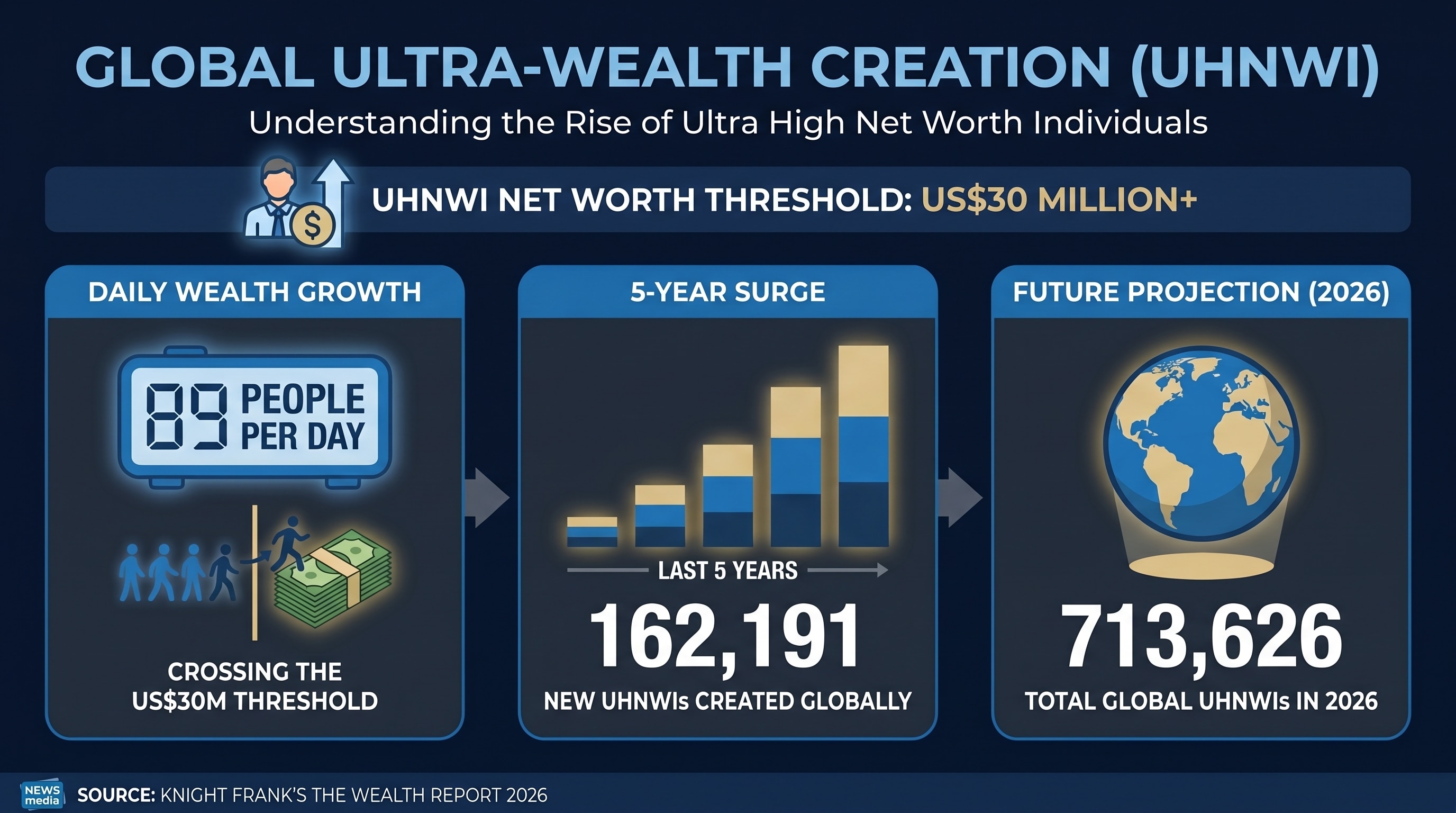
The world is creating new ultra‑rich individuals at a pace that would have sounded implausible a decade ago. Over the last five years, 89 people, every single day, crossed the US$30 million net‑worth mark, according to Knight Frank's Wealth Report 2026. That relentless churn has pushed the global population of ultra‑high‑net‑worth individuals (UHNWIs) to 713,626, underscoring how wealth accumulation at the very top continues even in an era marked by war, inflation scares and geopolitical fault lines.
Now, this isn't a short-term spike. Knight Frank's data shows a sustained, compounding trend, describing how capital accumulation among the world's richest remains structurally strong.
The US Effect: Scale Still Wins
This expansion is not evenly spread. The United States remains the undisputed engine of global wealth creation, accounting for 41% of all newly minted UHNWIs over the past five years. Its sheer economic scale, deep capital markets and technology-driven wealth cycle have allowed fortunes to be created, reinvested and multiplied at industrial speed. Knight Frank estimates that by 2031, the US alone will be home to 41% of the world's US$30 million-plus population.
Also Read | Layoffs Are Rising In Tech, But These Skills Are Helping People Unlock Better Pay
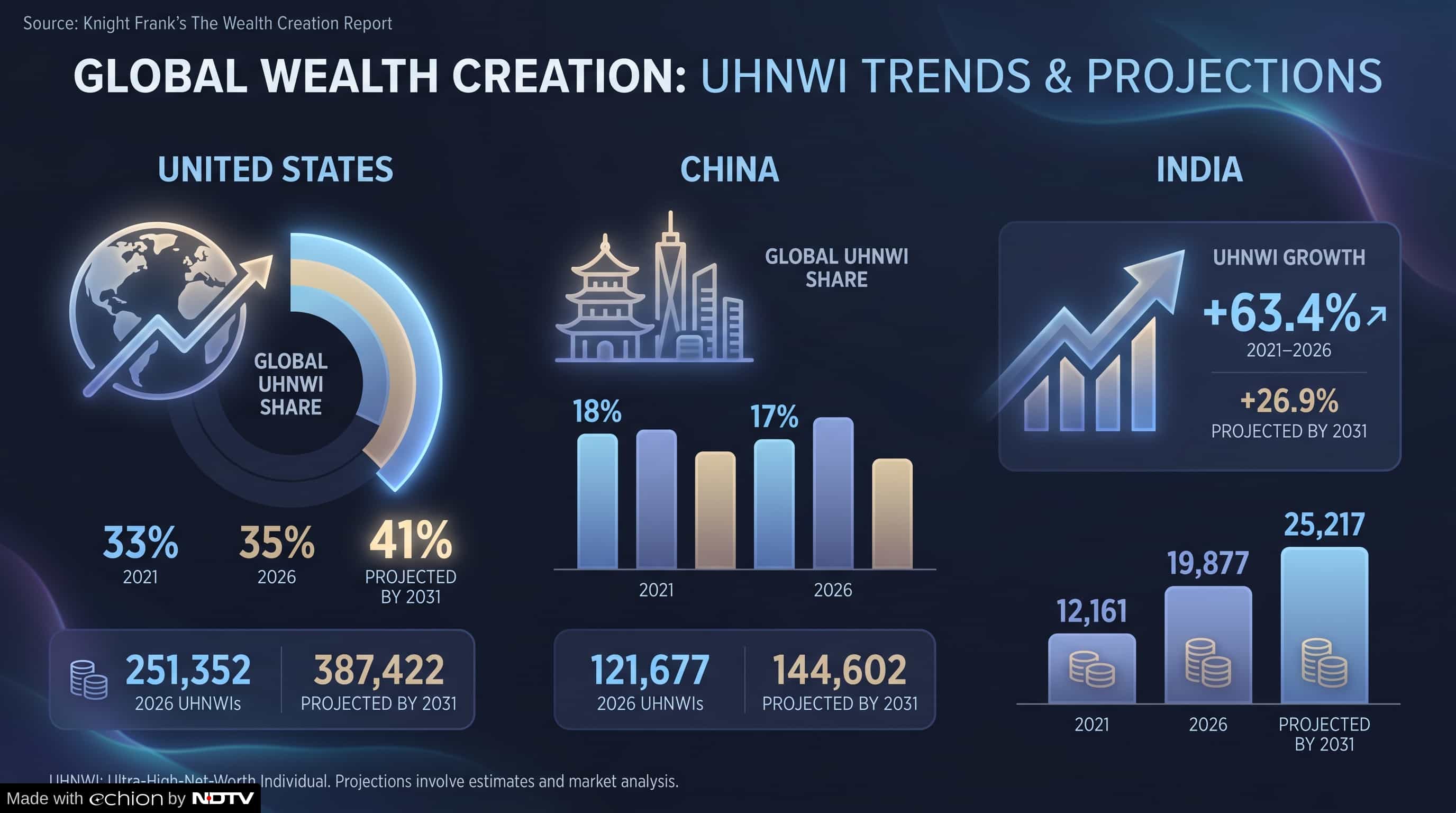
China still ranks as the second-largest pole of wealth creation, but its relative share is easing. While its ultra‑wealthy population continues to grow in absolute terms, it is not keeping pace with the US. India, by contrast, is quietly emerging as a standout counterbalance. The country's UHNWI population has surged more than 60% in the past five years, rising to nearly 20,000 individuals. By 2031, that figure is projected to cross 25,000, reinforcing India's position as one of the fastest-growing wealth markets globally.
More Than Just Asset Inflation
The pace of accumulation reflects more than just rising asset prices. Knight Frank points to structural forces that have proved resilient through multiple shocks: the financialisation of economies, technology-led entrepreneurship, and the ability of private capital to scale rapidly. Even as the global economy adjusts to renewed geopolitical stress—including war-driven energy volatility and inflation pressures—wealth creation at the top continues to outstrip overall GDP growth.
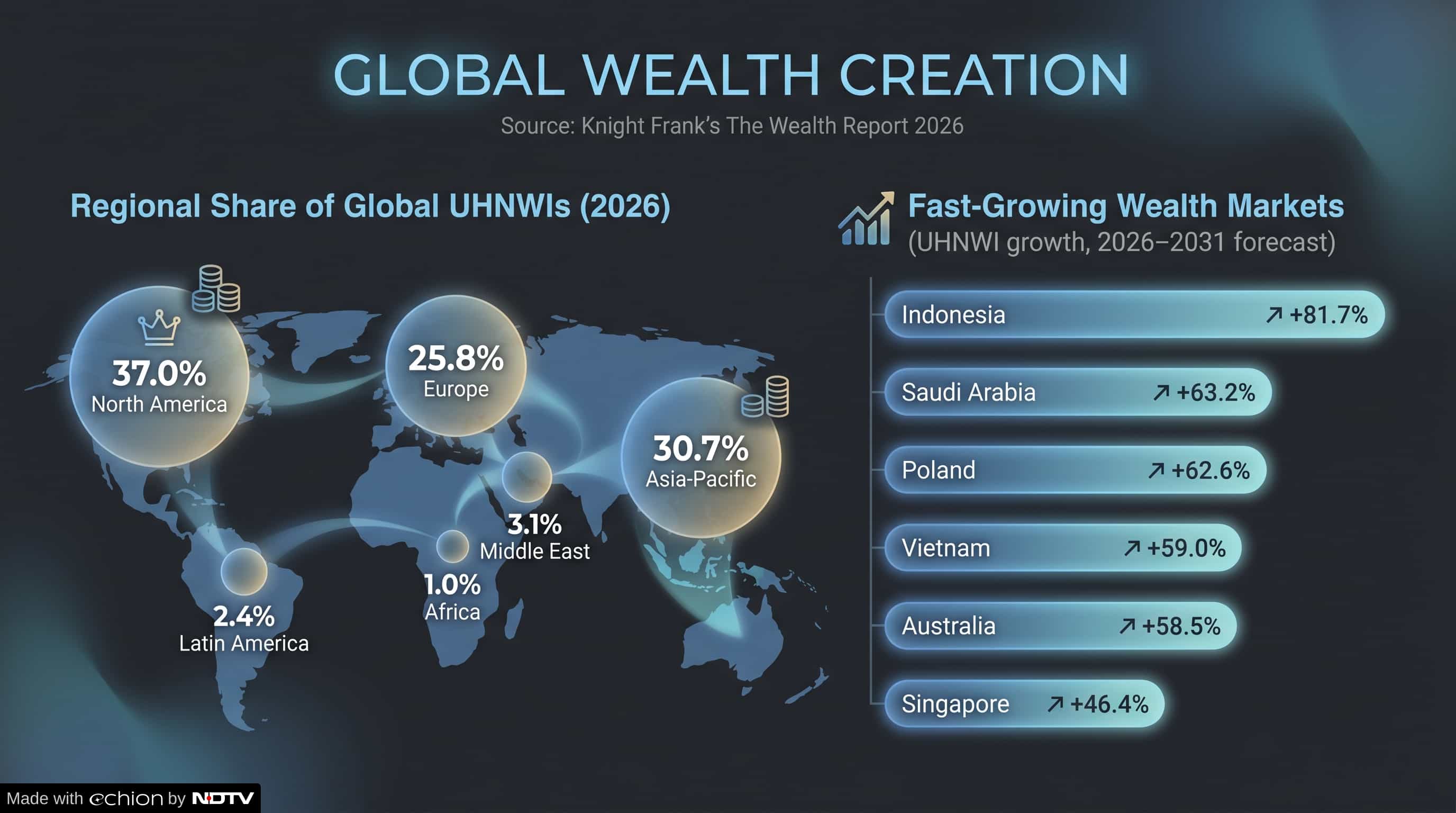
This concentration has knock-on effects. Accelerating wealth creation is insulating prime residential real estate and luxury assets from broader economic volatility. At the same time, rising wealth taxes and political rhetoric in mature markets are making the ultra‑rich increasingly mobile, fuelling cross-border capital flows and a “dip‑in, dip‑out” lifestyle rather than permanent relocation.
Knight Frank also flags a geographic broadening of wealth creation beneath the headline dominance of the US. Rapid growth in markets such as Indonesia, Saudi Arabia and Poland shows that new centres of extreme wealth are forming, even as capital continues to cluster in a handful of global hubs.
ALSO READ: India's Luxury Market Grows Without Structural Depth | The Reason Why
Essential Business Intelligence, Sharp Market Insights, Practical Personal Finance Advice, Daily Fuel, Gold and Silver Prices and Latest Stories — On NDTV Profit.