Emerging Market Currencies Fall After U.S. Jobs Surprise Prompts Fed Repricing
(Bloomberg) -- Emerging-market currencies weakened Friday after US job growth surged above expectations, causing traders to reprice odds the Federal Reserve cuts interest rates in the first half of the year.
Nonfarm payrolls climbed 303,000 last month, the strongest in nearly a year, following a combined 22,000 upward revision to job gains in the prior two months. Following the release, Fed swaps shifted full pricing of a rate cut to September from July and Treasury 10-year yields climbed to the highest in over four months.
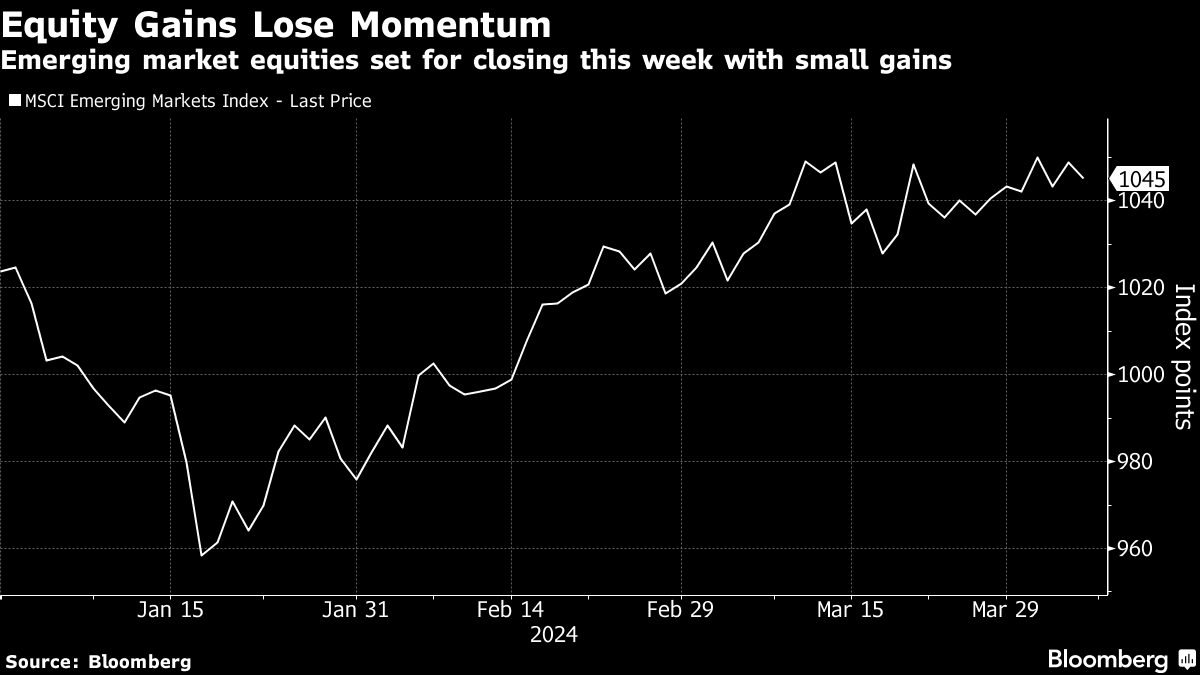
A gauge for EM currencies weakened, dragged down by the Chilean peso and the South Korean won. MSCI Inc.'s benchmark for EM equities fell 0.4% and pared this week's gains to less than 0.2%.
This “shifts rate cut expectations further out the curve which will keep the USD strong,” said Brad Bechtel, global head of FX at Jefferies Financial Group Inc.
The roaring data added to risk-off sentiment that already took a toll on assets Thursday afternoon as traders found themselves grappling with inflation concerns after an oil-price spike driven by Middle East tensions and digesting remarks from a Fed official that raised doubts whether the US central bank can cut rates this year.
Fears of an escalation in the Middle East sent oil prices above $90 a barrel for the first time since October. Israel was preparing for a potential retaliation by Tehran after Monday's strike on an Iranian diplomatic compound in Syria. Sentiment was further soured by Fed Bank of Minneapolis President Neel Kashkari, who said Thursday that rate cuts may not be needed this year if progress on inflation stalls.
“The market now knows that some kind of retaliation from Iran will likely come but it doesn't know when and where and what,” said Bjarne Schieldrop, an analyst at SEB Research. “That creates a great discomfort and nervousness.”
The shekel appreciated against the dollar after the US said it welcomes the steps announced by the Israeli government as requested by President Joe Biden to ease the flow of aid into Gaza. Turkish lender Yapi Ve Kredi Bankasi AS jumped 6% after a Bloomberg report that First Abu Dhabi Bank PJSC is studying potential acquisition targets in Turkey including the lender.
WuXi Biologics and other China biotech stocks fell in Hong Kong amid concerns that the impact of the US's Biosecure Act could become more widespread.
Read more: Zimbabwe Replaces Battered Dollar With New Unit Called ZiG
Zimbabwe announced its new currency policy on Friday, replacing its battered dollar with a new currency called ZiG, which will be backed by a basket of foreign currencies, gold and other precious metals.
--With assistance from Leda Alvim.
More stories like this are available on bloomberg.com
©2024 Bloomberg L.P.

-
Ten Things I Learnt This Samvat

Patience can be a trap. Cheap stocks can stay cheap. Leverage can wipe you out. What did Samvat 2082 teach us? Niraj Shah writes on 10 lessons from the year gone by.
-
Talking Points This Week: Tech Nerves, FII Buying, And A Faraway Banking Shock
The global markets are not shining this Diwali. The exception in the large markets is, India.
-
Midterm Rally Lasted A Day. The Hard Reality Of A Divided US May Last Two Years | Opinion
Between a contested AI boom, a debt ceiling that arrives in 2027 and a president with every incentive to act alone, the next two years may prove more volatile than the first day's rally suggests.
-
Blue Wave Will Derail the AI Trade but Won't Dismantle the AI Era | Unhedged Position
The Democrats' sweep of the US Congress will see politics collide with economic forces both over the long and short term.
-
It's Time To Take The GST Council's Bet On Trust Global
Payment records can prove India's services exports, and clear, proportionate rules can bring foreign digital sellers into the tax net.
-
Opinion | India at 38: From Innovation Overperformer to Innovation Powerhouse
India now has 453 VC-backed deep science startups, 18 of them late-stage, after 117 percent growth since 2020. Laurus Labs, at USD 9.3 billion, is the most valuable deep science company in any middle-income economy outside China.
-
Navigating Energy Crossroads: S Jaishankar's Call For Diversified Supply Chains At G20 Ministerial Meeting
As geopolitical fault lines continue to test maritime trade routes and commodity flows, Jaishankar's message remains pertinent: true economic resilience requires open markets, protected transit lines, and a genuine commitment to multilateral cooperation rather than coercion.
-
Indians Are Travelling, But Not Every Journey Is A Holiday | The Week In Whys
Pilgrims, patients and working women are the real travellers, and the system hasn't quite caught up with them.
-
Getting To Work Costs Women More | The Reason Why
It is not just about women paying more than men. It is about women paying much more in cities than in villages.









