Poorest EU Member Faces Risk To Euro Goal In Coalition Fight
(Bloomberg) --
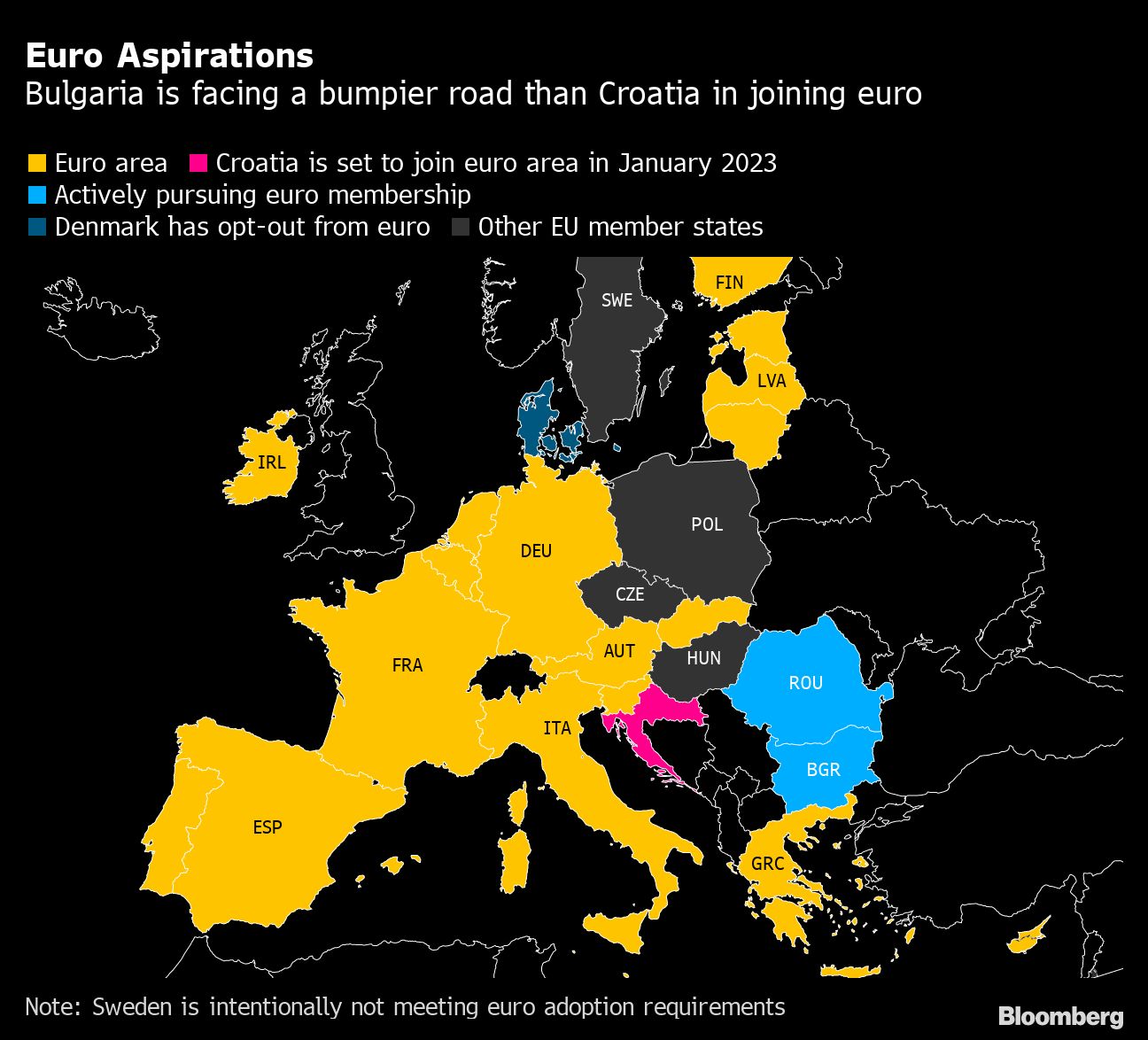
As Croatia is sailing through euro adoption and is poised to join the currency area on Jan. 1, political bickering in another European Union member is complicating its path.
Bulgaria's government approved a plan this week to take on the euro in 2024, with Prime Minister Kiril Petkov arguing that it will help the EU's poorest member to lure investment, boost the economy and improve living standards.
But two junior members of his ruling coalition, the Socialists and the upstart There Is Such a People party, known as ITN, have vowed to throw a wrench in the process. They've called for a parliamentary vote on a cost-benefit analysis from the Finance Ministry and the central bank, which could imperil the plan to swap the national currency for the euro.
“There Is Such a People will try to delay the implementation of the National Plan to adopt the euro,” the party said in a statement this week.

Still, the dispute underscores Bulgaria's struggles. A spate of banking scandals have created wariness among older euro-area members toward letting it in even as authorities say the troubles are in the past.
At home, support for euro-zone entry is mixed. Less than 40% of Bulgarians support the euro as the bloc's single currency, nearly twice as low as the EU average, according to a Eurobarometer survey published in April.
Bulgaria meets many of the formal criteria and the lev is already pegged to the euro. But media frequently warn that switching the currency may push up prices -- inflation is already at an almost 14-year high -- while the nationalist opposition says adoption would rob Bulgarians of part of their sovereign identity.
In the same report that gave a green light for Croatia to join next year, the European Central Bank said inflation in Bulgaria was “well above the reference value of 4.9% for the criterion on price stability” and is expected to rise.
The European Commission, the EU's executive arm, said Bulgaria was working to improve its business environment and financial stability, but it also had sharp criticism.
“Selected indicators related to the business environment show that Bulgaria performs worse than many euro area member states,” the Commission wrote. “Challenges also relate to the institutional framework including corruption and government efficiency.”
According to Bulgarian Finance Minister Assen Vassilev, the administration is pushing forward with the plan approved by the cabinet, which includes preparing banks and retailers for the switch and making changes to banking regulations.
Lawmakers are scheduled to discuss the cost-benefit analysis demanded by ITN and the Socialists next week.
“I hope for a clear commitment, both on behalf of the banks and on behalf of the parliament, so that there is no delay of the processes of euro adoption,” Vassilev told reporters on Thursday.
Central bank Governor Dimitar Radev, who has remained in his position almost a year after his term expired because ruling parties can't agree on a replacement, said the question whether Bulgaria should join the euro area amid the war in Ukraine is “rhetorical.”
“Under the current geopolitical situation, to me, the logical answer is -- now, or as soon as possible, and not in 5 or 10 years,” Radev told lawmakers. “The difference is that Croatia demonstrates a very clear and strong political engagement with the process.”
(Updates with survey in sixth paragraph, central bank comments in last)
More stories like this are available on bloomberg.com
©2022 Bloomberg L.P.

-
Talking Points This Week: Leadership Shock At Nvidia, Earnings Strength, And The Fog Over Hormuz

The Anthropic IPO pricing and first trading day, Nvidia's upcoming earnings, and any fresh signals from Iran will set the tone for the following week.
-
Signature Play: The Classic Cocktail Is Dead. Or Is It?
Classic cocktails are disappearing from India's cocktail menus. But they're still being ordered, taught to bartenders and borrowed from. So, who's really having the last drink?
-
A New Samvat Wishlist: Inclusive Prosperity And Human Development
India has strengthened its economic foundations through infrastructure, digital access and enterprise. Its next growth chapter must deepen productivity, create better livelihoods and widen participation in prosperity.
-
Love, Sex Aur Dhokha: The Audacious Plot To Spy On Jensen Huang
A Taipei dinner, a Singapore chip buyer and a suspected Chinese asset: inside the alleged spy operation that got close to NVIDIA's Jensen Huang.
-
Ten Things I Learnt This Samvat
Patience can be a trap. Cheap stocks can stay cheap. Leverage can wipe you out. What did Samvat 2082 teach us? Niraj Shah writes on 10 lessons from the year gone by.
-
Talking Points This Week: Tech Nerves, FII Buying, And A Faraway Banking Shock
The global markets are not shining this Diwali. The exception in the large markets is, India.
-
Midterm Rally Lasted A Day. The Hard Reality Of A Divided US May Last Two Years | Opinion
Between a contested AI boom, a debt ceiling that arrives in 2027 and a president with every incentive to act alone, the next two years may prove more volatile than the first day's rally suggests.
-
Blue Wave Will Derail the AI Trade but Won't Dismantle the AI Era | Unhedged Position
The Democrats' sweep of the US Congress will see politics collide with economic forces both over the long and short term.
-
It's Time To Take The GST Council's Bet On Trust Global
Payment records can prove India's services exports, and clear, proportionate rules can bring foreign digital sellers into the tax net.
-
Opinion | India at 38: From Innovation Overperformer to Innovation Powerhouse
India now has 453 VC-backed deep science startups, 18 of them late-stage, after 117 percent growth since 2020. Laurus Labs, at USD 9.3 billion, is the most valuable deep science company in any middle-income economy outside China.









