Alibaba Gets Rare Wall Street Downgrade As Rival Gains Traction
(Bloomberg) -- Alibaba Group Holding Ltd. received a rare downgrade from Wall Street on the same day it lost its crown as China's most valuable e-commerce firm to one of its main rivals.
Morgan Stanley cut its rating on Alibaba's American depositary receipts to equal-weight from overweight, lowering its price target to $90 from $110. That's the first downgrade on the company's US-listed shares since late June, according to data compiled by Bloomberg.
Alibaba is seeing a slower-than-expected turnaround, and its decision to withdraw the spinoff of its cloud business “brings uncertainty to the value-unlocking from reorganization,” analysts including Eddy Wang and Gary Yu wrote in a report dated Thursday.
At the same time, Morgan Stanley named PDD Holdings Inc. as its top pick in China's e-commerce sector, viewing it as “best placed amid the increasingly entrenched trait of consumer price sensitivity.”
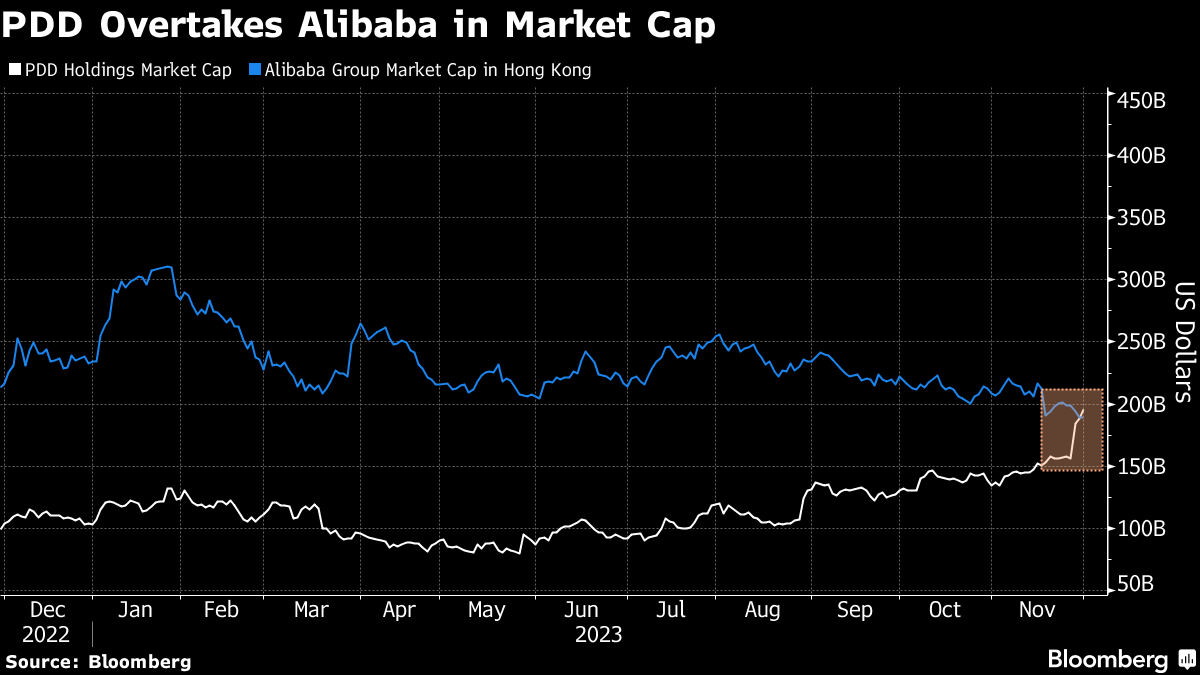
PDD — the eight-year-old upstart best known for its hit Temu marketplace — closed Thursday trading in the US with a market cap of about $196 billion, surpassing Alibaba's value for the first time. PDD has surged more than 80% so far this year while Alibaba has dropped 15% in US trading.
While Jack Ma's Alibaba has become an icon in the internet industry, dominating online shopping in China for more than a decade, PDD has been able win customers at home and expand abroad with cut-rate pricing.
Morgan Stanley also removed Alibaba from its China/HK Focus List, replacing it with mainland-listed Aluminum Corporation of China Ltd.
Brokers still remain largely bullish overall on Alibaba, whose ADRs have 44 buy ratings and eight recommendations at the equivalent of hold. That compares with 52 buys and three holds for PDD.
More stories like this are available on bloomberg.com
©2023 Bloomberg L.P.

-
Gold Is Rs 22,000 Cheaper Than A Month Ago. Should You Buy Amid The Wedding Season?

Gold's potential slide to $3,500 could save around Rs 4,700 per 10 grams, but a soft inflation print could just as easily push prices back up. One way to split the risk is to buy in parts, some now and the rest after the Fed's Dec. 9 decision.
-
AI Agents Are Gaining Power. Who Governs Them?
Artificial intelligence agents promise to transform productivity by moving machines from assisting decisions to executing them. But as organisations delegate greater authority to these AI-agents, they must first establish who controls that authority and who remains accountable when things go wrong.
-
Why Swapping Your Old Gold Can Trigger A Rs 5 Lakh Tax Bill, And How You Can Avoid It Legally
Swapping old gold for new is taxed as a sale and a fresh purchase. Getting your own gold remade can cut most of that bill, though it has its own costs.
-
The AI Trade is Done. The Real Opportunity for Investors Starts in 2027 | Unhedged Position
As pureplay AI stocks plunge and circular, capex-led financing unwinds, 2027 is set to be a year of reckoning for AI companies. Yet the bust clears the way for a better opportunity for investors in 2027 -- shifting the spotlight from AI builders to the companies using AI.
-
Leadership As Mission: Why The Age Of AI Demands More Human Leadership
Debjani Ghosh examines how AI is changing leadership, arguing that its success must be measured by its impact on people and the accountability of those guiding its use.
-
We May Need Another Tukaram Mundhe To Fight Air Pollution | The Reason Why
Developers may install basic measures such as sprinklers and green nets, resume work, and continue violating rules when this equipment stops working.
-
Extracting Value From Battery Scrap Could Be Challenging For India | The Reason Why
A discarded lithium-ion battery still contains valuable materials such as lithium, nickel and cobalt. These can be recovered and reused. When such batteries are crushed and shredded, they produce a dark powder called black mass.
-
One El Nino, India Can Handle. Two Could Break The Granary
India's grain stocks can absorb one bad year, but a second El Nino could drain the buffer in two to three years, economists say.
-
India's Troika Of Good Luck | Joining The Dots
As Jensen Huang's exit drags Nvidia down, a cooling AI trade and resilient earnings have revived investor interest in India. A likely RBI rate hike looms.
-
Talking Points This Week: Leadership Shock At Nvidia, Earnings Strength, And The Fog Over Hormuz
The Anthropic IPO pricing and first trading day, Nvidia's upcoming earnings, and any fresh signals from Iran will set the tone for the following week.









