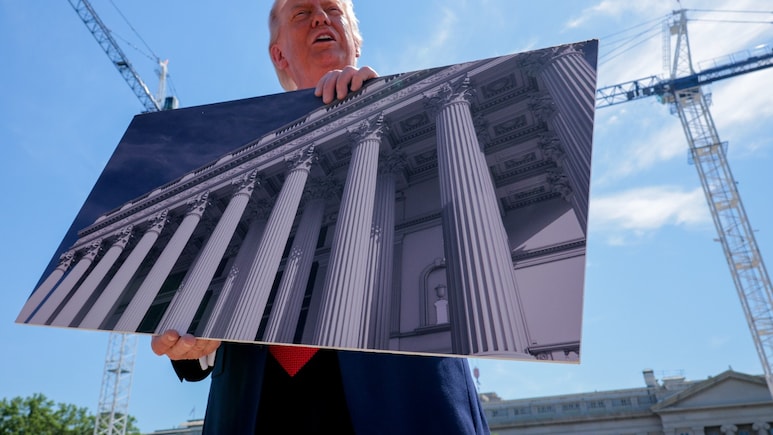
The US Supreme Court let President Donald Trump keep building his new White House ballroom for now, brushing aside conclusions by two lower courts that he is probably violating the law.
Granting a Trump request over four dissents, the justices on Monday put on hold a ruling that was poised to block most above-ground construction of the 90,000-square-foot facility. Although the high court order is temporary, it all but guarantees Trump can complete the vast majority of the structure before the legal fight concludes.
The decision marks a triumph for Trump, who has pursued the project even as he grapples with a Middle East war, a shaky economy and plummeting poll numbers that have put Republicans at risk of losing control of Congress in the November midterms.
Also Read | Layoffs Are Rising In Tech, But These Skills Are Helping People Unlock Better Pay
The court's majority agreed with the administration that the historic preservation group that sued likely lacked legal standing, based on representations from one of its members that they were harmed by seeing the project take shape. "Mere offense, disagreement, or distaste does not qualify as a concrete and particularized injury," according to the unsigned decision by the majority, which included Justices Samuel Alito, Clarence Thomas, Brett Kavanaugh, Neil Gorsuch and Amy Coney Barrett.
ALSO READ: US-Iran War: Full Scale Strikes To Resume Amid Hormuz Tensions? Trump Says...
Yet the "construction is likely unlawful," Chief Justice John Roberts wrote in a dissent joined by the court's three liberals, Justices Sonia Sotomayor, Elena Kagan and Ketanji Brown Jackson. Congress has explicitly prohibited the construction of any "building or structure" on grounds of the federal government in the District of Columbia without congressional authorization, he wrote. "Yet Congress has not passed any law resembling 'express authority' for the Executive's construction of it."
The "aesthetic injury" claimed by the challengers was enough to give the preservation group standing to sue, Roberts wrote.
The majority didn't rule on the merits of the dispute over the lawfulness of the ballroom project absent congressional approval. The Justice Department next can file a formal petition for the high court to hear the full case.
In a social media post Monday, Trump said he was "pleased" by the ruling. "When completed in the Summer of 2028, the magnificent Ballroom and Military Complex will be something that the entire Country is very proud of," he said, adding that the project was "under budget and ahead of schedule."
65% Finished
The ballroom has been the centerpiece of Trump's campaign to remake the White House complex to reflect his own vision of the presidency. His desire to build a ballroom dates back at least to 2011, when he said he had offered to build one for free during Barack Obama's presidency.
The administration says the project is already 65% built and is on track to be finished by August 2028. The preservation group challenging the ballroom accused Trump of trying to make it a "fait accompli" by racing to complete construction.
Assuming it is completed, the facility will be larger than the White House mansion and West Wing combined, with a security bunker underneath. Trump demolished the East Wing to make way for the ornate structure.
Trump told the Supreme Court he is building a "highly integrated military complex that incorporates a classical, but highly secured, ballroom and crucial national-security facilities."
The project is being challenged by the National Trust for Historic Preservation in the United States, a nonprofit organization chartered by Congress to preserve and promote the country's architectural and cultural heritage.
A key question was whether the National Trust had legal standing to sue over the construction. The US Court of Appeals for the District of Columbia Circuit said the group had standing because of the "historic, architectural, and aesthetic interests" at stake, as well as the impact on a National Trust member who frequently passes by the White House.
The administration told the Supreme Court that "to recognize standing based on a casual observer's preferences invites serial litigation and abuse." The National Trust countered that the National Park Service's own environmental assessment pointed to "permanent adverse impacts on the cultural landscape" of the area surrounding the White House.
In a statement, National Trust Chief Executive Officer Brent Leggs said it was "noteworthy that the majority did not weigh in on whether the ballroom project was in fact legal." He added, "this is not the final decision on the merits of our case and does not resolve our fundamental argument - that each President is a temporary steward of the People's House and does not have the unilateral authority to demolish and redesign it without the approval of Congress."
ALSO READ: Trump Squeezes Mid-Size Pharma For Cheaper Drugs In $64-Billion Savings Push
'Executive Self-Help'
In its 2-1 ruling, the DC Circuit said the Constitution gives Congress full control over federal property. The majority rejected Trump's contention that lawmakers authorized the project through a 1978 law that lets the president spend appropriated sums to maintain and improve the White House residence.
"Whether or not a massive ballroom should be constructed is for Congress to decide and is not a matter for executive self-help," wrote Judges Patricia Millett and Bradley Garcia, both Democratic appointees. Republican-appointed Judge Neomi Rao dissented.
The justices in dissent saw the case similarly. The majority's order "is no victory for the separation of powers," Roberts wrote.
The majority credited representations by various national security, military and law enforcement agencies that the above-ground part of the project was "crucial" to securing a below-ground section that the lower courts said could proceed.
The administration says the ballroom will be funded entirely through $400 million in private donations, though that doesn't include the security bunker. Democrats say the administration appears to be diverting almost $400 million that was allocated for the Secret Service last year in Trump's tax-cut law.
Trump has spent much of his second presidential term trying to leave his physical imprint throughout the Washington area. He is also pushing to construct a 250-foot arch and build a championship-level golf course near the Jefferson Memorial. After a board with numerous Trump appointees added his name to the John F. Kennedy Memorial Center for the Performing Arts, a court ordered that it be removed. In each case, the administration did not get explicit congressional approval or funding.
The case is National Park Service v. National Trust for Historic Preservation in the United States, 26a203.
(This story has not been edited by NDTV staff and is auto-generated from a syndicated feed.)
Essential Business Intelligence, Sharp Market Insights, Practical Personal Finance Advice, Daily Fuel, Gold and Silver Prices and Latest Stories — On NDTV Profit.