Thai PM Srettha To Hold Finance Minister Post In Rare Move
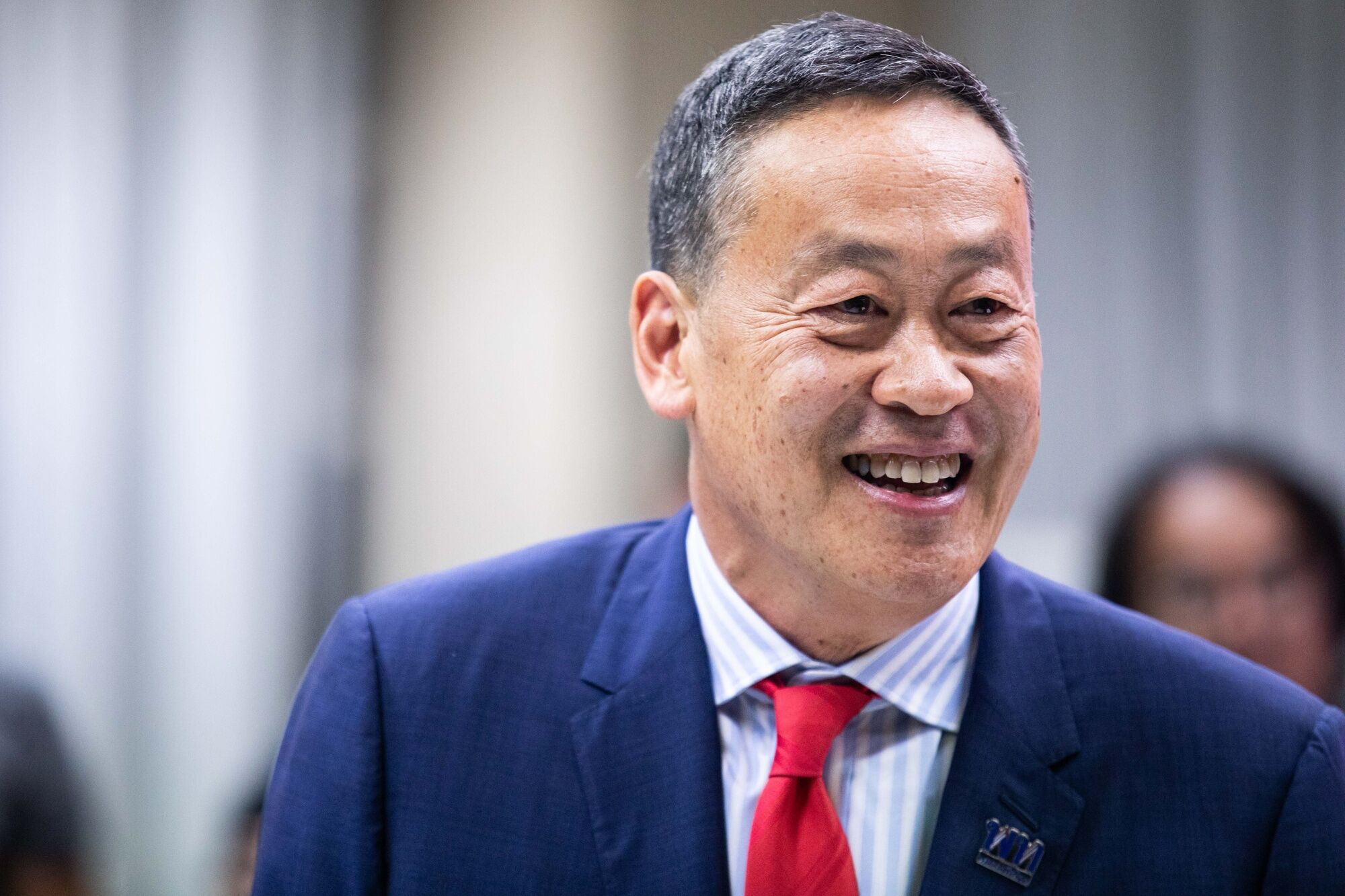
(Bloomberg) -- Thailand's new Prime Minister Srettha Thavisin unveiled a cabinet line-up that sees him also assume the post of finance chief, a rare move as focus turns to his government's plans to revive the economy.
Phumtham Wechayachai was appointed commerce minister, Pirapan Salirathavibhaga was named energy minister and Pimpatra Wichaikul will be the industry minister, according to a gazette notification on Saturday. Phumtham and Pirapan will also hold the positions of deputy prime ministers.
Srettha is the first premier in more than four decades to also take the finance minister role. The former business tycoon and his core ministerial team face the task of jump-starting the economy amid rising interest rates and a slowdown in exports. Household debts are near record levels and farmers and small and medium enterprises are still reeling from the impact of the pandemic.
“He is qualified as finance chief with his extensive experience in business,” said Titipol Phakdeewanich, dean of political science at Ubon Ratchathani University. “Still, the move may lead to questions about checks and balances.”
The new Cabinet is expected to be sworn in by the king next week.
Srettha was elected prime minister last week, ending months of political impasse that led to a partial policy paralysis and the exit of foreign investors from Thai stocks and bonds. His Pheu Thai party leads an 11-member coalition, forcing him to divvy up key cabinet positions among the groups.
The energy and industry ministers are from the military-linked United Thai Nation Party, while Pheu Thai kept the commerce and foreign affairs portfolios. Anutin Charnvirakul, who leads Bhumjaithai — the second-largest party in the coalition — will head the high-profile interior ministry. He, along with Parnpree Bahiddha-Nukara as foreign minister, will also be deputy premiers.
Srettha's immediate tasks include the finalization of the state budget for the fiscal year starting Oct. 1. The government has already announced plans to cut energy prices and city-train fares and temporarily suspend debt repayment by farmers as part of a raft of measures to ease the cost of living and boost investment in the $500 billion economy.
His administration will also have to balance spurring growth without stoking inflation. The economy grew 1.8% in the second quarter, among the slowest in Southeast Asia.
Bank of Thailand Governor Sethaput Suthiwartnarueput said last month the new government should pursue fiscal consolidation in tandem with monetary policy, where 175 basis points of rate increases have helped to bring inflation down from a 14-year high.
(Updates with analyst comments, other appointments from fourth paragraph.)
More stories like this are available on bloomberg.com
©2023 Bloomberg L.P.

-
Navigating Energy Crossroads: S Jaishankar's Call For Diversified Supply Chains At G20 Ministerial Meeting

As geopolitical fault lines continue to test maritime trade routes and commodity flows, Jaishankar's message remains pertinent: true economic resilience requires open markets, protected transit lines, and a genuine commitment to multilateral cooperation rather than coercion.
-
Indians Are Travelling, But Not Every Journey Is A Holiday | The Week In Whys
Pilgrims, patients and working women are the real travellers, and the system hasn't quite caught up with them.
-
Getting To Work Costs Women More | The Reason Why
It is not just about women paying more than men. It is about women paying much more in cities than in villages.
-
AI Bias In Investing Cannot Be Eliminated, But It Can Be Governed
Framing is a particularly important example as identical financial information presented in terms of gains rather than losses can lead an LLM to reach a different assessment.
-
Joining The Dots | Dark Skies, Steady Diya: Why Hope Holds This Diwali
With war, a weak rupee and foreign outflows weighing on sentiment, policymakers at the NDTV World Summit and market veterans at NDTV Profit Ignite: Diwali Edition offered the same advice: stay invested and filter out the noise.
-
The Curious Case of Equitas Small Finance Bank And A CEO Who Quit For Stock
PN Vasudevan believes persistent investor concerns over a perceived conflict of interest had become a governance overhang on Equitas Small Finance Bank's stock, even as the lender improved profitability and asset quality.
-
Talking Points This Week: AI Cash Burn, A Tiger Comeback And An India That Still Finds Its Own Path
India is not immune to higher oil or tighter global liquidity, yet its earnings base is broader, its domestic policy levers are still available.
-
Foreign Investors Own Half Of HDFC Bank and ICICI Bank. An LTCG Cut Could Matter Most Here
Foreign portfolio investors have US$115 billion parked in HDFC Bank, ICICI Bank. If the government cuts long-term capital gains tax, Jefferies says returning foreign money could land here first.
-
'Never Seen This Level Of Negativity': Sandeep Tandon Says The Next Rally May Be Closer Than You Think
Veteran investor Sandeep Tandon says foreign selling is easing, large-caps are due a comeback and mid-caps are crowded, while he turns positive on gold, power and pharma this Diwali.
-
Indians Stay With Family, Not In Hotels | The Reason Why
India still lacks enough clean, reliable and affordable hotels for budget-conscious travellers.










