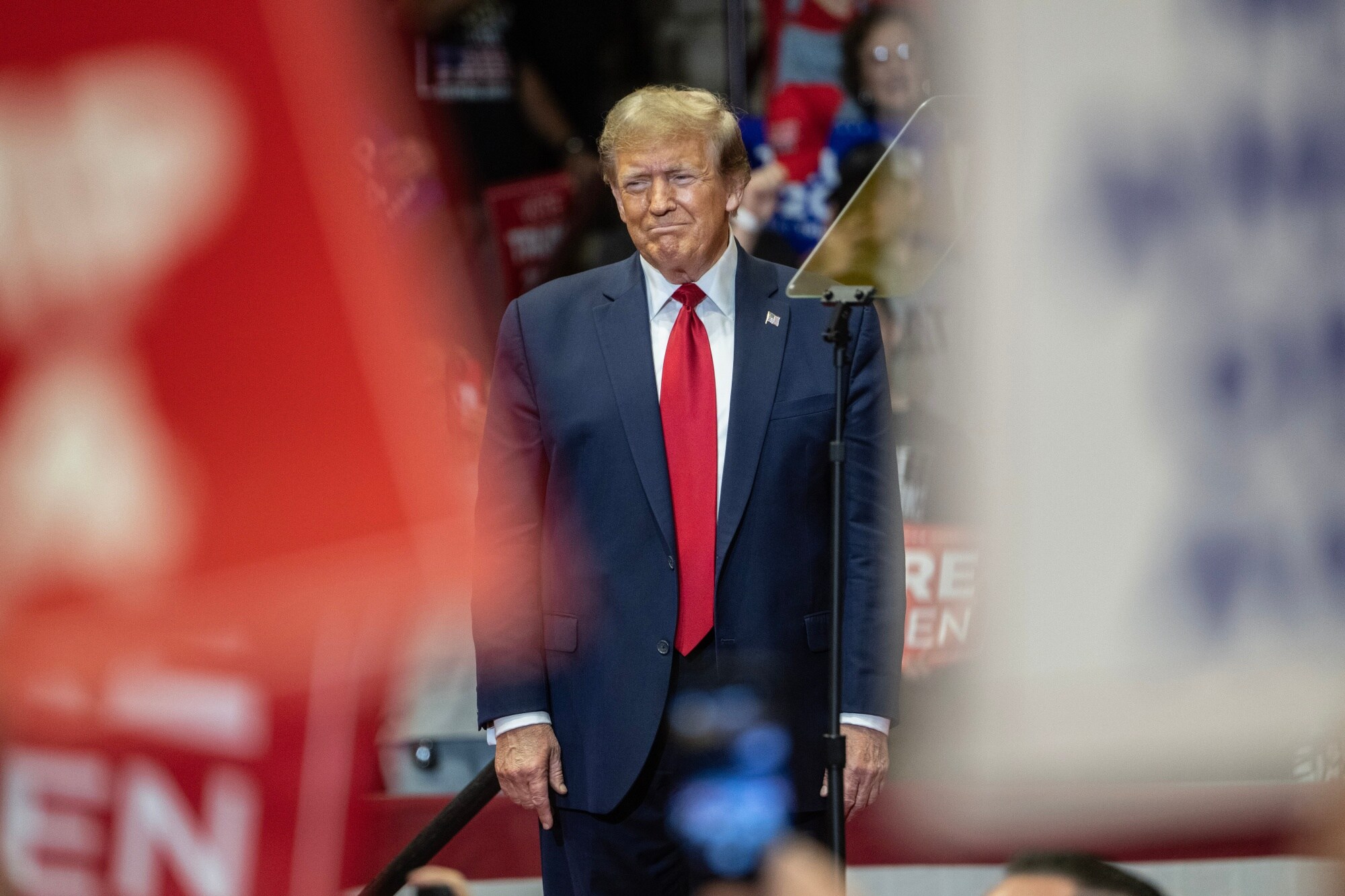
(Bloomberg) -- The Supreme Court's decision to take up Donald Trump's bid for immunity from criminal prosecution raises the prospect that a trial to hold him accountable for trying to overturn the 2020 election could face a lengthy delay — potentially until after the November election.
The justices on Wednesday said they will hear arguments in late April, putting the case on a slower track than Special Counsel Jack Smith had sought. With a ruling likely by the end of June, a trial this year remains a possibility, but with little margin for further setbacks.
“This could delay his trial, perhaps significantly,” said Ilya Somin, a professor of law at George Mason University. “It makes it less likely the trial will be done before the election.”
The timing is potentially crucial. Polls indicate a conviction of Trump could undercut the Republican frontrunner's bid to reclaim the White House. And should Trump win election and become president before the matter is resolved, he could order the Justice Department to drop the case. Trump, who is facing four indictments, has pushed to delay any trial until after the election.
Smith had urged the justices to let the trial begin. As an alternative, Smith said the court should hear arguments on a fast-track basis, but with a March argument date.
Smith's office declined to comment Wednesday. Trump said he was pleased about the decision and started fundraising about an hour after the news.
“Without Presidential Immunity, a President will not be able to properly function,” Trump said in a post on social media.
Four Prosecutions
The Supreme Court has never taken up the question of whether a former president is immune from criminal charges for actions taken while in office. The case will be the court's second unprecedented Trump showdown this year, joining a clash over the ability of states to bar him from the ballot because of his role in the Jan. 6, 2021, Capitol riot.
On Wednesday, Illinois became the third state to bar Trump from the Republican primary ballot, but a judge paused the decision to allow him to appeal, which he said he would quickly do.
Earlier: Illinois Judge Removes Trump From State Ballot
The Washington election interference case is one of four criminal prosecutions Trump is facing, including a similar election case under state law in Georgia. Trump is set to go to trial March 25 in New York state court in a criminal case centering on alleged hush-money payments to porn star Stormy Daniels.
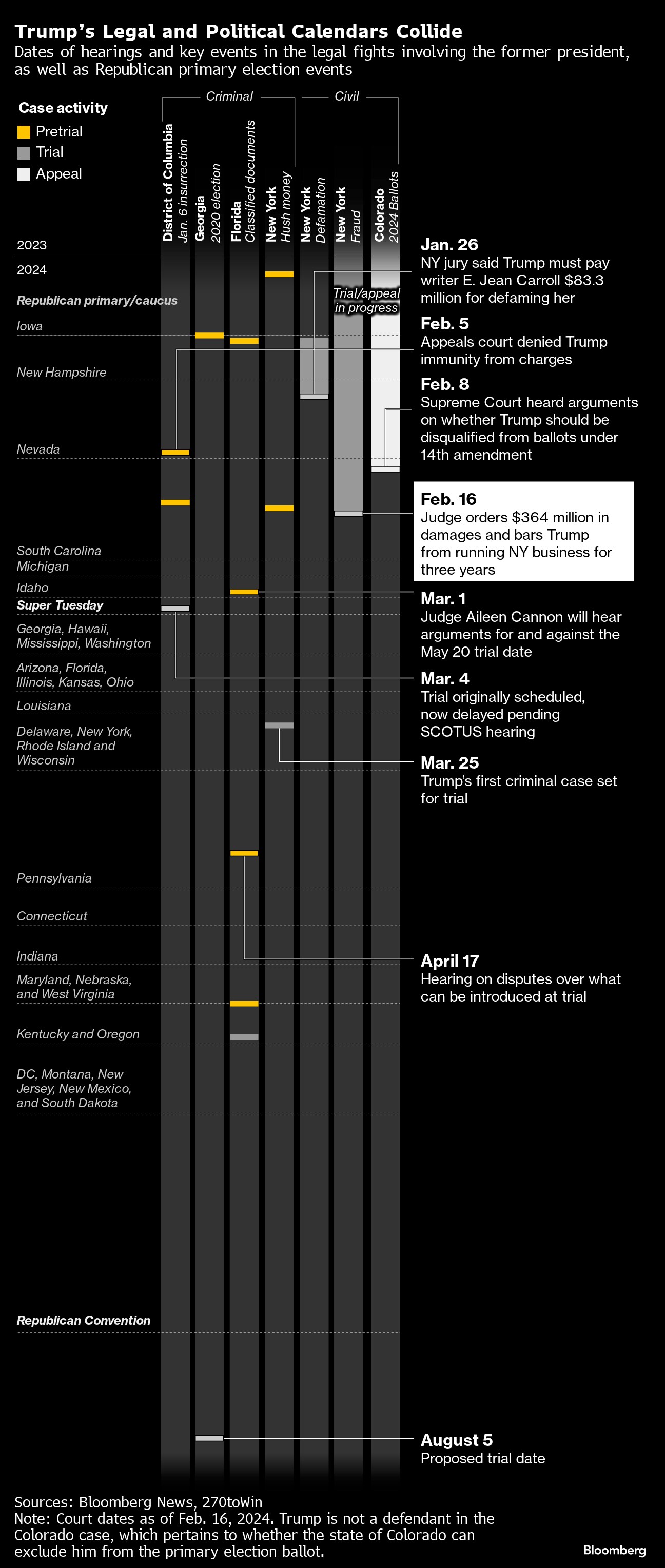
Trump has used court appearances to drive home his message, often speaking to the press outside courtrooms before and after hearings. But his legal troubles have also hamstrung his reelection campaign. More than $27 million from Trump-affiliated fundraising committees went to pay legal fees in the last six months of 2023, rather than toward his political activities.
More than half of voters in seven swing states say they wouldn't vote for Trump if he were convicted of a crime, according to a recent Bloomberg News/Morning Consult poll.
Weeks of Delay
The schedule set out by the court is less aggressive than the one it adopted for the Colorado ballot case. In that case, the court heard arguments 36 days after Trump filed his appeal. In the immunity clash, the session will be at least 70 days after Trump brought the case to the high court.
The justices — who have a 6-3 conservative majority as a result of Trump's three appointments as president — deliberated for almost two weeks after Trump filed his second and final brief before deciding to intervene. The high court in December refused to intervene at an earlier stage, as Smith had requested.
Robert Mintz, a former federal prosecutor, predicted that US District Judge Tanya Chutkan will move quickly if the Supreme Court rejects Trump's immunity bid and returns the case to her.
She “has shown every indication to get this case moving as quickly as possible,” he said on Bloomberg Radio. “I think we will see her bringing the parties in and setting a very aggressive schedule to bring this case to trial.”
But Rick Hasen, an election-law expert at UCLA School of Law, said the high court's decision Wednesday “could well be game over” for what he said was potentially the most important prosecution in the country's history.
“It may not happen because of timing, timing that is completely in the Supreme Court's control,” he said.
At the Supreme Court, Trump is challenging a federal appeals court decision letting him be prosecuted for allegedly trying to remain in power illegally. The 3-0 ruling, from a panel with two judges appointed by Democrats and one by a Republican president, said Trump's immunity claim would give him “unbounded authority to commit crimes that would neutralize the most fundamental check on executive power — the recognition and implementation of election results.”
‘Extraordinary' Claim
Trump's lawyers told the justices that “if the prosecution of a president is upheld, such prosecutions will recur and become increasingly common, ushering in destructive cycles of recrimination.”
Trump contends he was acting within his official capacity as president during the lead-up to the Capitol assault. He points to a 1982 Supreme Court ruling that said, with regard to civil suits, presidents have complete immunity for actions taken within the “outer perimeter” of their official duties.
Special Counsel Smith called Trump's immunity claim “extraordinary,” saying it would upend long-held understandings about presidential accountability and the Constitution, particularly given the nature of the allegations. Smith said that “from the inception of the nation,” all presidents have understood that they could be prosecuted for any criminal violations after they left office.
“The charged crimes strike at the heart of our democracy,” Smith argued. “A president's alleged criminal scheme to overturn an election and thwart the peaceful transfer of power to his successor should be the last place to recognize a novel form of absolute immunity from federal criminal law.”
The case is Trump v. United States, 23A745.
--With assistance from Chris Strohm, Jordan Fabian, Stephanie Lai, Sabrina Willmer and Kyle Kim.
More stories like this are available on bloomberg.com
©2024 Bloomberg L.P.
Essential Business Intelligence, Sharp Market Insights, Practical Personal Finance Advice, Daily Fuel, Gold and Silver Prices and Latest Stories — On NDTV Profit.