India’s Manufacturing Activity Gauge Recovers From Demonetisation Hit
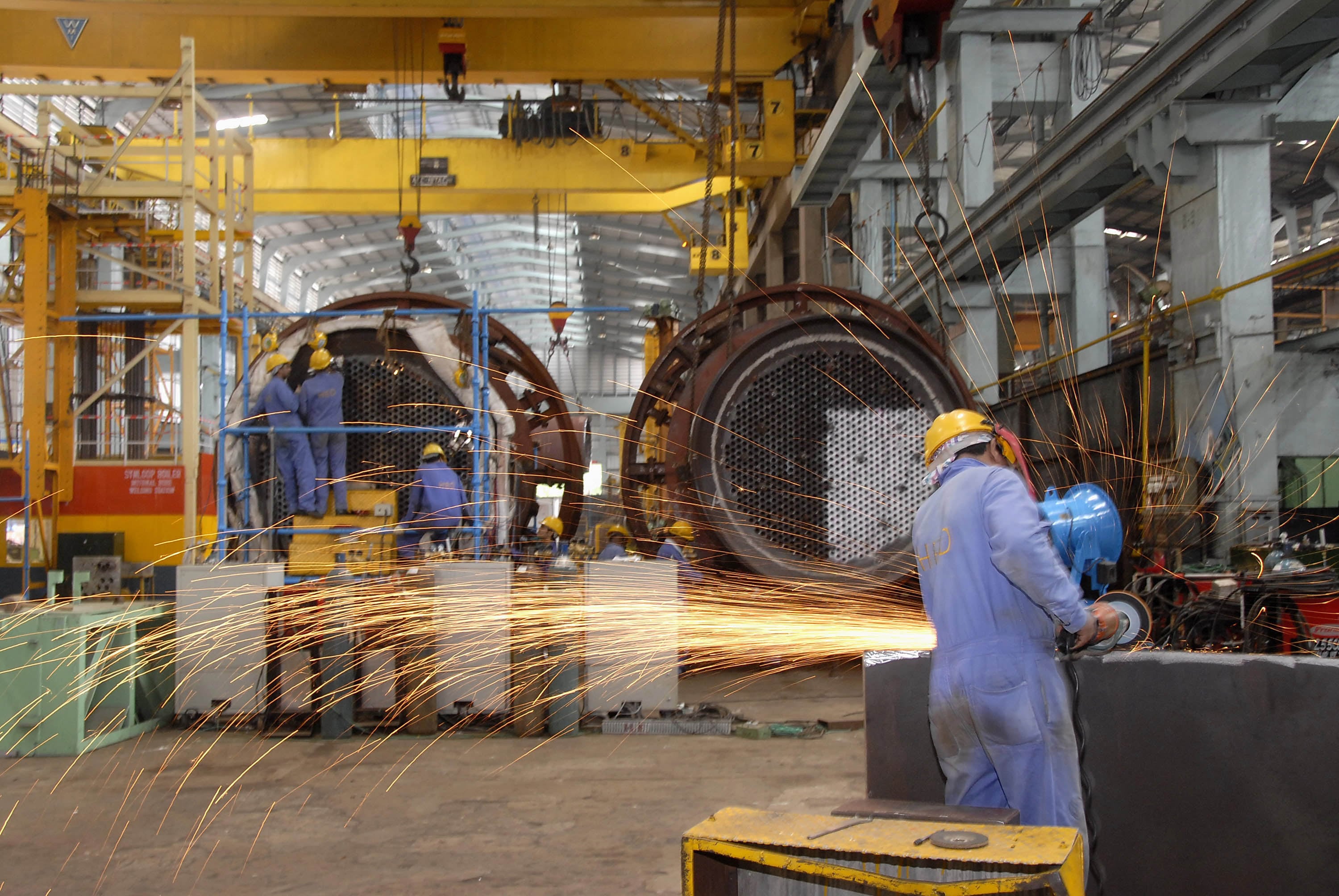
India's manufacturing sector expanded for the third straight month in March, taking activity back to levels seen before demonetisation.
The Nikkei India Manufacturing Purchasing Managers' Index (PMI) – compiled by Nikkei and research firm Markit – rose to 52.5 in March from 50.7 in February. A reading below 50 indicates a contraction and a reading above it indicates expansion.
The Manufacturing PMI had declined sharply following the government's decision to withdraw notes of Rs 500 and Rs 1,000 on November 8. Activity levels hit a low of 49.6, indicating a contraction in the manufacturing sector, in December. However, as the cash crunch eased, manufacturing activity started to normalize and is now back at levels seen before the note exchange program was announced.
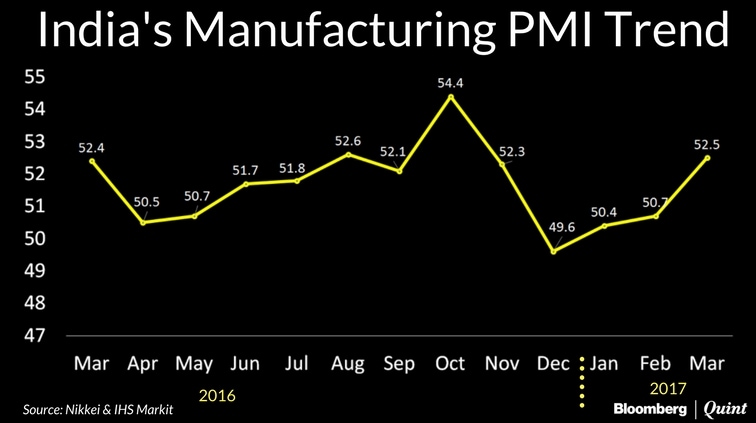
In March, the PMI was led higher by an expansion in production and orderbooks, which grew the fastest in five months, said the press release accompanying the data. A pick up in exports, in particular, supported manufacturing activity. Export growth has remained positive for six consecutive months now and hit a multi-year high of 17.5 percent in February, shows data from the commerce ministry.
The increase in total new work was supported by higher new export orders, which grew at a solid and accelerated pace. New work and output increased across the three monitored sub-sectors, with the upturn led by intermediate goods producers in both casesNikkei India Manufacturing PMI Report
Jobs in the manufacturing sector rose compared to a decline in February as companies looked to hire more to meet their capacity expansion objectives.
Business confidence among manufacturers also improved in March, said the report. Almost one-fifth of those surveyed said that they expect output levels at their units to be higher in 12 months' time. An expected pick-up in demand and the launch of new product lines, underpinned the optimism.
Looking ahead, production volumes are likely to rise further as businesses will seek to replenish their stocks. Indeed, we saw a marked drop in inventories of finished items, alongside a stronger degree of confidence towards the year-ahead outlook for output.Pollyanna De Lima, Economist At IHS Markit And Author Of The Report
In terms of costs, both input and output costs increased but the inflation rate was at the slowest in four months.
The increase in input prices largely reflected higher commodity prices. Output prices, however, increased at a slower pace as manufacturers reportedly kept selling prices unchanged to stimulate demand, said Nikkei.
The data suggest that the disruption caused by demonetisation had eased by March, said Nomura Global Markets Research in a note on Monday. However, on average, the manufacturing PMI was lower in the January-March quarter when compared to the previous quarter. This suggests that GDP growth in the March quarter may slow to 6.7 percent compared to 7 percent in the December quarter, said Nomura.

-
Unhedged Position: Can India See An Indonesia-Style Time Correction?

The Nifty is trading below levels it first clocked in 2024. Is there, then, as I have suggested in the headline, potential that the current time correction drags on painfully for the next three-five, even ten years?
-
Navigating Friction And Energy Realities: An Analysis Of Marco Rubio's October Visit To India
Occurring at a critical juncture marked by stalled trade negotiations and escalating geopolitical pressures over global energy supplies, the visit offers a profound window into modern US-India relations.
-
India Exports Capital. Why Not Export Trusteeship?
The big question, then, is whether India can build an institution that global borrowers, investors, banks, and lawyers can trust, even without an Indian connection.
-
France's Economy & Politics Are In Crisis | The Reason Why
Let's look at how the French economy and politics evolved under Nicolas Sarkozy, Franois Hollande and Emmanuel Macron.
-
You May Inherit The Business. You Must Earn Its Credibility.
Succession tests the founder's ability to share authority as much as it tests the next generation's readiness to assume it.
-
Signing Deals Is One Thing; Making Them Work Is Another | The Week In Whys
Sometimes, things don't turn out as planned. Indian companies have lost some bids to rivals, some projects won't produce until 2030.
-
FOMC Wall, PERM Suspension, Hospital Stocks | Talking Points This Week
A PERM suspension would directly affect green-card sponsorship rather than H-1B visas, so the near-term earnings impact could remain relatively limited. The key question is whether this marks a new phase in US scrutiny of Indian IT.
-
Everything, Everywhere, All At Once: Dalal Street's Week To Forget | Joining The Dots
Visa curbs, a Starlink spat and cancer drug caps: what connects this week's shocks for Indian markets
-
India Is Going Abroad For Critical Minerals. But It May Take Years To Pay Off | The Reason Why
Although India's steps are in the right direction, they remain modest compared with India's growing dependence.
-
When Everyone Has AI, What Gives You An Edge?
India's young workforce is entering an uncertain world of work where powerful AI tools are becoming widely accessible. The advantage will belong to those who combine deep expertise with digital fluency, and the distinctly human capabilities that technology cannot manufacture.