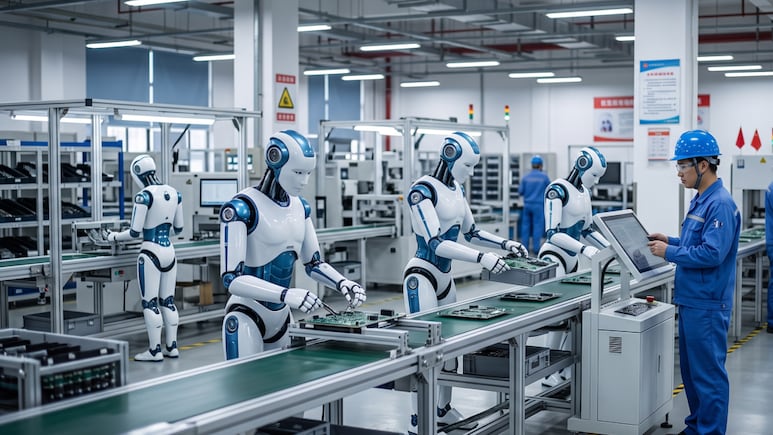
China is accelerating the use of artificial intelligence-driven robotics to help replace workers as its population ages and the workforce shrinks.
At facilities such as Sany Truck Manufacturing in Changsha, Hunan province, humanoid robots are increasingly being deployed to handle labour-intensive vehicle assembly. The focus is to reduce reliance on human workers, according to a new report in The Financial Times.
The shift comes as China's working-age population, aged 15 to 64, is projected to shrink sharply. According to the United Nations, estimates suggest a fall from a peak of around 1 billion in the last decade to roughly 300 million by 2100.
Also Read | Layoffs Are Rising In Tech, But These Skills Are Helping People Unlock Better Pay
As a result, the country is adopting measures such as automation. China already leads globally in industrial robot installations and is a major producer of humanoid systems.
ALSO READ: Blueprint For Job Loss? How Camera-Strapped Indian Workers Are Showing AI How To Work
“China's demographic structure is shifting and the population is gradually shrinking — that is an undeniable reality,” Huang Tie, deputy general manager of Sany Truck Manufacturing told FT. “For labour-intensive industries, we believe replacing humans with robots is inevitable.”
How China Is Fighting Its Demographic Shift
Beijing now sees AI-enabled machines as a way out of the demographic trap. The government is encouraging businesses to use “embodied artificial intelligence” across factories and service industries. From factory quality checks to high-end restaurant kitchens, more jobs are being considered for automation. According to the FT report, this rapid shift could be the biggest technological transformation since the Industrial Revolution.
“We have not seen a transformation of this speed and scale since the industrial revolution,” says Yuhan Zhang, principal economist of the China Center at the Conference Board.
China already installs more industrial robots than the rest of the world combined and produces most of the world's humanoid robots. Between 2021 and 2024, the country doubled the number of units installed in its factories to 2 million, according to the International Federation of Robotics. It also accounted for 90% of the 13,000-16,000 humanoid robots that were shipped globally last year, according to a report by Morgan Stanley.
President Xi Jinping has also strongly supported China's robot industry, hoping to become a global leader in the sector. As of last year, China had 166 industrial robots per 10,000 workers. According to the FT report, the Communist Party's latest five-year plan promotes human-machine collaboration and the use of AI-powered robots in jobs facing labour shortages or safety risks.
This month local governments and state-owned enterprises were ordered to include “embodied artificial intelligence” in manufacturing, logistics, retail and healthcare industries.
The goal is to install at least 10,000 AI-powered robots in commercial settings nationwide this year. Sales of China's homegrown humanoids would rise to about 50,000 units this year, higher than any other country, Morgan Stanley report added.
However, the boom in automation in China is also expected to cause major economic and social challenges. Experts warn that while AI and robots may solve labour shortages, they could also displace millions of workers.
The report noted that China already faces high youth unemployment and has about 320 million gig workers after the property market downturn in 2021. This means that a rapid shift to automation could reduce job opportunities for both skilled professionals and low-skilled migrant workers.
ALSO READ | AI To Bring More Jobs; Indian Engineers Must Focus On Collaboration: Microsoft's Rajiv Kumar
Essential Business Intelligence, Sharp Market Insights, Practical Personal Finance Advice, Daily Fuel, Gold and Silver Prices and Latest Stories — On NDTV Profit.