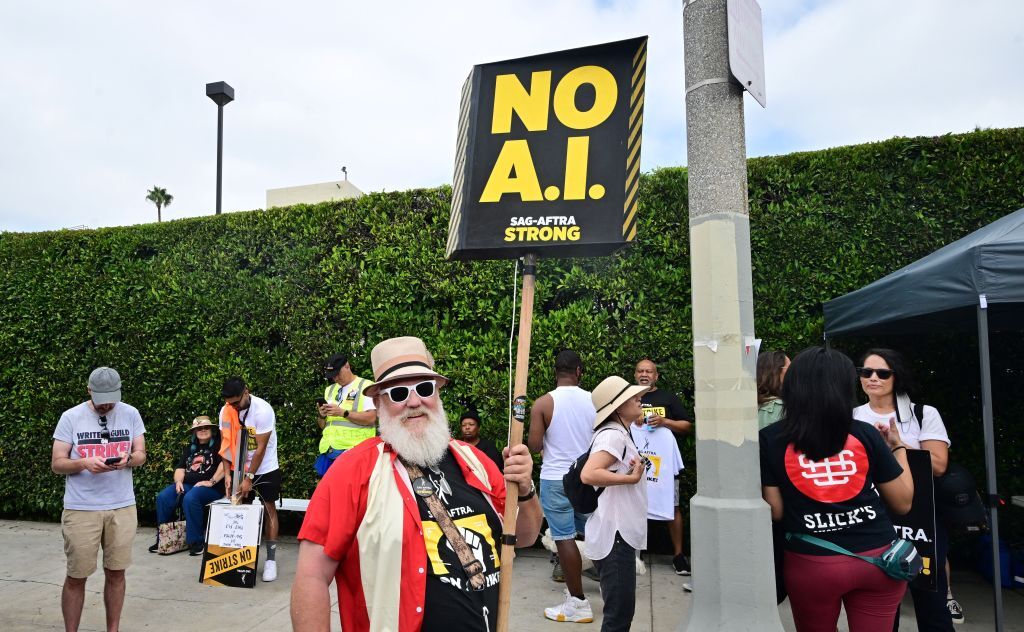
(Bloomberg) -- One month after the Hollywood writers' strike ended following a landmark agreement with studios to establish guardrails for how artificial intelligence is used in their work, actors are still working to reach a similar deal for their own AI protections.
“The principle that actors need to have informed consent over the creation of a digital replica and the use of that digital replica and fair compensation, that's not negotiable,” said Duncan Crabtree-Ireland, chief negotiator for SAG-Aftra, on the latest episode of the Bloomberg Originals series AI IRL. “Those are basic principles that need to be enshrined.”
SAG, which represents about 160,000 performers, made “some progress during the first part of negotiations” on this issue, Crabtree-Ireland said earlier this month, but “there were proposals put out right at the end of our negotiating period that were really inconsistent with the idea of informed consent and fair compensation."
Hollywood ground to a halt this year on twin strikes by writers and actors, which hadn't happened in 40 years. The writers' union officially ended its strike that started in May. But the walk-out by the actors' union, which began in July, continues — with noticeable impacts on blockbuster films. Paramount Pictures said this week that the release date for Tom Cruise's final film has been pushed back by almost a year, one of several caught in the crossfire of the strikes.
Earlier this month, the Alliance of Motion Picture & Television Producers, which represents the studios, said it's offered several AI protections, including requiring “advance consent from the performer and background actor to create and use digital replicas” and prohibiting the use of a replica later unless the performer “specifically consents to that new use and is paid for it.”
Read more: AI in Hollywood Goes From Contract Hurdle to Existential Crisis
Even those in Hollywood who are enthusiastic about the upside of incorporating AI into filmmaking have been unnerved by the lack of clear safeguards for actors whose livelihoods will be impacted by it.
“There were seemingly true reports of studios literally scanning extras and then saying, ‘We now have the rights to your scan forever,' which is completely disgusting and insane,” said Edward Saatchi, chief executive officer of Fable, a studio that's used AI to create automated episodes of the animated TV series, . (Representatives for the studios have subsequently downplayed the extent of a replica's usability.)
But in his interview on AI IRL, Saatchi said those AI-generated programs helped illustrate an important point. “Every single year, other than this year, we've always felt AI just isn't good enough to be funny, to really make a work of art,” he said. “And this year it really did change.”
Tim Webber, an Oscar-winning visual effects supervisor and chief creative officer at Framestore, said the surge of interest in generative AI this year worried him, too.
“We all thought our jobs are going,” he said. “But quite quickly we looked at it and realized there were lots and lots of limitations.”
One of those is in the creation of concept artwork, used in many industries to sketch out visual ideas and themes during a project's nascent stages. “AI in that space gets us quite a bit closer, but still a long way from what the concept artists can do,” Webber said.
He was reminded of Pixar's original , the world's first full-length CGI movie. “One of the amazing things about they took technology that was still quite nascent and they created a new form of film, computer-animated movies,” he said. “At the moment, there is no equivalent for AI. And I think it might take a while.”
“If we get generative video where you can do voice prompts and you can control the video and it will look sufficiently good quality, possibly there may be something new out of that,” he added. “But I think that's a long way away.”
More stories like this are available on bloomberg.com
©2023 Bloomberg L.P.
Essential Business Intelligence, Sharp Market Insights, Practical Personal Finance Advice, Daily Fuel, Gold and Silver Prices and Latest Stories — On NDTV Profit.