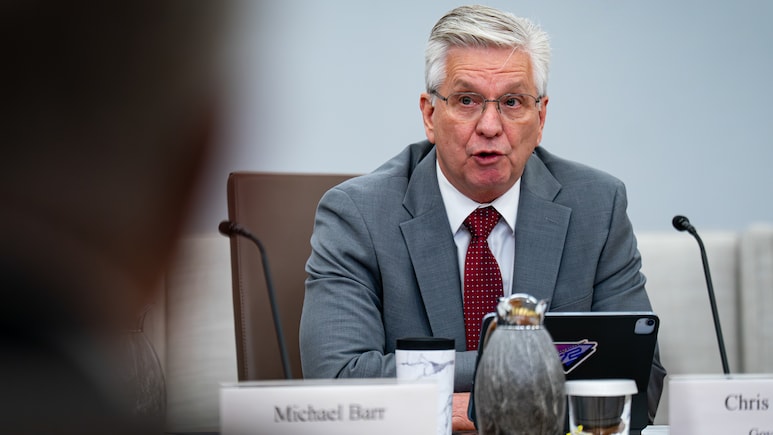
Federal Reserve Governor Christopher Waller said he is cautious about how surging oil prices on the back of the Iran war will impact inflation, though a weak job market may still call for interest-rate cuts later this year.
“Caution is warranted,” Waller said Friday in an interview on CNBC. “It doesn't mean that I'm going to stay put for the rest of the year. I just want to wait and see where this goes, and if things go reasonably well, and the labor market continues to be weak, I would start advocating again for cutting the policy rate later this year.”
Federal Reserve officials this week left interest rates unchanged and continued to project one rate cut this year as they acknowledged increased uncertainty due to war in the Middle East.
Also Read | Layoffs Are Rising In Tech, But These Skills Are Helping People Unlock Better Pay
Waller, who dissented against the Fed's decision in January to stay on hold — at the time citing continued softness in the labor market — said he would have dissented again this week, but the Iran war gave him pause.
The longer oil prices remain high, the greater the risk they have an impact on underlying inflation, Waller said. He added that the conflict is already looking more protracted, raising the risk of higher oil prices for longer.
“This is very different than, say, a tariff on toys,” Waller said. “You put a tariff on toys, it doesn't bleed through into all the other goods in the economy. But oil is a major intermediate input, and it will at some point bleed through.”
In economic projections released alongside the policy decision, officials raised their outlook for inflation in 2026 to 2.7% from 2.4%. Notably, they adjusted their outlook for the core measure — which excludes volatile food and energy categories — to 2.7% as well.
In their post-meeting statement, policymakers underscored economic uncertainty due to the conflict in the Middle East, a theme Fed Chair Jerome Powell returned to in his subsequent press conference.
Officials also dropped language in their post-meeting statement describing the labor market as showing signs of stabilization. Instead, they said the unemployment rate was “little changed in recent months.”
Waller said research suggesting that the break-even rate for employment is around zero is another challenge for assessing labor-market strength.
“My brain understands the math, but I can't get through my gut that this is OK,” Waller said.
Fed Vice Chair for Supervision Michelle Bowman, speaking earlier Friday on the Fox Business Network, said she was maintaining her outlook for three quarter-point rate cuts in 2026.
“It's too soon to tell what the impacts of Iran and the conflict may be, but I do expect that we'll start to see some of the supply-side policies working their way through the economy,” she said.
Essential Business Intelligence, Sharp Market Insights, Practical Personal Finance Advice, Daily Fuel, Gold and Silver Prices and Latest Stories — On NDTV Profit.