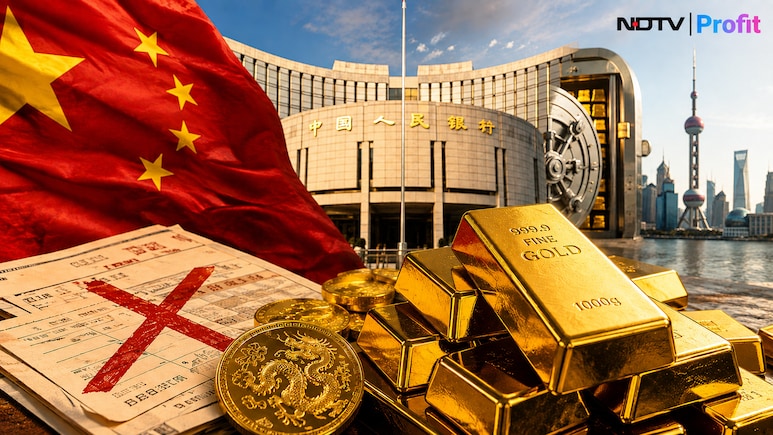
- China is shifting its gold market focus from paper contracts to physical bullion trading.
- Hong Kong launched a gold clearing system and Delivery Connect scheme with Shanghai in July.
- China aims to expand gold storage in Hong Kong from 200 to over 2,000 tonnes in three years.
China is steering its gold market away from paper contracts and toward physical bullion, according to Jefferies' Christopher Wood in his GREED & fear note dated July 30.
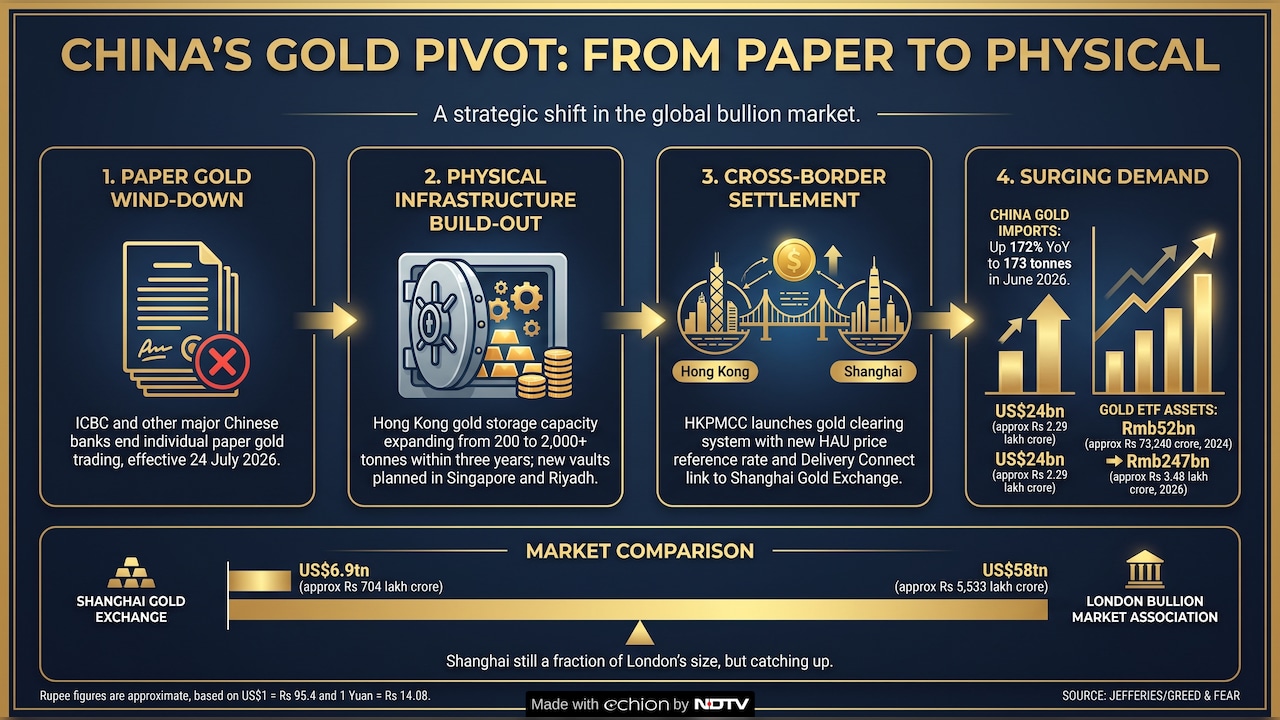
The Industrial and Commercial Bank of China said on June 24 it would end individual precious metals trading linked to the Shanghai Gold Exchange, effective 24 July, discontinuing both leveraged deferred contracts and spot contracts. Retail investors were required to close positions or take delivery by the deadline. Other Chinese banks have made similar announcements.
Wood said the pattern suggests Beijing is "actively encouraging a move to trading and investing in physical gold," steering investors away from paper positions.
Timeline And Rationale
The shift comes alongside two related developments. The Hong Kong Precious Metals Central Clearing Company launched a central gold clearing and settlement system on July 7, introducing a Hong Kong-specific gold price reference rate called HAU, along with the first phase of a "Delivery Connect" scheme with the Shanghai Gold Exchange enabling cross-border settlement using physical gold. Wood compared this to Hong Kong's Stock and Bond Connect schemes with mainland China.
ALSO READ: The Silk Route Is Back: India, China Resume Border Trade After Six-Year Gap
Separately, the Shanghai International Gold Exchange opened a certified gold vault in Hong Kong last year, the first in a planned network that will extend to Singapore and Riyadh. Hong Kong aims to expand its gold storage capacity from 200 tonnes to more than 2,000 tonnes within three years.
China is changing its gold play strategy, again
Photo Credit: NDTV Profit
Demand data support the trend. China's gold imports rose 172% year-on-year to 173 tonnes in June, the highest since March 2024, worth roughly US$24bn (approx Rs 2.29 lakh crore). Jefferies China financial analyst Betty Li estimates so-called "gold accumulation accounts", where retail buyers accumulate physical gold in small increments, could hold Rmb200-300bn (approx Rs 2.82-4.23 lakh crore). China's gold ETF assets have grown to Rmb247bn (approx Rs 3.48 lakh crore), up from just Rmb52bn (approx Rs 73,240 crore) in July 2024.
The broader push ties into China's long-standing effort to build settlement infrastructure outside the US dollar system, alongside the Cross-Border Interbank Payment System (CIPS), whose transaction value rose from Rmb481bn (approx Rs 6.77 lakh crore) in 2015 to Rmb180tn (approx Rs 2,535 lakh crore) in 2025.
Shanghai gold trading volumes reached Rmb50tn, or US$6.9tn (approx Rs 704 lakh crore), last year, still well below the London Bullion Market Association's estimated US$58tn (approx Rs 5,533 lakh crore).
Note: Rupee conversions are indicative, based on US$1 = Rs 95.4 and 1 Yuan = Rs 14.08. Actual conversions would use spot rates at the time of transaction.
ALSO READ: AI Distillation Dilemma: What Is It, And Why US Labs Accuse China of Harvesting Their Reasoning?
Essential Business Intelligence, Sharp Market Insights, Practical Personal Finance Advice, Daily Fuel, Gold and Silver Prices and Latest Stories — On NDTV Profit.